

Powerful Voice for High School Sports
December 19, 2014
By Geoff Kimmerly
Second Half editor
Paul Carey was home from the U.S. Army only a few months and just shy of 25 years old when Beal City embarked on its first trip deep into the MHSAA boys basketball tournament.
On the call for local radio station WCEN from gyms at Saginaw Arthur Hill and Lansing Sexton, Carey served as the voice of the previously “laughable” Aggies as they reached the Class D Semifinals before falling just six points short of playing for the title.
“All of Beal City emptied out. They’d never had anything before,” Carey recalled during his annual Thanksgiving weekend visit to the MHSAA Football Finals at Ford Field. “When I got home, within the next two weeks I got a letter from every citizen of Beal City thanking me for broadcasting their games. That’s the kind of appreciation that meant so much.”
During 42 years on the airwaves, Carey was best known as a voice of the Detroit Tigers bounding out of transistor radios all over Michigan, thanks to WJR’s powerful signal.
But for the state’s high school sports community, his legacy is similarly memorable as the voice of the longtime football and basketball scoreboard show and a voter for various all-state teams and wire polls over the decades.
Now 86 and retired since 1991, Carey remains a regular during the first day of the Football Finals, taking in games he broadcast for the MHSAA during the late 1970s and that continue to hold his eye as they have for more than a half-century.
“It was a passion of mine. High school sports always has been,” Carey said. “I think because my dad was a high school coach, and teacher initially, and my brother was a high school coach and teacher, I just grew up in families that appreciated coaching and athletics. I was not a great athlete, but it kept my hand in following sports that way.”
Now, the scores
Carey partnered with Ernie Harwell for Tigers radio broadcasts from 1973-91, including during the march to the 1984 World Series championship. He was named Michigan Sportscaster of the Year six times and to the Michigan Sports Hall of Fame in 1992.
But Carey’s early career included sitting on top of a car, plugged into a phone pole, for a Sacred Heart football game at old Fancher Field just a few blocks from his family’s Mount Pleasant home. Among many more accolades are a Distinguished Service Award from the Michigan High School Coaches Association and a place in the Basketball Coaches Association of Michigan Hall of Fame.
In fact, the start of his weekly announcing of statewide football and basketball scores preceded his baseball career by 16 years and ended two months after he announced his final professional out.
The Michigan High School Scoreboard show was a staple of WJR’s late Friday nights from 1957-91. Carey would read every score he could collect from a variety of sources, often organized by league and with state rankings and context mixed in.
His idea came from something similar read by Len Colby for Kalamazoo’s WKZO. Carey’s brother Terry was coaching at Niles during the second half of the 1950s, and he and other coaches would get together to listen to the Friday night scores from the southwestern part of the state.
Carey, who left WKNX in Saginaw for WJR in 1956, explained to then-sports director Bob Reynolds that the station’s strong signal could provide for a truly statewide scoreboard experience.
Carey then connected with Edgar Hayes of the former Detroit Times, who gave the OK for Carey to call the paper on Friday nights to get scores from the Detroit metro area. For the rest, Carey relied on wire services – there were three at the time – who relied on newspapers from all over Michigan to call in scores over the course of an evening.
Before every Friday during high school football season – and later Tuesdays and Fridays during boys basketball season – Carey typed up lists of games based on schedules in the newspaper, with spaces to add scores. More than a few times, Carey raced down a back ramp at Tiger Stadium after a Friday night game, back to the WJR studio, with 15 minutes to prep for the show’s 11:30 p.m. start.
“If the Flint Journal, the Grand Rapids Press, the Traverse City paper didn’t call in scores to the AP, then I was out of luck too. And that happened all the time,” Carey said. “I would call back occasionally, say, ‘Did you get anything more?’ It was a rat race.”
The show originally was set for 10 minutes and then extended to 15. American Airlines sponsored a record show that followed, and Carey’s scoreboard show had a sponsor only once in 35 years. Finishing up on time was expected, even with more than 200 scores to read.
But Carey said he always went 20 minutes, sometimes 25.
“Because I wasn’t done. I just kept right on going,” Carey said. “Jay Roberts did the all-night show most of the time, and he was patient with me. He didn’t say too much on the air about ‘that guy ahead of me took all of my time.’”
Carey continued the “rat race” until his final scoreboard show, Dec. 20, 1991. He retired from WJR at the end of that calendar year. And it's important to note: Carey was never paid a dime extra for doing the program. .
“I think Paul is really just a sports fan, and that came across to the listener on his broadcasts,” MHSAA historian Ron Pesch said. “Paul would gather as much as possible off the wire. He'd interject if scores were missing from sections of the state. Press polls from the Free Press, News, AP and UPI were big, so he could point out close calls and upsets.
“He provided immediacy, or the closest thing to it in the days before cable TV and the Internet, and because of his scoreboard show, you could get the results before the morning paper. For listeners, he brought life to something as simple as game scores.”
First team all the way
Carey, who resides in Rochester, also served as the engineer on Tigers broadcasts for 16 years, through 1990. He broadcast Pistons games on the radio for six seasons and did the first broadcast of a Central Michigan University football game, in 1949.
Harry Atkins, covering Detroit’s teams while with The Associated Press for 29 years including the last 21 as its sports editor for Detroit, took note of his colleague's hard work – and especially that Carey was one of few broadcasters who was a journalist in addition to a voice.
That made Carey's other major role in high school sports a natural fit.
Atkins split The Associated Press all-state selection panels for football and basketball into 11 regions, and Carey represented the Detroit area for a number of years. He also was a longtime voter in those sports' weekly polls.
“Paul is just that kind of guy. He thought it was important and he made time in his busy schedule to do it,” Atkins said “And it had an impact on the other 10 voters on the All-State panels, too.
“Some of them were from small out-state newspapers or radio or TV stations. Yet every one of them knew who Paul Carey was. And when he spoke, of course, with what often is called "The Voice of God," those voters paid attention.”
And he still does, as well.
At the end of each fall, Carey still puts together a compilation of the three high school all-state football teams – Associated Press, Detroit Free Press and Detroit News – and files them with years of research and results.
“It’s important to me. Nobody sees it but me, but I get a certain kick,” Carey said. “Once in a while I’ll see a kid playing at Central, Western or (Michigan) State or Michigan, and they’ll say he came from Clawson. I’ll go into my all-state collections, say that would’ve been 2009 he played, and I find a name.”
In addition to the Football Finals on WJR, Carey was part of the Baseball Finals broadcasts into the early 1990s, continuing to contribute even after his retirement from his fulltime gig.
He spent high school games over the years sitting next to legends like the Free Press’ Hal Schram and remembers when current Free Press longtime scribe Mick McCabe was just a rookie. One of Carey's final broadcasts was a 1992 Baseball Final with his nephew Mike Carey, who continues to broadcast MHSAA championship games to this day.
“I am eternally grateful to Paul Carey. His contribution to high school sports in Michigan has been great and significant,” Atkins said.
“We are lucky to have him.”
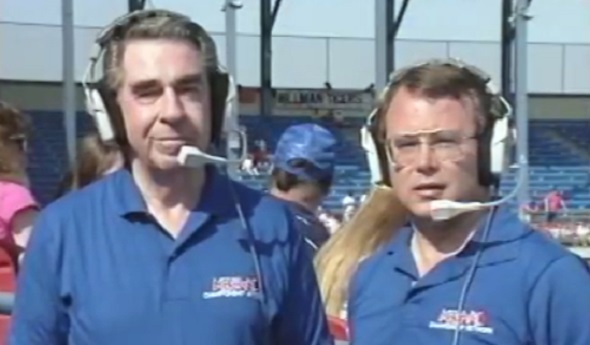
PHOTO: Paul Carey (left) and nephew Mike Carey broadcast the MHSAA 1992 Class D Baseball Final between Hillman and Athens for PASS.
Coldwater Boys Trade Up for 1st Track Title
June 2, 2018
By Dan D’Addona & Tom Markowski
Special for Second Half
ZEELAND — Led by a trio of dominant throwers, the Coldwater boys track & field team had high hopes of winning the Lower Peninsula Division 2 Finals on Saturday.
The team finished runner-up to Zeeland East last year and returned most of its point scorers.
Coldwater turned the tables and surged to the championship this time with 60 points at Zeeland Stadium.
“It means a lot. We got second last year, and we were really happy with that,” Coldwater’s Dylan Targgart said. “But we have never done this in school history. It feels really good.”
Zeeland East was second with 53 points, followed by Harper Woods Chandler Park (37), Tecumseh (33), Chelsea (26), Saginaw (25), Flint Powers Catholic (21), Wyoming Lee (20), Essexville Garber (18) and Romulus (18).
Coldwater powered through the shot put, taking the top three places behind Dylan Targgart (61-2), Zach Gipple (54-0¼) and Cole Targgart (52-6¾).
“The energy is always there when we are in the ring, and that helps us a lot,” Dylan Targgart said. “It’s fun. After each person hits their throw, we build off of each other and off of the energy that the crowd is giving us.”
Zeeland East’s Boone Bonnema was fifth (52-1) in the shot put.
Dylan Targgart won the discus with a throw of 170 feet, 10 inches, holding off East’s Brenden Knoll (170-1).
Coldwater’s Shuaib Aljabaly added a win in the 1,600 in 4:16.56.
“Nobody remembers who finishes second,” Aljabaly said of 2017. “Finishing second last year was a big part of what we did today.”
Aljabaly placed second in the 3,200-meter run last season and said he needed to do more this season to help his team score points. He ran the 1,600 just a few times as a junior and made a concerted effort in this event to compete with the best.
“This year the mile was my best event,” he said. “I felt, in the shorter the race, the more guts you have to have. I wanted more of a challenge this year.”
Aljabaly placed third in the 3,200 and then, oddly, ran in the next and final race, the 1,600 relay and helped Coldwater finish seventh for two more points.
“It was great seeing everyone perform,” Targgart said.
Zeeland East’s Gabe Taylor, Alex Stockdale, Bryce Metzger and Corbin DeJonge won the 800-meter relay (1:29.67). The quartet also won the 400 (43.06).
DeJonge won the 300-meter hurdles in 38.14 for the Chix.
“My Regional time wasn’t very good, and I knew I had to do something different to try to win this, so I tried to bring it out way faster than I normally do, then try to have the crowd drag me through at the end,” DeJonge said. “It is tough because (the state title) as a team is what we were working toward.”
One of the more impressive athletes on this day was Thomas Robinson of Wyoming Lee. This was Lee’s first season competing at the Division 2 meet. Robinson won the 100 and 200 both of the last two seasons in Division 3, improving his times in both each time.
Robinson made it a double three-peat Saturday as he set personal bests in the 100 (10.85) and in the semifinals of the 200 (21.6). His winning time in the 200 was 21.62.
Robinson didn’t compete in track until his sophomore year, the same year he tried out for football. A 6-foot-1, 180-pound receiver, Robinson said he’s more of a fan in that sport than he is in track. Be that as it may, Robinson signed to run track at Michigan State.
“My football coach at the time told me I should go out for track,” he said. “He said it would make me better in football. I don’t like track as much as football. I’m just better at track.
 “I felt good running the 200. I am getting better. Just look at my times.”
Like Robinson, Anthony Hudson of Harper Woods Chandler Park competed in football and track. And, like Robinson, Hudson began his high school career rather late. Hudson competed in track in middle school but decided not to compete as a freshman. He ran a couple of races as a sophomore before making a commitment his junior year. Last season he placed sixth in the long jump and was second in the 200. This season he won the 110 hurdles with a time of 14.68. He also placed fourth in the 200.
He held off Zeeland East’s DeJonge (14.69) by a hundredth of a second in the 110 in one of the closest races of the day.
“I didn’t think I’d be that good my freshman year,” he said. “That’s why I didn’t come out.”
Hudson signed to play football at Davenport University and said he might try both sports if he can handle the load. He plans on majoring in sports management in college.
Chances are not many in the crowd expected Jacob Denison of Tecumseh to do well in the 400 run. That’s all right. Denison followed his own expectations.
The junior won the 400 with a time of 49.27, a personal best. Last season he competed in one event, the 1,600 relay. Denison also ran on the 400 and 800 relays this season.
“I’ve been working hard all season for this,” he said. “It’s not much of a surprise to me. It was just a lot of hard work. I knew I had to take it out fast today. I had a good coach who got me out of the block faster, and I had a lot of support from my family. I’m blessed.”
Injuries held Alex Comerford back last season as the junior from Otsego placed 11th in the 3,200. Healed by the time fall rolled around, Comerford placed second at the Cross Country Finals and won the 3,200 on Saturday with a time of 9:07.25.
“It’s something I’ve been working on,” he said. “I haven’t been finishing well, and it was really my cross country season that started things. I got stronger. I grew up.”
In the 3,200-meter relay, Chelsea’s Connor Gilbreath, Jensen Holm, Carson Rabbitt and Tom Oates won in 7:56.48, holding off Zeeland West’s Carson Holwerda, Bryce Arredondo, Lunke Munsey and Matthew Converse (7:59.93).
Parma Western’s Alex Inosencio won the pole vault in 15-8, besting the field by an entire foot. Lake Fenton’s Jaden Zaitshik won the high jump in 6-7, and Saginaw’s Tony Martin won the long jump in 22-7.
Essexville Garber’s Josiah Morse won the 800 (1:55.63), and Lansing Catholic’s Ryan Schroeder, James Fedewa, Jack Fedewa and Ryan Ruiter won the 1,600 relay (3:23.27).
VIDEO: Coldwater's Shuab Aljabaly wins the 1,600.
VIDEO: Oak Park's Donnie James sets a meet record in the 200.
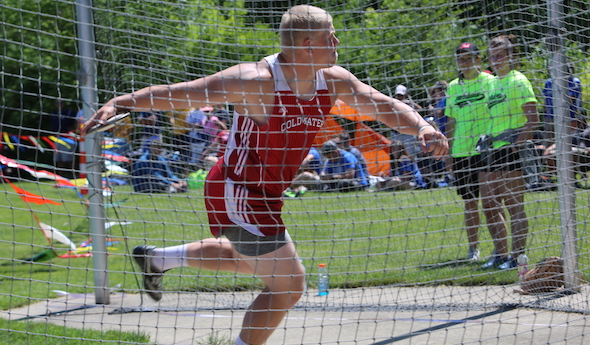
PHOTOS: (Top) Coldwater's Zach Gipple begins to unwind on a discus toss Saturday. (Middle) Chandler Park's Anthony Hudson, middle, stays just ahead of Zeeland East's Corbin DeJonge, left, in the 110 hurdles, which proved to be the closest race of the meet. (Photos by Janina Pollatz. Click for more from RunMichigan.com.)