

Powerful Voice for High School Sports
December 19, 2014
By Geoff Kimmerly
Second Half editor
Paul Carey was home from the U.S. Army only a few months and just shy of 25 years old when Beal City embarked on its first trip deep into the MHSAA boys basketball tournament.
On the call for local radio station WCEN from gyms at Saginaw Arthur Hill and Lansing Sexton, Carey served as the voice of the previously “laughable” Aggies as they reached the Class D Semifinals before falling just six points short of playing for the title.
“All of Beal City emptied out. They’d never had anything before,” Carey recalled during his annual Thanksgiving weekend visit to the MHSAA Football Finals at Ford Field. “When I got home, within the next two weeks I got a letter from every citizen of Beal City thanking me for broadcasting their games. That’s the kind of appreciation that meant so much.”
During 42 years on the airwaves, Carey was best known as a voice of the Detroit Tigers bounding out of transistor radios all over Michigan, thanks to WJR’s powerful signal.
But for the state’s high school sports community, his legacy is similarly memorable as the voice of the longtime football and basketball scoreboard show and a voter for various all-state teams and wire polls over the decades.
Now 86 and retired since 1991, Carey remains a regular during the first day of the Football Finals, taking in games he broadcast for the MHSAA during the late 1970s and that continue to hold his eye as they have for more than a half-century.
“It was a passion of mine. High school sports always has been,” Carey said. “I think because my dad was a high school coach, and teacher initially, and my brother was a high school coach and teacher, I just grew up in families that appreciated coaching and athletics. I was not a great athlete, but it kept my hand in following sports that way.”
Now, the scores
Carey partnered with Ernie Harwell for Tigers radio broadcasts from 1973-91, including during the march to the 1984 World Series championship. He was named Michigan Sportscaster of the Year six times and to the Michigan Sports Hall of Fame in 1992.
But Carey’s early career included sitting on top of a car, plugged into a phone pole, for a Sacred Heart football game at old Fancher Field just a few blocks from his family’s Mount Pleasant home. Among many more accolades are a Distinguished Service Award from the Michigan High School Coaches Association and a place in the Basketball Coaches Association of Michigan Hall of Fame.
In fact, the start of his weekly announcing of statewide football and basketball scores preceded his baseball career by 16 years and ended two months after he announced his final professional out.
The Michigan High School Scoreboard show was a staple of WJR’s late Friday nights from 1957-91. Carey would read every score he could collect from a variety of sources, often organized by league and with state rankings and context mixed in.
His idea came from something similar read by Len Colby for Kalamazoo’s WKZO. Carey’s brother Terry was coaching at Niles during the second half of the 1950s, and he and other coaches would get together to listen to the Friday night scores from the southwestern part of the state.
Carey, who left WKNX in Saginaw for WJR in 1956, explained to then-sports director Bob Reynolds that the station’s strong signal could provide for a truly statewide scoreboard experience.
Carey then connected with Edgar Hayes of the former Detroit Times, who gave the OK for Carey to call the paper on Friday nights to get scores from the Detroit metro area. For the rest, Carey relied on wire services – there were three at the time – who relied on newspapers from all over Michigan to call in scores over the course of an evening.
Before every Friday during high school football season – and later Tuesdays and Fridays during boys basketball season – Carey typed up lists of games based on schedules in the newspaper, with spaces to add scores. More than a few times, Carey raced down a back ramp at Tiger Stadium after a Friday night game, back to the WJR studio, with 15 minutes to prep for the show’s 11:30 p.m. start.
“If the Flint Journal, the Grand Rapids Press, the Traverse City paper didn’t call in scores to the AP, then I was out of luck too. And that happened all the time,” Carey said. “I would call back occasionally, say, ‘Did you get anything more?’ It was a rat race.”
The show originally was set for 10 minutes and then extended to 15. American Airlines sponsored a record show that followed, and Carey’s scoreboard show had a sponsor only once in 35 years. Finishing up on time was expected, even with more than 200 scores to read.
But Carey said he always went 20 minutes, sometimes 25.
“Because I wasn’t done. I just kept right on going,” Carey said. “Jay Roberts did the all-night show most of the time, and he was patient with me. He didn’t say too much on the air about ‘that guy ahead of me took all of my time.’”
Carey continued the “rat race” until his final scoreboard show, Dec. 20, 1991. He retired from WJR at the end of that calendar year. And it's important to note: Carey was never paid a dime extra for doing the program. .
“I think Paul is really just a sports fan, and that came across to the listener on his broadcasts,” MHSAA historian Ron Pesch said. “Paul would gather as much as possible off the wire. He'd interject if scores were missing from sections of the state. Press polls from the Free Press, News, AP and UPI were big, so he could point out close calls and upsets.
“He provided immediacy, or the closest thing to it in the days before cable TV and the Internet, and because of his scoreboard show, you could get the results before the morning paper. For listeners, he brought life to something as simple as game scores.”
First team all the way
Carey, who resides in Rochester, also served as the engineer on Tigers broadcasts for 16 years, through 1990. He broadcast Pistons games on the radio for six seasons and did the first broadcast of a Central Michigan University football game, in 1949.
Harry Atkins, covering Detroit’s teams while with The Associated Press for 29 years including the last 21 as its sports editor for Detroit, took note of his colleague's hard work – and especially that Carey was one of few broadcasters who was a journalist in addition to a voice.
That made Carey's other major role in high school sports a natural fit.
Atkins split The Associated Press all-state selection panels for football and basketball into 11 regions, and Carey represented the Detroit area for a number of years. He also was a longtime voter in those sports' weekly polls.
“Paul is just that kind of guy. He thought it was important and he made time in his busy schedule to do it,” Atkins said “And it had an impact on the other 10 voters on the All-State panels, too.
“Some of them were from small out-state newspapers or radio or TV stations. Yet every one of them knew who Paul Carey was. And when he spoke, of course, with what often is called "The Voice of God," those voters paid attention.”
And he still does, as well.
At the end of each fall, Carey still puts together a compilation of the three high school all-state football teams – Associated Press, Detroit Free Press and Detroit News – and files them with years of research and results.
“It’s important to me. Nobody sees it but me, but I get a certain kick,” Carey said. “Once in a while I’ll see a kid playing at Central, Western or (Michigan) State or Michigan, and they’ll say he came from Clawson. I’ll go into my all-state collections, say that would’ve been 2009 he played, and I find a name.”
In addition to the Football Finals on WJR, Carey was part of the Baseball Finals broadcasts into the early 1990s, continuing to contribute even after his retirement from his fulltime gig.
He spent high school games over the years sitting next to legends like the Free Press’ Hal Schram and remembers when current Free Press longtime scribe Mick McCabe was just a rookie. One of Carey's final broadcasts was a 1992 Baseball Final with his nephew Mike Carey, who continues to broadcast MHSAA championship games to this day.
“I am eternally grateful to Paul Carey. His contribution to high school sports in Michigan has been great and significant,” Atkins said.
“We are lucky to have him.”
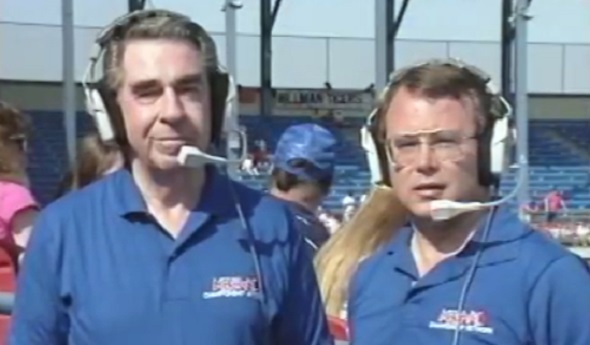
PHOTO: Paul Carey (left) and nephew Mike Carey broadcast the MHSAA 1992 Class D Baseball Final between Hillman and Athens for PASS.
Hope Rained Eternal During 1978 Finals
May 31, 2018
By Ron Pesch
Special for Second Half
“If the weatherman is in a co-operative mood, Michigan’s high school athletes, both boys and girls, will wind up another competitive school year Saturday,” wrote Detroit’s premier high school sports scribe, Hal Schram, 40 years ago just prior to the staging of the 1978 MHSAA softball and baseball state finals weekend.
“Let’s hope we get them in on schedule”, said Bob James, director of athletics for the Warren Consolidated Schools and a member of the MHSAA Representative Council. “I’ve been in high school sports for 35 years, and can’t remember a spring with more postponements and cancellations.”
Despite highest hopes, weather would, again, be a factor on the final weekend of the prep season. Games were scheduled for eight locations around the Lower Peninsula, with rain postponing Class B and Class C contests in softball and Class B and Class D in baseball.
SOFTBALL
In the 1979 yearbook, Impressions, published by East Detroit High School, staff celebrated school’s past half-decade of accomplishment and history:
“Girls have been playing softball at East Detroit now for almost 50 years, although it was called the girls baseball team until the mid-sixties. The teams have always done very well, many of them went undefeated, but none of them ever did as well as the 1978 squad.”
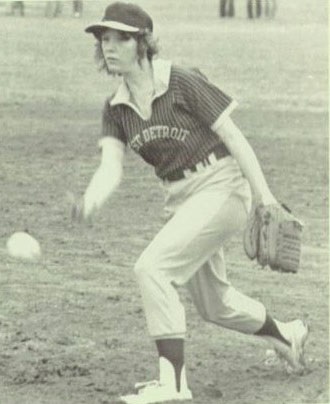
Roxanne “Rocky” Szczesniak, who would later earn All-American honors at Wayne State University, tossed a four-hitter and smashed a three-run homer as the Shamrocks eliminated defending Class A champion Portage Central, 6-3, in the day’s opening Semifinal, played at East Detroit’s Memorial Park. It was only the second defeat in 52 games for Portage Central, coached by Tom Monroe.
 Waterford Township slipped past Flint Carman, 1-0, in 10 innings in the day’s second Semifinal, then capitalized on six errors by East Detroit in the title game to grab the Class A softball championship, 4-0. In the first inning, Mari Latozas doubled home a run to open the scoring for the Skippers. Waterford then added unearned runs in the third and fifth to seal the win. Coached by Joe Alsup, the Skippers finished the year at 25-3. He would post a 197-39 record in nine seasons at the school before it closed following the 1982-83 school year. Twenty years later, Alsup’s Waterford Kettering team earned the 1998 Class A softball crown. Today, he ranks fourth in all-time softball coaching victories in Michigan.
In Class B, Fenton cruised to their first of three straight titles with an 8-5 win over South Haven at Belknap Park in Grand Rapids on Monday, June 19, the game rescheduled because of the weather. Pitcher Barb Barclay posted her 24th win without a loss and boosted Fenton’s season mark to 28-1. Barclay was instrumental in the win at the plate as well with a triple and a single, while scoring three runs for the Tigers. With two outs in the third inning, Fenton rallied with four straight hits to open up a 2-1 lead. South Haven again jumped in front, 4-2, in the fifth, but Fenton bounced right back, again rallying with two down to open up a 7-4 lead.
“This was our biggest challenge of the season,” said Fenton coach Dave Lazar. “For a young team, South Haven is pretty good. They’re scrappers.”
It was South Haven’s second consecutive trip to the Finals. In 1977, the Rams lost to Grosse Ile, 5-3. South Haven would return to the Finals for a third straight time in 1979, again falling to Fenton.
Earlene Seeley, who would later play college ball at Ferris State, reached first base on a bunt, stole second, then scored on an error to give Shepherd a 1-0 lead over New Lothrop before rain forced delay at Brookwood Park in Clare on Saturday. Pitcher Deb McAvoy, who had hurled three and a third innings of no-hit ball, completed the first no-hitter in MHSAA title game history as Shepherd grabbed a 2-0 victory in the Class C championship on Monday. It would be six more years before a second no-hitter was tossed in the Softball Finals. Since McAvoy’s gem, 14 additional no-nos have been thrown in the MHSAA softball title game.
At Robinson Park in Ionia, Laingsburg swept to a 6-1 win over Central Lake for the Class D softball title. Junior Robbin Sawyer, who upped her record to 17-0 on the season, tossed a two-hitter in the Wolfpack’s 15-2 Semifinal win over Owendale-Gagetown and then held Central Lake to a single hit in the title game. Sue Hurst went 3 for 3 at the plate in the championship game, including singling home a run before scoring on the front end of a double steal, all in the first inning. Carrie Kooster tripled twice in the Semifinal, driving in six runs to lead the Wolves.
BASEBALL
Boasting an outstanding pitching staff, coach Marv Rettenmund’s Flint Southwestern squad rolled through the regular season, then battled its way through the tournament before downing East Kentwood, 7-1, to win the first, and only, Class A baseball title in Flint-area history.
"Sometimes, you have pretty good players, and when you have them, you'd better cash in," Rettenmund told the Flint Journal 30 years later.
 Blessed with a “1-2 punch of senior left-hander Ruben Luna (14-0 with a 0.82 earned-run average) and senior right-hander Risto Nicevski (9-1, 0.72),” Southwestern dropped only three of 35 games, (all by a single run) before rolling to 16 straight victories. Tournament play was “capped by five close games,” including a scare in the Semifinal, before the championship matchup.
Luna and Nicevski combined for a one-hitter in the title contest, played at Memorial Field in Wyandotte. Earlier in the day, Luna fanned 12 batters in a three-hit, 1-0 shutout of Plymouth Canton. Third baseman Bob Cardenas singled home designated hitter Al Weatherford in the fifth inning for the game’s only run.
"That was one of the toughest teams we played," said Rettenmund. Plymouth Canton’s Russ Mandle led off the seventh inning with a booming double between the gap in left and centerfield, but was gunned down when trying to stretch it to a triple. “We made a perfect relay — (left fielder Dale) Bennis to (shortstop Matt) Diment to Cardenas.
"That was a once-in-a-lifetime ballclub."
Tom O’Dowd allowed a single hit in Jackson Lumen Christi’s 10-6 victory over Spring Lake in Class B, played at Aquinas College’s Kimble Field in Wyoming. The game, rescheduled to Monday after Saturday’s rain, saw six errors mar Spring Lake’s dreams of a title. Three of Lumen Christi’s first four batters reached base or advanced on errors, and all scored as the Titans jumped out to a quick 3-0 lead. Dave Schonhard notched the game’s only RBI, doubling in a pair of runs in the second inning to increase the lead to five. O’Dowd, selected in the 12th round of Major League Baseball’s amateur draft by the Toronto Blue Jays earlier in the spring, claimed 14 strikeouts, but dealt with control problems, walking 13. Trailing 10-2 entering the bottom of the seventh, the Lakers took advantage, gaining four walks and notching their only hit to pull within four before O’Dowd was relieved and the side was retired.
“We ran into a heckuva pitcher,” said Spring Lake coach Don Rohn following the game. “He throws the ball well. He’s probably the fastest right-hander we’ve seen all season.”
The win capped a stellar school year for the Titans, who won the Class B football crown in the fall and the Tier II hockey title in the winter.
 Delayed by heavy rain, Bay City All Saints pounded out 13 hits including three singles by Ed Pawlaczyk, to down Addison, 8-0, in Class C championship play at Marshall High School. Dave Shooltz allowed seven hits in five innings for the win. Randy Morse, who went the distance in the team’s 2-0 Semifinal triumph over Allen Park Cabrini, earned the save. It was the first of seven final game appearances by All Saints and their first of four state baseball titles. The seven visits to the championship game has been equaled by Grosse Pointe Woods University Liggett and exceeded by Harper Woods Bishop Gallagher, with eight. Blissfield leads the list with nine trips to championship games, and tops all schools for baseball state titles with seven.
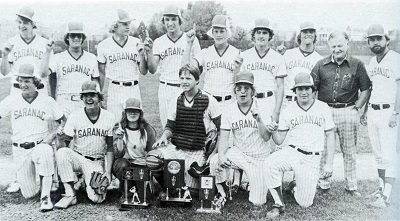
With two outs in the top of the 10th inning, Saranac’s Steve Metternick doubled in two runs to break a 1-1 deadlock as the Redskins topped Frankfort 4-1 in the Class D title showdown. The game, played at Alumni Field on the campus of Central Michigan University, had been interrupted on Saturday at the top of the third, with Saranac leading 1-0. Southpaw Craig Coulson earned the win for the Cinderella squad, going all the way. The sophomore hurler allowed four hits, struck out eight and walked four on the afternoon. Saranac ended the season with 16 victories against 11 defeats.
 Ron Pesch has taken an active role in researching the history of MHSAA events since 1985 and began writing for MHSAA Finals programs in 1986, adding additional features and "flashbacks" in 1992. He inherited the title of MHSAA historian from the late Dick Kishpaugh following the 1993-94 school year, and resides in Muskegon. Contact him at [email protected] with ideas for historical articles.
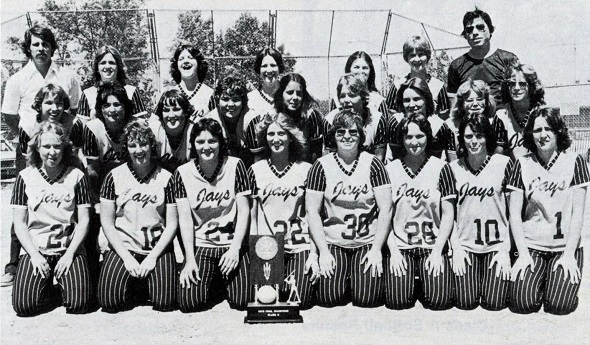
PHOTOS: (Top) Shepherd’s softball team poses with its 1978 Class C championship trophy. (Middle top) East Detroit’s Rocky Szczesniak unloads a pitch for the eventual Class A champ. (Middle below) Ruben Luna prepares to deliver for Flint Southwestern. (Below) Saranac’s “Cinderella” Class D champion celebrates.