

'Prepapalooza' Kicks Off 3-Week Celebration
May 31, 2016
By Geoff Kimmerly
Second Half editor
Nearly 30,000 athletes will take part over the next six days in what will again be the busiest week of the MHSAA calendar, with teams in all nine spring sports competing for District, Regional or Finals championships at sites across both peninsulas.
The first Finals champions of this spring will be awarded Wednesday in Upper Peninsula boys tennis (UPDATE: both U.P. tennis Finals have been moved to Thursday due to rainy weather concerns), followed by six more in Upper Peninsula boys and girls golf Thursday. Four divisions of Lower Peninsula girls tennis start their two-day tournament Friday, and on Saturday, more than 7,000 athletes will join them competing in four Lower and three Upper Peninsula Track & Field Finals.
In addition, baseball, softball and girls soccer teams begin District action tonight, with most of those tournaments wrapping Saturday. Girls and boys lacrosse teams continue Regional play this week, and Lower Peninsula boys golf teams will play Regionals on Wednesday, Thursday and Friday.
Second Half again will serve as your home for all MHSAA Finals coverage, with correspondents providing stories and photos, along with full results, from all of the Upper Peninsula Finals this week and then all 18 LP and UP Finals this weekend, Lacrosse and LP Golf Finals on June 14, and Baseball, Softball and Soccer Finals being played June 19-21.
Check back as well for video highlights from most competitions and sign up to watch all broadcast tournament action over the next three weeks for only $9.95 on MHSAA.tv. All schedules, lists of competitors and tournament brackets updated with scores real-time can be found on MHSAA.com. Keep connected as well with the MHSAA’s social media on Facebook, Twitter and Instagram.
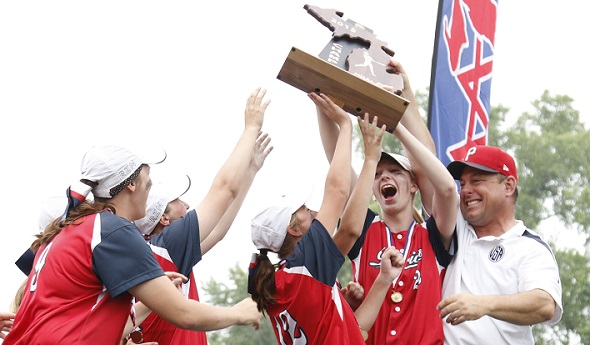
PHOTO: The Unionville-Sebewaing softball team celebrates last season's Division 4 championship.

NFHS Voice: 'Commit' is Verb, not Noun
January 13, 2020
By Karissa Niehoff
NFHS Executive Director
When is “commit” not a verb? According to Webster’s never – that is, unless the reference is to where the high school’s star quarterback is headed to college.
Even in game stories, the “top” players on high school teams are often referred to as a “(name of college) commit.” It seems innocent enough, but the continual focus on a player’s advancement to the next level is concerning given the current – and future – landscape of college sports.
With the NCAA’s recent decision to allow athletes to earn compensation for their name, image and likeness, high school sports governed by the NFHS and its member state associations will be the last bastion of pure amateur competition in the nation. And it must remain that way.
The focus on the individual rather than the team that often grabs the headlines in college basketball and football cannot become a part of high school sports. In college basketball, there is constant discussion about who the “one and done” players will be. At the end of the season in college football, the talk is about which juniors are turning pro and which players are sitting out bowl games to guard against injury.
Although we recognize that this decision by the NCAA was perhaps inevitable as a result of the earlier “Fair Pay to Play Act” by California Governor Gavin Newsom, we are concerned that it will further erode the concept of amateurism in the United States.
While only about one percent of high school boys basketball players and about 2.8 percent of high school 11-player football players will play at the NCAA Division I level, the perks offered to attend certain colleges will be enhanced and recruiting battles could escalate. Current issues with parents pushing their kids into specialization in the fight for scholarships could intensify as they consider the “best offer” from colleges.
This weakening of the amateur concept at the college level must not affect the team-based concept in education-based high school sports. The age-old plan of colleges relying on high schools for their players will continue; however, high school coaches and administrators must guard against an individual’s pursuit of a college scholarship overriding the team’s goals.
As the new model develops at the college level, the education-based nature of high school sports must be preserved. These programs cannot become a training ground or feeder program for college sports.
Instead, the focus should be on the millions of high school student-athletes who commit (an action verb) to being a part of a team and gain untold benefits throughout their high school days. Some of these individuals will play sports at the college level and move on to their chosen careers; others will take those values of teamwork, discipline and self-confidence from the playing field directly into their future careers.
There is nothing more sacred and fundamental to the past – and future – history of high school sports in the United States than the concept of amateurism. It is up to the NFHS and its member state associations to ensure that education remains the tenet of high school sports.
Dr. Karissa L. Niehoff is in her second year as executive director of the National Federation of State High School Associations (NFHS) in Indianapolis, Indiana. She is the first female to head the national leadership organization for high school athletics and performing arts activities and the sixth full-time executive director of the NFHS, which celebrated its 100th year of service during the 2018-19 school year. She previously was executive director of the Connecticut Association of Schools-Connecticut Interscholastic Athletic Conference for seven years.