

'Prepapalooza' Kicks Off 3-Week Celebration
May 31, 2016
By Geoff Kimmerly
Second Half editor
Nearly 30,000 athletes will take part over the next six days in what will again be the busiest week of the MHSAA calendar, with teams in all nine spring sports competing for District, Regional or Finals championships at sites across both peninsulas.
The first Finals champions of this spring will be awarded Wednesday in Upper Peninsula boys tennis (UPDATE: both U.P. tennis Finals have been moved to Thursday due to rainy weather concerns), followed by six more in Upper Peninsula boys and girls golf Thursday. Four divisions of Lower Peninsula girls tennis start their two-day tournament Friday, and on Saturday, more than 7,000 athletes will join them competing in four Lower and three Upper Peninsula Track & Field Finals.
In addition, baseball, softball and girls soccer teams begin District action tonight, with most of those tournaments wrapping Saturday. Girls and boys lacrosse teams continue Regional play this week, and Lower Peninsula boys golf teams will play Regionals on Wednesday, Thursday and Friday.
Second Half again will serve as your home for all MHSAA Finals coverage, with correspondents providing stories and photos, along with full results, from all of the Upper Peninsula Finals this week and then all 18 LP and UP Finals this weekend, Lacrosse and LP Golf Finals on June 14, and Baseball, Softball and Soccer Finals being played June 19-21.
Check back as well for video highlights from most competitions and sign up to watch all broadcast tournament action over the next three weeks for only $9.95 on MHSAA.tv. All schedules, lists of competitors and tournament brackets updated with scores real-time can be found on MHSAA.com. Keep connected as well with the MHSAA’s social media on Facebook, Twitter and Instagram.
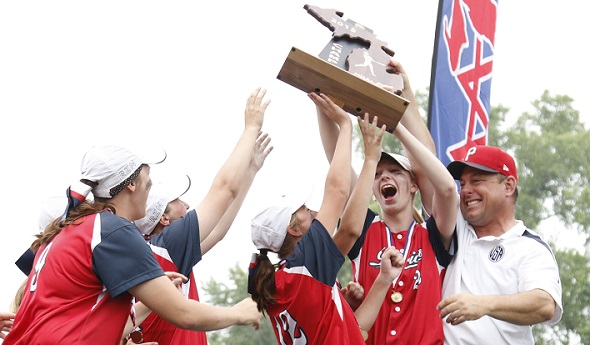
PHOTO: The Unionville-Sebewaing softball team celebrates last season's Division 4 championship.

NFHS Voice: Security Wake-Up Call
December 4, 2019
By Karissa Niehoff
NFHS Executive Director
Given the increase in school-related shootings since the Columbine massacre 20 years ago, perhaps it is not surprising that these acts of violence are no longer confined to regular school hours.
The tragic shooting – and eventual death of an innocent 10-year-old – at a New Jersey high school football game last month made headlines across the country and was a somber reminder that events occurring after school hours are subject to the same type of senseless violence.
This was not the first shooting at a high school sporting event this year – actually it was the 23rd according to the National Center for Spectator Sport Safety and Security (NCS4) – but the death of Micah Tennant and the eventual conclusion of the game five days later at the Philadelphia Eagles’ stadium drew nationwide coverage.
Camden High School and Pleasantville High School finished the playoff game at a nearly empty Lincoln Financial Field before a few hundred family members and friends as the stadium was closed to the public. Larry White, New Jersey State Interscholastic Athletic Association executive director, said the decision to finish the game was made by both schools “to provide closure and send a powerful message that acts of violence and those who perpetrate them will not win.”
High school sporting events traditionally have been safe gathering places for fans to attend and celebrate the accomplishments of high school student-athletes – particularly the sport of football. And we must do whatever is necessary to make sure these venues remain safe and secure.
Reports have been encouraging about attendance as state football playoffs have concluded in many states. In Indiana, about 20,000 people attended the Class 5A championship at Lucas Oil Stadium in Indianapolis on the day after Thanksgiving.
We want to ensure that our stadiums remain open for everyone to attend. The fans – students, parents, other family members, friends, community residents – are what make education-based athletics different from non-school sports.
More intense security plans have been in existence at college and professional sports venues for many years; it is essential that leaders in high school sports move after-school safety and security to the top of their priority lists.
In addition to school athletic events that typically start in early evening hours, security plans also should be in place for practices inside and outside the school building.
Many resources are available for high school athletic administrators to implement an after-school safety and security program, including the free online education course on the NFHS Learning Center at www.NFHSLearn.com. “Afterschool Security” provides practical strategies for developing and implementing a school safety team and an after-school activities supervision plan.
As was the case with increased security at airports after September 11, 2001, the results of heightened safety plans for after-school activities may be an inconvenience for some individuals. However, plans must be in place to ensure that high school stadiums and arenas remain open for the almost eight million participants in high school sports, as well as the estimated 350 million fans annually.
Dr. Karissa L. Niehoff is in her second year as executive director of the National Federation of State High School Associations (NFHS) in Indianapolis, Indiana. She is the first female to head the national leadership organization for high school athletics and performing arts activities and the sixth full-time executive director of the NFHS, which celebrated its 100th year of service during the 2018-19 school year. She previously was executive director of the Connecticut Association of Schools-Connecticut Interscholastic Athletic Conference for seven years.