

'Prepapalooza' Kicks Off 3-Week Celebration
May 31, 2016
By Geoff Kimmerly
Second Half editor
Nearly 30,000 athletes will take part over the next six days in what will again be the busiest week of the MHSAA calendar, with teams in all nine spring sports competing for District, Regional or Finals championships at sites across both peninsulas.
The first Finals champions of this spring will be awarded Wednesday in Upper Peninsula boys tennis (UPDATE: both U.P. tennis Finals have been moved to Thursday due to rainy weather concerns), followed by six more in Upper Peninsula boys and girls golf Thursday. Four divisions of Lower Peninsula girls tennis start their two-day tournament Friday, and on Saturday, more than 7,000 athletes will join them competing in four Lower and three Upper Peninsula Track & Field Finals.
In addition, baseball, softball and girls soccer teams begin District action tonight, with most of those tournaments wrapping Saturday. Girls and boys lacrosse teams continue Regional play this week, and Lower Peninsula boys golf teams will play Regionals on Wednesday, Thursday and Friday.
Second Half again will serve as your home for all MHSAA Finals coverage, with correspondents providing stories and photos, along with full results, from all of the Upper Peninsula Finals this week and then all 18 LP and UP Finals this weekend, Lacrosse and LP Golf Finals on June 14, and Baseball, Softball and Soccer Finals being played June 19-21.
Check back as well for video highlights from most competitions and sign up to watch all broadcast tournament action over the next three weeks for only $9.95 on MHSAA.tv. All schedules, lists of competitors and tournament brackets updated with scores real-time can be found on MHSAA.com. Keep connected as well with the MHSAA’s social media on Facebook, Twitter and Instagram.
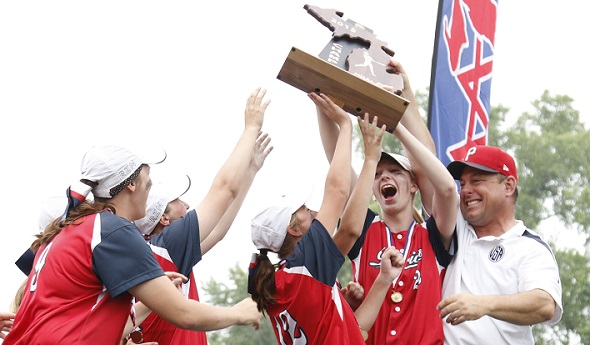
PHOTO: The Unionville-Sebewaing softball team celebrates last season's Division 4 championship.

NFHS Voice: Amateurism Benefits
October 9, 2019
By Karissa Niehoff
NFHS Executive Director
While we addressed a number of important issues with our member state associations at section meetings the past month, perhaps none of the topics are as significant as the tremor that occurred in California on September 30 – the signing of the “Fair Pay to Play Act” by California Governor Gavin Newsom.
Although there are more questions than answers at this point, this ruling would allow college athletes in the state of California to make money from their name, image and likeness through endorsement deals, sponsorships, autograph signings and other opportunities. The legislation is due to take effect in 2023.
Obviously, the NCAA opposes this legislation and is working through its governance structure to address the issue. As Mark Emmert, NCAA president, told the Indianapolis Star, “for all intents and purposes, athletes become employees of the schools. This is just a new form of professionalism and a different way of converting students into employees.”
And since it would not work for athletes in one state to be receiving money legally while athletes in the other 49 could not, a national bill similar to California’s is already being considered by U. S. Representative Anthony Gonzalez of Ohio.
Needless to say, the NFHS and its member state associations oppose the California ruling as it could further erode the concept of amateurism in the United States. At the high school level, current issues with parents pushing their kids into specialization in the fight for scholarships would only be exacerbated as they considered the “best offer” from colleges.
In the aforementioned Indianapolis Star article, Emmert noted the following: “Under the California law, there would be complete elimination of all of those rules (regulations related to shoe companies). It would also include the use of agents in that process and the agent could represent high school students.”
There is nothing more sacred and fundamental to the past – and future – history of high school sports in the United States than the concept of amateurism. While this California ruling addresses college sports directly, it undoubtedly would have an impact on sports at the high school level as well.
The signing of the “Fair Pay to Play Act” comes on the heels of the Alston v. NCAA case earlier this year in which a federal judge in California found the NCAA’s scholarship rules to be illegal – to a point. The NFHS filed an amicus curiae brief in support of the NCAA noting the following:
“Amateurism in athletics is not only valuable for its own sake, but also is a key aspect of a well-rounded education. The NFHS is concerned that the district court’s opinion does not fully appreciate either the concept of amateurism or the many benefits it brings to college and high school sports – and to American sports in general.
“... If amateurism were to give way to professionalism at the collegiate level ... high schools would struggle to fulfill their ultimate goal of preparing large numbers of well-rounded individuals for futures beyond athletics. … The NCAA should be afforded the freedom to define amateurism in a way that preserves the ideal of the student-athlete in higher education which would protect important values of education-based sports at all levels.”
The NFHS will continue to support the NCAA in its efforts to preserve amateurism as it is our belief that paying student-athletes – whether it is in the form of selling one’s name, image or likeness, or whether it eventually becomes a paycheck – will erode the spirit of sport at all levels in this country.
Dr. Karissa L. Niehoff is in her second year as executive director of the National Federation of State High School Associations (NFHS) in Indianapolis, Indiana. She is the first female to head the national leadership organization for high school athletics and performing arts activities and the sixth full-time executive director of the NFHS, which celebrated its 100th year of service during the 2018-19 school year. She previously was executive director of the Connecticut Association of Schools-Connecticut Interscholastic Athletic Conference for seven years.