

Ramping Up for Prepapalooza 2014
May 27, 2014
By Geoff Kimmerly
Second Half editor
Over the next five days, thousands of teams representing more than 700 MHSAA high schools will compete for championships at the District, Regional and Finals levels in 11 sports in what annually is the busiest week in Michigan high school sports.
MHSAA.com and Second Half are the places to be for results, coverage and live video from championship events all over both Peninsulas.
Total, 26 Finals champions will be crowned in girls and boys tennis, girls and boys track and field and Upper Peninsula girls and boys golf, with 36 Regional champions rewarded in girls and boys lacrosse and Lower Peninsula boys golf and 320 winners earning trophies in softball, baseball and girls soccer. All tournament rounds combined, more than 8,000 medals will be presented to individual winners or contributors on those team champions.
 Game scores as they are reported for baseball, softball, soccer and lacrosse will be available on the MHSAA Score Center throughout the week. Full results from golf Regionals also will be posted over the next five days, as will Finals tennis and golf results as we receive them from Lower and Upper Peninsula hosts (Lower Peninsula tennis opening rounds late Friday evening). Track and Field Finals results will be posted Saturday evening.
All MHSAA Finals from both peninsulas will be covered with stories and photos on Second Half by a crew of valuable correspondents from around the state. Second Half will continue its coverage at the Lacrosse and LP Boys Golf Finals on June 14 and the Baseball, Softball and Girls Soccer Finals from June 19-21.
Live championship races from all seven sites of MHSAA Track and Field Finals will be available on a subscription basis on MHSAA.TV, beginning with the 3,200-meter relays at 10 a.m. at each site. The rest of the Upper Peninsula races then will continue, with Lower Peninsula championship races beginning again at 1 p.m. Highlights from this week's golf and tennis championship events will debut on MHSAA.TV in July.
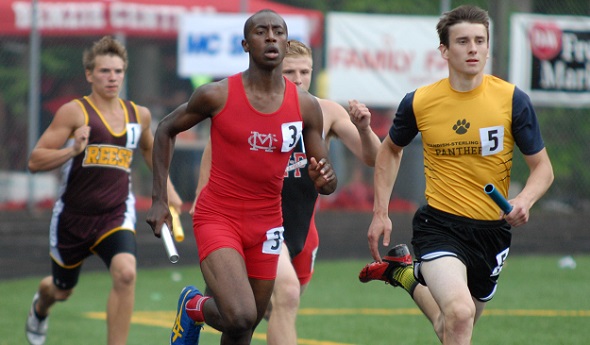
PHOTOS: (Top) Runners push toward the finish during the 2013 LP Division 3 Final. (Middle) Members of the Bloomfield Hills Academy of the Sacred Heart tennis team hold up number ones to signify their place at last season's LP Division 4 Final.
The Dangers of Returning to a Sport Too Soon After an Injury
September 12, 2023
 When you've been hit with an injury, it's natural to want to get back to your regular activities as soon as possible. In fact, it's not uncommon for athletes to sidestep doctors' orders and return to the field or the court before an injury has healed.
"It doesn’t matter how much you train, or how much you prepare, injuries are going to happen, especially if you're an athlete," says Jamie Schwab, an athletic trainer at Henry Ford Health System. "But the real trouble arises when athletes try to play through their pain without allowing sufficient time for recovery."
Risks Of Returning Too Soon After Injury
If you sprain your ankle during a cross country run, it can be tempting to finish the race. Unfortunately, hiding your pain and powering through the activity can actually make matters worse.
"If you continue to work out after suffering from an injury, you run the risk of furthering that injury," Schwab says. So what began as a minor ankle sprain can evolve into a major sprain that sidelines you for weeks.
Returning to play after surgery demands extra precautions. "Athletes are a lot more susceptible to re-injury after returning from surgery, especially if they don't complete the entire 9-month or year-long rehabilitation protocol," Schwab says. In some cases, you can exacerbate an injury to such a degree that you'll never be able to participate in the same capacity.
A Safe Return To Play
The road back to play after an injury is a long and winding one. Before you can even consider returning to exercise, you need to reduce swelling, get pain under control and get your range of motion back to almost normal.
"The recovery process takes time," Schwab says. "But if you stick with it, and you take it seriously, it's going to be a whole lot easier for you to return to the playing field in a timely manner."
Once you get pain and swelling under control, you can focus on agility and weight exercises that will help you regain strength and slowly return to baseline. The key tenets for a safer return to play:
► Be honest about your abilities: "So many athletes are afraid to tell the truth," Schwab says. "But if you're hurting and you're not competing at your full potential, you're letting your team down and yourself down, too." Even worse, you could increase your risk of further injury.
► Focus on building strength: Strength training is critical. It can help you become faster, stronger and more agile on the field. It can also help you recover more quickly after an injury.
► Listen to your body: If something doesn't feel right, pay attention to it. Talk to your athletic trainer or a physical therapist to get to the bottom of what's bugging you and put a plan in place to address it.
Boosting Performance Over The Long Haul
Unfortunately, not every coach and athletic trainer stresses the importance of a maintenance program. In fact, focused training and maintenance exercises are key to preventing injuries in the first place.
"The rehabilitation exercises you begin doing on day one after injury need to be maintained at least three to four times each week, indefinitely," Schwab says. "If you follow that regimen, all of your muscular nagging strains will no longer be a problem because your body is constantly adapting to the stresses. It's conditioned, it's strong, it can withstand the constant changes in direction."
Most importantly, don't be afraid to try complementary strategies. Practice using a foam roller, try cupping to release tension in the muscles and enhance blood flow and consider getting a monthly massage.
Jamie Schwab, AT, ATC, SCAT, CSCS, is an athletic trainer with Henry Ford Sports Medicine and works with student athletes at Edsel Ford High School. She is a National Strength and Conditioning Association-certified strength and conditioning specialist.
To find a sports medicine doctor or athletic trainer at Henry Ford, visit henryford.com/sports.