

Ramping Up for Prepapalooza 2014
May 27, 2014
By Geoff Kimmerly
Second Half editor
Over the next five days, thousands of teams representing more than 700 MHSAA high schools will compete for championships at the District, Regional and Finals levels in 11 sports in what annually is the busiest week in Michigan high school sports.
MHSAA.com and Second Half are the places to be for results, coverage and live video from championship events all over both Peninsulas.
Total, 26 Finals champions will be crowned in girls and boys tennis, girls and boys track and field and Upper Peninsula girls and boys golf, with 36 Regional champions rewarded in girls and boys lacrosse and Lower Peninsula boys golf and 320 winners earning trophies in softball, baseball and girls soccer. All tournament rounds combined, more than 8,000 medals will be presented to individual winners or contributors on those team champions.
 Game scores as they are reported for baseball, softball, soccer and lacrosse will be available on the MHSAA Score Center throughout the week. Full results from golf Regionals also will be posted over the next five days, as will Finals tennis and golf results as we receive them from Lower and Upper Peninsula hosts (Lower Peninsula tennis opening rounds late Friday evening). Track and Field Finals results will be posted Saturday evening.
All MHSAA Finals from both peninsulas will be covered with stories and photos on Second Half by a crew of valuable correspondents from around the state. Second Half will continue its coverage at the Lacrosse and LP Boys Golf Finals on June 14 and the Baseball, Softball and Girls Soccer Finals from June 19-21.
Live championship races from all seven sites of MHSAA Track and Field Finals will be available on a subscription basis on MHSAA.TV, beginning with the 3,200-meter relays at 10 a.m. at each site. The rest of the Upper Peninsula races then will continue, with Lower Peninsula championship races beginning again at 1 p.m. Highlights from this week's golf and tennis championship events will debut on MHSAA.TV in July.
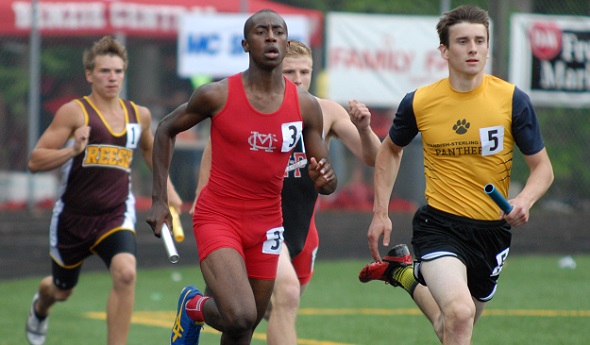
PHOTOS: (Top) Runners push toward the finish during the 2013 LP Division 3 Final. (Middle) Members of the Bloomfield Hills Academy of the Sacred Heart tennis team hold up number ones to signify their place at last season's LP Division 4 Final.

NFHS Voice: Source of HS Playing Rules
November 12, 2019
By Karissa Niehoff
NFHS Executive Director
When it comes to writing playing rules for major sports in the United States, it’s all in the acronyms. In football, you have the NFL, NCAA and NFHS. In basketball, it’s the NBA, NCAA and NFHS. In baseball, the rules-makers are MLB, NCAA and NFHS.
While the NFL, NBA, MLB and NCAA can be used on first reference without explanation, many people are unfamiliar with the NFHS. And yet the NFHS has been around as long – or longer – than the other four major sports organizations.
In many cases, references to NFHS rules – not only in these three major sports but the other 14 sports for which the organization writes rules – are simply noted as “high school rules.” The reality, however, is that the NFHS – the National Federation of State High School Associations – has been the national organization most directly focused on sports playing rules in the past 90 years since it published its first Football Rules Book in 1932.
With almost eight million participants in high school sports, NFHS rules are written for more individuals than all other levels of sports combined. As a result, risk minimization and the fundamentals of good sportsmanship are paramount to the rules-writing process for the NFHS and often are the distinguishing factors from rules at the higher levels of the sport.
Perhaps football is the best example of the commitment to risk minimization. In the mid-1970s, the NFHS was at the forefront of change when it outlawed spearing in high school football. The 1976 rule revision changed the landscape of high school football from an injury standpoint – from a high of 36 direct fatalities in 1968 to an average of about two per year by 2018.
Some people have questioned why there are multiple rules codes for a sport. Very simply, NFHS rules for high school play must be different than at the college and professional levels.
As an example, while professional baseball is concerned with how fast a baseball exits the batter’s box (Velocity Exit Speed) and how far the ball travels on a home run, the NFHS has enacted bat standards during the past 20 years to reduce the speed of balls coming off aluminum bats. In wrestling, the NFHS has enacted strict weight-management plans to reduce the risk of health issues. In ice hockey, while fighting is an accepted part of the sport at the professional level, NFHS rules have strict rules prohibiting all forms of unsportsmanlike conduct. In football, NFHS rules do not permit the excessive celebration displays following touchdowns that occur during NFL games.
In addition to risk minimization and sportsmanship, the NFHS must also weigh financial implications for schools when considering equipment and uniform changes. With schools ranging in size from less than 100 to more than 5,000 students, decisions must be made for the masses and cannot put undue financial hardships on schools.
NFHS rules are also written with the understanding that appropriate behavior begins with the coach, who is responsible for ensuring that his or her team exhibits good sporting behavior. Many penalties for unsportsmanlike conduct on the team are first directed against the coach.
While the NFHS and its member state associations govern the high school place in various sports – not only with playing rules but other issues as well – we maintain relationships with the National Governing Bodies (NGBs) in these sports to assist in meeting the needs of all participants.
Last week, the NFHS hosted a summit of various leaders of NGBs in Indianapolis. Leaders from about 15 NGBs were set to meet with NFHS staff to discuss various initiatives and opportunities for collaborative programs. We hope this is the first of many such meetings as it is crucial that all levels of sport work together to ensure ongoing opportunities for all sports participants.
Dr. Karissa L. Niehoff is in her second year as executive director of the National Federation of State High School Associations (NFHS) in Indianapolis, Indiana. She is the first female to head the national leadership organization for high school athletics and performing arts activities and the sixth full-time executive director of the NFHS, which celebrated its 100th year of service during the 2018-19 school year. She previously was executive director of the Connecticut Association of Schools-Connecticut Interscholastic Athletic Conference for seven years.