


Rivaling for a Cause
January 25, 2013
It’s impossible to include all the perspective we gain from every “Battle of the Fans” visit.
But this anecdote, although it didn't make Tuesday’s story about our Frankenmuth trip, tells of another great example for what student cheering sections can accomplish.
Frankenmuth and Millington are heated rivals, to say the least, separated by 13 miles and made more competitive by plenty of championship-deciding matchups over the years.
But for their boys basketball game Jan. 10 at Frankenmuth, student section leaders from both schools almost completely on their own set up the game as a cancer awareness night, complete with Frankenmuth students in black shirts and Millington’s wearing pink.
The idea was the brainchild of a of Frankenmuth section leader, who then received help from a local bank and contacted Millington to get the ball rolling.
Battle of the Fans has shown us the obvious – these student sections need strong leaders – but also the special things they can accomplish with additional initiative.
“Never Forgotten”
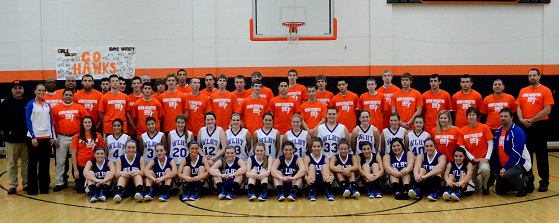 Two more rivals, Fennville and Saugatuck, met late last month for their second “Never Forgotten” boys and girls basketball games with proceeds going to the Wes Leonard Heart Team for the purchase of AEDs.
Players wore jerseys with names on the backs of friends and family members who had died, and those jerseys were then given to family members after the games. Officials Ace Cover, Chris Dennie and Kyle Bowen also donated their game checks to the Heart Team, as did the winner of that night’s 50-50 raffle.
Leonard died from sudden cardiac arrest after making the game-winning shot in a basketball game March 3, 2011. The two schools played their first “Never Forgotten” games last season.
More support for less specialization
I’m asked once a year at least about sport specialization – that is, athletes focusing on just one sport, often from an early age, and if it pays off some way down the road.
Most of my evidence to support my belief in the well-rounded athlete has been anecdotal, based on conversations with people at the high school and college levels over the years. But a British study published this fall in the Journal of Sport Sciences by University of Birmingham researchers provides some interesting empirical findings.
The study of 1,006 people from the United Kingdom showed that those who participated in three sports at ages 11, 13 and 15 were “significantly more likely to compete at a national rather than club standard” between ages 16-18 than those who had practiced only one sport.
In other words, the study found that those who played more sports at earlier ages played at a higher level during their high school-age years, which seems to contradict the one-sport focus philosophy.
Click for more perspective on the study from Chris Kennedy, the Superintendent of Schools in West Vancouver, British Columbia.
PHOTO: The boys and girls teams for Fennville and Saugatuck pose together after their "Never Forgotten" games Dec. 21 at Fennville High. (Photo courtesy of Al LaShell.)
Pair of 4th-Year Standouts Helping Fuel Bronson's Rising Expectations
By
Scott Hassinger
Special for MHSAA.com
December 3, 2024
BRONSON – Kam Brackett and Boston Bucklin are hoping to close out their Bronson basketball careers with a Big 8 Conference title and more postseason hardware this winter.
 Brackett and Bucklin, who both begin their fourth seasons on the Vikings' varsity, are confident they can accomplish some lofty goals.
Both Brackett and Bucklin and their teammates are riding a wave of momentum following a successful football season that saw Bronson finish 6-4 and make the MHSAA Playoffs.
Eighth-year Bronson boys basketball coach Damien Loveless is excited to see how far his two senior leaders can take the Vikings, who finished 14-9 last winter.
"Kam is a phenomenal basketball player. He came in as an physically undersized freshman, and we asked him to go in there and bang with bigger guys. By the end of the season he became our starting point guard," Loveless said.
Loveless had another solid scorer at the time in then-junior Aiden Hathaway.
"It was around game 11 that we needed someone to relieve some of the pressure on Aiden. We put Kam at point guard and bumped Aiden off the ball, and the switch was very instrumental to our success and we ended up winning Districts,” Loveless explained. “This undersized kid (Brackett) thrived in that role. and he could've cared less if he scored and did a nice job distributing the ball to the other guys. He showed right away that he understood the game of basketball. When you have someone like that in your lineup, you're going to be a pretty good team.”
Brackett averaged 5.8 points, 2.7 rebounds and a pair of assists his freshman year. As a sophomore, he averaged 12.3 points, 2.9 rebounds, 3.3 assists and 2.3 steals per contest as Hathaway remained as Bronson's main scoring threat.
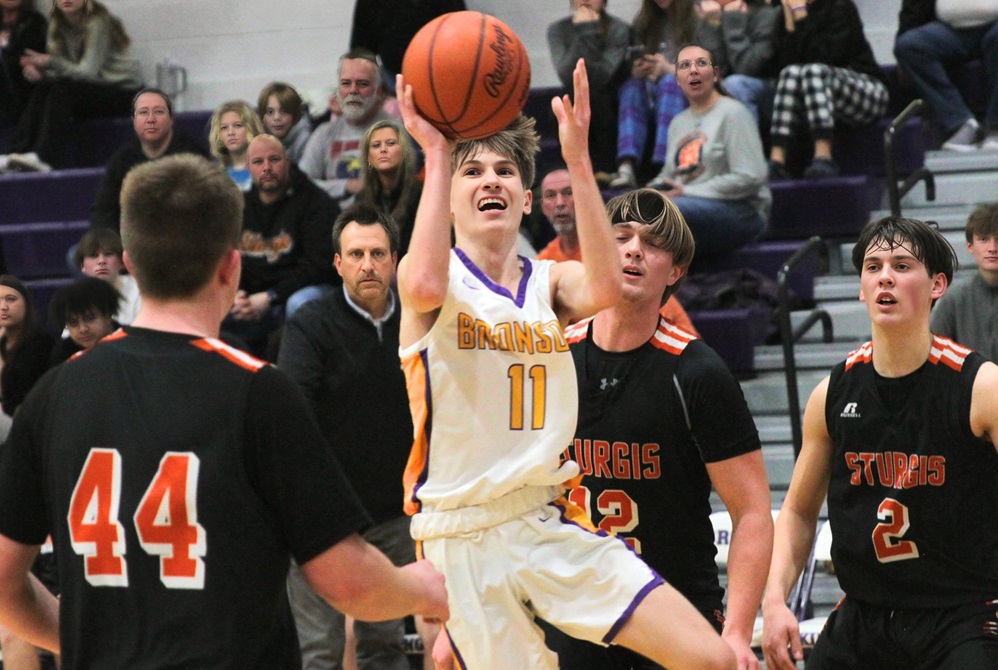
After losing Hathaway to graduation in 2023, Loveless asked Brackett to shoulder more of the scoring load as a junior. The son of Dave Brackett, a past all-stater at Burr Oak, Kam Brackett didn't disappoint as he finished his junior campaign averaging 23.7 points, 7.2 rebounds, 4.2 assists and 4.5 steals. That performance earned the 6-foot-0 Brackett all-state honorable mention in Division 3, along with a runner-up finish for the Big 8 Conference Player of the Year honor. He is a two-time first-team all-league player.
"Last year we asked Kam to become our scorer, and that's a role he willingly stepped into," Loveless said.
Brackett poured in 37 points during Bronson's 2023-24 season opener and later posted a season high of 42 and another game with a triple-double with nine steals.
 "Halfway through my freshman year I moved up and earned a starting spot on varsity. Ever since then I've been working to continue growing as a person and increasing my basketball skills," Brackett said. "My biggest strength is definitely getting to the rack. When my teammates find me open, I'm looking to drive and score or dish the ball off to our big guys when the defense collapses in on me. Coach Loveless and my teammates show a lot of trust in me when I have a good shot.
“I feel like we're going to go far in the tournament this year. We have a real good group of guys with different abilities and a bunch of underclassmen who will contribute greatly. There are a lot of people who can score, rebound or make a good pass. This team has improved a great deal over last season. We have to focus on league and Districts first, but a big step to putting our mark on this program would be to win a Regional title."
Going into the season opener against Battle Creek St. Philip last week, Brackett had 963 career points and was just 37 shy of going over the 1,000-point milestone for his career.
"Kam's instincts on the basketball court are so incredible. I love watching him play,” said Loveless, who during the school day serves as White Pigeon High School principal. “He's a great defender and takes a great deal of pride in that. Many of his points come off transition, but he can just flat out shoot, scores the ball very well and can play the game at the rim. He just loves the contact, pressure and intensity and thrives in the moment. Having someone like that on your team makes everyone around him better."
Brackett is looking to continue his academic career by studying business in college focusing on finance or accounting. Following a big football season this fall as a wide receiver, Brackett is weighing his options and considering continuing his gridiron career at the next level.
Bucklin, a 6-1 power forward, averaged 5.8 points, 6.5 rebounds, 1.7 assists and one steal per game his junior season.
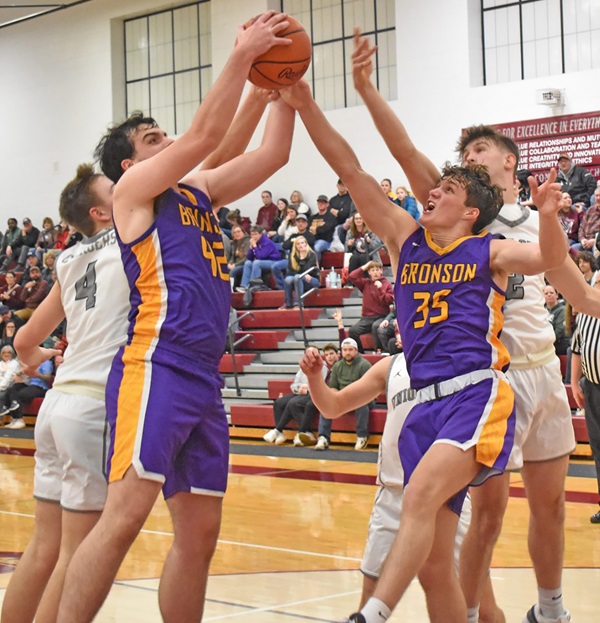
"Boston has always been a big and athletic kid. He's physical, our strongest guy on the team and is going to move bodies out on the floor. He is good at just about everything he puts his mind to," Loveless said.
Bucklin is anxious to help put his stamp on the Bronson program as well.
"Like every year we are hoping for a Big 8 championship and a District title. Our conference is pretty tough, and our team is one of the most skilled teams I've ever been on,” Bucklin said. “Kam is one of those players that just makes everyone around him better. Everyone is always double-teaming him, and he still finds a way to score or he passes off to that open guy.
“Our team doesn't have lot of size, but it’s about how hard you are willing to work to be successful. I'm more of a rebounder than a scorer and prefer to get that rebound and get the ball back out to Kam or another teammate because I know they are going to do something great with the basketball. Everyone on this team is so positive when we're together."
 Besides basketball, Bucklin has participated in football, soccer and track & field. He has been accepted and will attend the University of South Florida where he plans to study to become a physician's assistant.
Basketball runs in the Bucklin family genes. Boston's father Steve Bucklin and his uncle Jeremy Bucklin both played at Bronson. Jeremy Bucklin recently served as Sturgis' varsity girls coach. Boston's cousin Aaron Bucklin, another Bronson grad, is the varsity boys coach at Coldwater.
Brackett, Bucklin and Tyler Wilber, another senior, will serve as the Vikings' tri-captains. The remaining seniors on the roster are Drew Norton and Keegan Krebs. Other key players are sophomores Layne Arver and Warner Wotta, juniors Matt Anderson, Spencer Losinski, Stevie Wilson, Zeb Olsen and Carter Sikorski, and freshman Owen Losinski.
Bronson finished second in the Big 8 Conference last winter and fell in the District Semifinals to league rival Union City. The Vikings have not won a league title since joining the Big 8 Conference, but Loveless expects this team to be in the hunt.
Bronson finished 6-15 a year before Loveless took the reins of the program beginning with the 2016-17 season. The Vikings have won at least 13 games the last three seasons.
"To see the change in our kids' expectations the last few seasons has been remarkable and has set the tone for our program," Loveless said.
Loveless, an Olivet native and a Grand Valley State University graduate where he served as a student assistant, served as director of basketball operations at Olivet College before coming to Bronson.
While a student at GVSU and working at Olivet College, Loveless conducted research on the correlation between yoga and sports injuries. Along with weightlifting, Loveless has included yoga as part of his team's workouts twice a week at Bronson.
"When I was at Grand Valley we did a lot of stretching, and that led me to do some research. I found that there was this college that had implemented yoga in its sports program, and they had a 70 percent injury prevention rate," Loveless said.
"Yoga helps with your flexibility and injury prevention. It also makes our athletes a lot stronger."
 Scott Hassinger is a contributing sportswriter for Leader Publications and previously served as the sports editor for the Three Rivers Commercial-News from 1994-2022. He can be reached at [email protected] with story ideas for Berrien, Cass, St. Joseph and Branch counties.
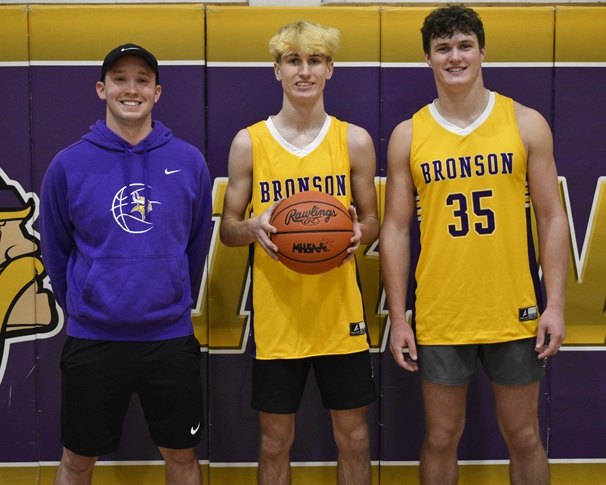
PHOTOS (Top) Bronson senior point guard Kam Brackett (11) looks to score against Sturgis during a game his junior season. (Middle) Bronson senior post player Boston Bucklin (35) battles for a rebound in a District game against Union City last winter. (Below) Vikings head boys basketball coach Damien Loveless, left, is joined by his two returning four-year senior standouts Brackett (middle) and Bucklin. (Top photo courtesy of Brandon Watson/Sturgis Journal. Middle photo courtesy of Troy Tennyson/Coldwater Daily Reporter. Loveless/Brackett/Bucklin photo by Scott Hassinger.)