


Rivaling for a Cause
January 25, 2013
It’s impossible to include all the perspective we gain from every “Battle of the Fans” visit.
But this anecdote, although it didn't make Tuesday’s story about our Frankenmuth trip, tells of another great example for what student cheering sections can accomplish.
Frankenmuth and Millington are heated rivals, to say the least, separated by 13 miles and made more competitive by plenty of championship-deciding matchups over the years.
But for their boys basketball game Jan. 10 at Frankenmuth, student section leaders from both schools almost completely on their own set up the game as a cancer awareness night, complete with Frankenmuth students in black shirts and Millington’s wearing pink.
The idea was the brainchild of a of Frankenmuth section leader, who then received help from a local bank and contacted Millington to get the ball rolling.
Battle of the Fans has shown us the obvious – these student sections need strong leaders – but also the special things they can accomplish with additional initiative.
“Never Forgotten”
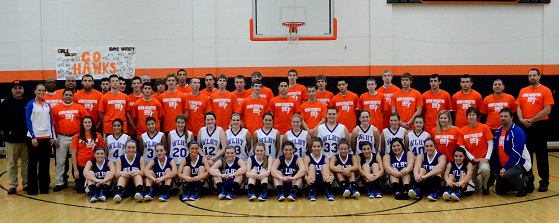 Two more rivals, Fennville and Saugatuck, met late last month for their second “Never Forgotten” boys and girls basketball games with proceeds going to the Wes Leonard Heart Team for the purchase of AEDs.
Players wore jerseys with names on the backs of friends and family members who had died, and those jerseys were then given to family members after the games. Officials Ace Cover, Chris Dennie and Kyle Bowen also donated their game checks to the Heart Team, as did the winner of that night’s 50-50 raffle.
Leonard died from sudden cardiac arrest after making the game-winning shot in a basketball game March 3, 2011. The two schools played their first “Never Forgotten” games last season.
More support for less specialization
I’m asked once a year at least about sport specialization – that is, athletes focusing on just one sport, often from an early age, and if it pays off some way down the road.
Most of my evidence to support my belief in the well-rounded athlete has been anecdotal, based on conversations with people at the high school and college levels over the years. But a British study published this fall in the Journal of Sport Sciences by University of Birmingham researchers provides some interesting empirical findings.
The study of 1,006 people from the United Kingdom showed that those who participated in three sports at ages 11, 13 and 15 were “significantly more likely to compete at a national rather than club standard” between ages 16-18 than those who had practiced only one sport.
In other words, the study found that those who played more sports at earlier ages played at a higher level during their high school-age years, which seems to contradict the one-sport focus philosophy.
Click for more perspective on the study from Chris Kennedy, the Superintendent of Schools in West Vancouver, British Columbia.
PHOTO: The boys and girls teams for Fennville and Saugatuck pose together after their "Never Forgotten" games Dec. 21 at Fennville High. (Photo courtesy of Al LaShell.)
Preview: Past Champions Setting Up as Storylines Again in Finals Returns
By
Geoff Kimmerly
MHSAA.com senior editor
November 1, 2024
Two reigning champions ranked to repeat and a past individual champion setting the statewide pace are among those anticipated to make headlines across four Lower Peninsula Girls Cross Country Finals on Saturday at Michigan International Speedway.
Romeo in Division 1 and Whitmore Lake in Division 4 will enter their championship races top-ranked after finishing first in their respective divisions a year ago. Holland West Ottawa senior Helen Sachs is looking to close her high school career with a second individual championship after placing first in Division 1 in 2022.
See below for more on several team and individual contenders Saturday. The "season bests" list referred to frequently is a ranking list of every runner's best time this season, maintained by Athletic.net. The first girls race, in Division 4, begins at 10:50 a.m.; click here for the full schedule and ticket information.
Additionally, all eight races Saturday at MIS will be streamed live and viewable with subscription on the NFHS Network: Divisions 1 & 2 | Divisions 3 & 4.
Division 1
Reigning champion: Romeo
2023 runner-up: Ann Arbor Pioneer
2024 top-ranked: 1. Romeo, 2. Holland West Ottawa, 3. Saline.
We’ve seen two repeat Division 1 girls champions over the last decade (technically three as Pioneer won three straight titles from 2019-21), and Romeo is favored to accomplish that feat as well. The Bulldogs placed the first seven individuals at their Regional, with six of those runners their top six from last season’s Final when they finished with 65 points – 61 fewer than the runner-up Pioneers. Sophomore Annie Hrabovsky (fourth), juniors Natalia Guaresimo (seventh) and Emmerson Clor (13th), and senior Lillian Deskins (22nd) all medaled last year. Holland West Ottawa finished third last season, and 2022 Finals individual champion Helen Sachs led West Ottawa to a dominating Regional win this time with four individuals among the top nine. Saline was fifth at the 2023 Final and won its Regional last weekend just ahead of Pioneer 28-41 with six individuals among the top 10.
Individuals: Two-time champion Rachel Forsyth of Pioneer graduated in the spring, but this field still returns a past winner in Sachs, whose 16:52.8 at the Otsego Invitational on Sept. 28 is the fastest time this season among runners competing this weekend in any division. She placed 11th in LPD1 a year ago. Rochester senior Lucy Cook has finished third the last two seasons and has the fourth-fastest top 5K time in any division this fall, and Midland Dow senior Victoria Garces has the third-fastest top time this season and is coming off a fifth-place Finals finish in 2023. Grand Blanc senior Gracy Tykocki was 10th at last year’s Final and finished runner-up at her Regional last weekend. Sachs, Garces, Cook and Annie Hrabovsky were Regional champions, joined by Kalamazoo Central senior Annie Alkema, Brighton junior Lydia LaMarra, Pioneer freshman Natasza Dudek, Canton junior Aiden Pengelly and Novi sophomore Katelynn Egli. Dudek has the fourth-fastest top time in Division 1 this fall.
Division 2
Reigning champion: Grand Rapids Christian
2023 runner-up: Otsego
2024 top-ranked: 1. Goodrich, 2. Zeeland East, 3. Grand Rapids Christian.
Grand Rapids Christian topped 2022 champion Otsego 112-131 a year ago with Goodrich just behind them in third at 139, and some combination could dominate the top of the standings again. The Martians didn’t have a senior in last year’s lineup, and six of those runners from 2023 were among the seven Goodrich competitors who finished among the top 15 at their Regional last weekend. Zeeland East is seeking its first top-two Finals finish and placed fifth last season with only one senior, and Grand Rapids Christian brings back three from last year’s championship lineup and placed five among the top 17 in its Regional victory.
Individuals: St. Johns sophomore Ava Schafer is the top returning placer from last year’s Final after finishing fourth, and she’s undefeated this season with the third-fastest top time in Division 2 at 17:32.4. Zeeland East senior Emma Drnek is right behind her on that list at 17:44.4 and finished seventh at last year’s Final, and Goodrich’s Kamryn Lauinger was ninth at last year’s Final. The fastest top times in Division 2 this season belong to Otsego junior Emma Hoffman – who also is undefeated – and Gaylord junior Katie Berkshire, who placed 17th and 73rd, respectively, in 2023. Berkshire ran a personal record 17:31.05 to win her Regional last weekend and was joined among Regional champs by Drnek, Hoffman, Schafer, East Grand Rapids sophomore Adeline Armstrong, Freeland sophomore Clara Kaczor, Linden sophomore Addison Josephson, Croswell-Lexington senior Eva Thompson and Carleton Airport senior Courtney Bovair.
Division 3
Reigning champion: Jackson Lumen Christi
2023 runner-up: Traverse City St. Francis
2024 top-ranked: 1. Lansing Catholic, 2. Traverse City St. Francis, 3. Central Montcalm.
Lansing Catholic is pursuing a second Finals championship after previously winning Division 2 in 2017 and finishing seventh in Division 3 last fall with just one senior. Four of last season’s Finals runners were among the seven who finished among the top 20 in last weekend’s Regional victory, with freshman Josie Bishop second individually. St. Francis won the championship in 2022 before finishing second last year to Lumen 140-177, and the Gladiators placed six among the top 14 in winning their Regional including the top two in senior Betsy Skendzel and sophomore Molly Kate Hollandsworth. Central Montcalm finished eighth last season with no seniors and is seeking its first top-two Finals finish, coming off falling one point behind No. 4 Pewamo-Westphalia but placing the top two individuals at their Regional.
Individuals: Central Montcalm’s Kyah Hoffman was that Regional champion noted above and finished third at last year’s Final; she’s run the fastest top time in the Division 3 field at 17:25.3. Skendzel is next on the top times list at 17:46.8 and finished fourth last season, and Emmry Ross (17:47.3) follows on the top times list after placing fifth at the 2023 Final. Lakeview sophomore Kamryn Salladay, Ypsilanti Arbor Prep senior Eliza Bush and Kent City senior Lila Volkers finished eighth, ninth and 10th, respectively, in last year’s championship race, and Muskegon Western Michigan Christian senior Grace VanderKooi was third in Division 4 and won her Division 3 Regional last week just ahead of Volkers. Also winning Regionals were Bush, Hoffman, Ross, Skendzel, Salladay, Fennville sophomore Isabelle Sliter, Millington junior Abigail Ross and Leslie junior Hailey Creisher.
Division 4
Reigning champion: Whitmore Lake
2023 runner-up: Johannesburg-Lewiston
2024 top-ranked: 1. Whitmore Lake, 2. Hillsdale Academy, 3. Harbor Springs.
Whitmore Lake’s championship last season was its first since 1996, and four of those title-winning runners return this weekend including 2023 individual runner-up Kaylie Livingston – who outpaced the field at her Regional last weekend by 1 minute, 44 seconds, at 17:51.9. Hillsdale Academy is hoping to make a jump from fourth last season as it pursues its first championship; the Colts didn’t have a senior last year and finished Division 4 runners-up in 2022, and placed all seven runners among the top 17 in a Regional title win. Harbor Springs won back-to-back titles in 2008 and 2009 and finished runner-up in 2015 as it too seeks to move up from a year ago, when it finished fifth also without a senior. The Rams placed six among the top 12 in winning their Regional.
Individuals: Livingston’s top time of 17:46.2 tops the Division 4 list by 14 seconds, and she is followed by Johannesburg-Lewiston senior Allie Nowak, who placed fourth in 2023. Whitmore Lake junior Carina Burchi was sixth at last year’s Final and sits fourth on this year’s top times list, and Gobles sophomore Libby Smith finished one spot behind her at last fall’s Final but is one spot ahead with the third-fastest top time in the division. Adrian Lenawee Christian senior Izzy Brooks is back after placing eighth last year, and Petoskey St. Michael senior Jane Manthei returns after placing 10th. Nowak was first and Manthei second at their Regional, and joining Nowak and Livingston among Regional winners were Brooks, Smith, Bear Lake/Onekama freshman Callie Sinke, Vestaburg senior Abigail Davis, Kalamazoo Hackett Catholic Prep junior Emma Riker, Dryden junior Cara Prusakiewicz and Auburn Hills Oakland Christian senior Eliza Keith.
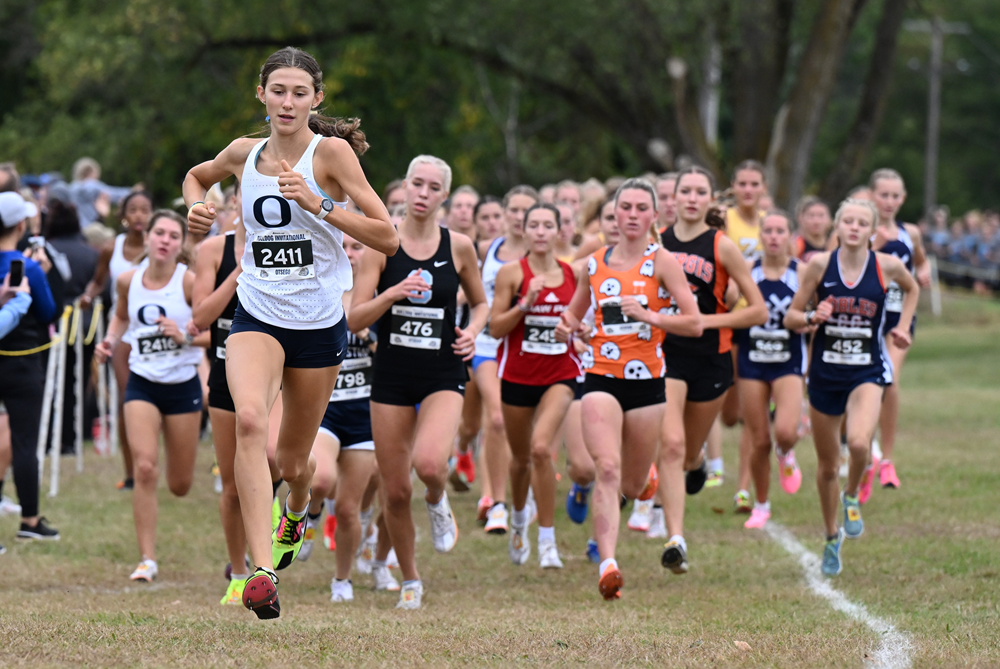
PHOTO Otsego’s Emma Hoffman (2411) leads on the way to winning Division 2 race Sept. 28 at the Otsego Invitational. (Photo by Gary Shook.)