


Rivaling for a Cause
January 25, 2013
It’s impossible to include all the perspective we gain from every “Battle of the Fans” visit.
But this anecdote, although it didn't make Tuesday’s story about our Frankenmuth trip, tells of another great example for what student cheering sections can accomplish.
Frankenmuth and Millington are heated rivals, to say the least, separated by 13 miles and made more competitive by plenty of championship-deciding matchups over the years.
But for their boys basketball game Jan. 10 at Frankenmuth, student section leaders from both schools almost completely on their own set up the game as a cancer awareness night, complete with Frankenmuth students in black shirts and Millington’s wearing pink.
The idea was the brainchild of a of Frankenmuth section leader, who then received help from a local bank and contacted Millington to get the ball rolling.
Battle of the Fans has shown us the obvious – these student sections need strong leaders – but also the special things they can accomplish with additional initiative.
“Never Forgotten”
 Two more rivals, Fennville and Saugatuck, met late last month for their second “Never Forgotten” boys and girls basketball games with proceeds going to the Wes Leonard Heart Team for the purchase of AEDs.
Players wore jerseys with names on the backs of friends and family members who had died, and those jerseys were then given to family members after the games. Officials Ace Cover, Chris Dennie and Kyle Bowen also donated their game checks to the Heart Team, as did the winner of that night’s 50-50 raffle.
Leonard died from sudden cardiac arrest after making the game-winning shot in a basketball game March 3, 2011. The two schools played their first “Never Forgotten” games last season.
More support for less specialization
I’m asked once a year at least about sport specialization – that is, athletes focusing on just one sport, often from an early age, and if it pays off some way down the road.
Most of my evidence to support my belief in the well-rounded athlete has been anecdotal, based on conversations with people at the high school and college levels over the years. But a British study published this fall in the Journal of Sport Sciences by University of Birmingham researchers provides some interesting empirical findings.
The study of 1,006 people from the United Kingdom showed that those who participated in three sports at ages 11, 13 and 15 were “significantly more likely to compete at a national rather than club standard” between ages 16-18 than those who had practiced only one sport.
In other words, the study found that those who played more sports at earlier ages played at a higher level during their high school-age years, which seems to contradict the one-sport focus philosophy.
Click for more perspective on the study from Chris Kennedy, the Superintendent of Schools in West Vancouver, British Columbia.
PHOTO: The boys and girls teams for Fennville and Saugatuck pose together after their "Never Forgotten" games Dec. 21 at Fennville High. (Photo courtesy of Al LaShell.)
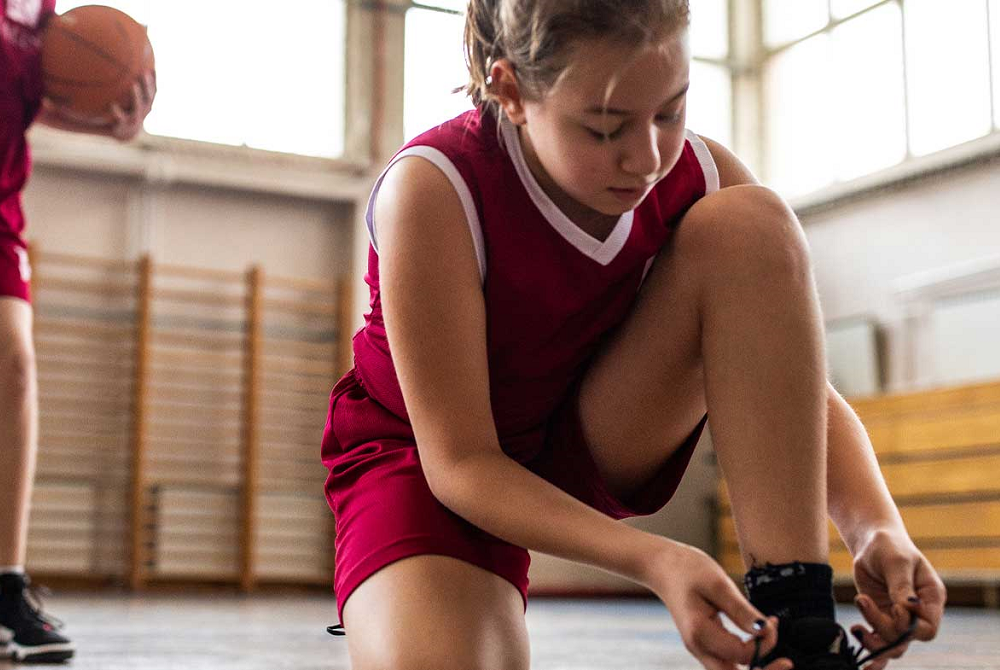
Sports Injuries & Student Athletes: A Parent’s Guide
February 6, 2024
Playing sports is a great way for children of all ages to maintain a healthy lifestyle. It also builds confidence and teaches them valuable life lessons, like working as a team and the value of hard work. While it may be every sports fanatic’s dream to have their kid make it big time in the arena or on the diamond, sometimes pushing young athletes to be the best at a young age can lead to serious injuries that will take them out of the game altogether.
 "Sports help with physical and psychological well-being," says Matthew Santa Barbara, M.D., a sports medicine physician at Henry Ford Health. "However, year-round participation in a single sport at a young age can lead to overuse injuries and mental burnout."
Nowadays, many kids will start playing one sport at a young age and continue to play that same sport year-round for years. This can be harmful to your child because his or her soft tissue and bone structures aren't fully developed. Furthermore, the pressures of year-round participation and focus on excelling, rather than enjoyment, can negatively affect a young athlete's mental health.
Basketball causes the most injuries among high schoolers, causing many visits to the emergency room each year for stressed and torn ankle ligaments. In baseball, the Tommy John surgery, a procedure to reconstruct torn ligaments in the elbow after overuse, has also been increasingly used to treat young athletes still in high school.
How To Prevent Sports Injuries
Preparing your children appropriately before a sports season begins and supporting them during the season is important. Dr. Santa Barbara offers four key pieces of advice to help your youth athletes avoid injury.
1. Don’t limit your child to one sport. Playing a variety of sports in different seasons is a great way to work different parts of the body. When your child gets older, they can make the transition to playing a single sport they are good at and enjoy.
2. Warm up. Make sure your child is properly warming up before they play any sport. Dynamic warmups--incorporating exercises that involve moving the body such as lunges, high knees and arm circles – are preferable to stretching alone.
3. Strengthen core muscles. Building up core strength takes pressure off joints in the arms and legs. It gives young athletes more momentum and can help improve their performance.
4. Abide by rest rules. Many schools and sports leagues have rules in place to limit how many teams kids are on or how often they play. Follow these to ensure your child is allowing time for their joints and muscles to recover from physical activity.
Children participating in a sport should never push through pain, and injuries should be promptly evaluated by a sports medicine physician. Physical injuries are often more obvious, while mental health issues due to sports participation can be more subtle. Symptoms such as fatigue and declining performance can be signs of burnout. In these situations, rest is also important.
"Sports should be fun for kids," says Dr. Santa Barbara. "Avoiding single-sports specialization at a young age keeps the focus on enjoyment while reducing the physical and psychological risks of year-round participation."
To find a sports medicine provider at Henry Ford Health, visit henryford.com/sportsmedicine or call 313-651-1969.
Matthew Santa Barbara, M.D., is a non-operative sports medicine physician at Henry Ford Health. He sees patients at the Henry Ford Center for Athletic Medicine in Detroit, Henry Ford West Bloomfield Hospital, Henry Ford Medical Center - Columbus, Henry Ford Medical Center - Bloomfield Township and Henry Ford Medical Center - Fairlane.