

Rivaling for a Cause
January 25, 2013
It’s impossible to include all the perspective we gain from every “Battle of the Fans” visit.
But this anecdote, although it didn't make Tuesday’s story about our Frankenmuth trip, tells of another great example for what student cheering sections can accomplish.
Frankenmuth and Millington are heated rivals, to say the least, separated by 13 miles and made more competitive by plenty of championship-deciding matchups over the years.
But for their boys basketball game Jan. 10 at Frankenmuth, student section leaders from both schools almost completely on their own set up the game as a cancer awareness night, complete with Frankenmuth students in black shirts and Millington’s wearing pink.
The idea was the brainchild of a of Frankenmuth section leader, who then received help from a local bank and contacted Millington to get the ball rolling.
Battle of the Fans has shown us the obvious – these student sections need strong leaders – but also the special things they can accomplish with additional initiative.
“Never Forgotten”
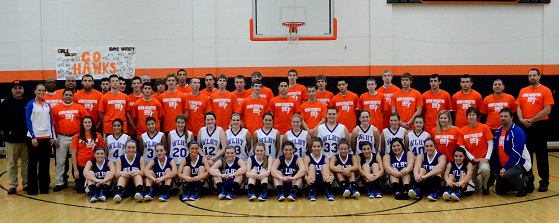 Two more rivals, Fennville and Saugatuck, met late last month for their second “Never Forgotten” boys and girls basketball games with proceeds going to the Wes Leonard Heart Team for the purchase of AEDs.
Players wore jerseys with names on the backs of friends and family members who had died, and those jerseys were then given to family members after the games. Officials Ace Cover, Chris Dennie and Kyle Bowen also donated their game checks to the Heart Team, as did the winner of that night’s 50-50 raffle.
Leonard died from sudden cardiac arrest after making the game-winning shot in a basketball game March 3, 2011. The two schools played their first “Never Forgotten” games last season.
More support for less specialization
I’m asked once a year at least about sport specialization – that is, athletes focusing on just one sport, often from an early age, and if it pays off some way down the road.
Most of my evidence to support my belief in the well-rounded athlete has been anecdotal, based on conversations with people at the high school and college levels over the years. But a British study published this fall in the Journal of Sport Sciences by University of Birmingham researchers provides some interesting empirical findings.
The study of 1,006 people from the United Kingdom showed that those who participated in three sports at ages 11, 13 and 15 were “significantly more likely to compete at a national rather than club standard” between ages 16-18 than those who had practiced only one sport.
In other words, the study found that those who played more sports at earlier ages played at a higher level during their high school-age years, which seems to contradict the one-sport focus philosophy.
Click for more perspective on the study from Chris Kennedy, the Superintendent of Schools in West Vancouver, British Columbia.
PHOTO: The boys and girls teams for Fennville and Saugatuck pose together after their "Never Forgotten" games Dec. 21 at Fennville High. (Photo courtesy of Al LaShell.)
Stretching Done Right: Easy Tips To Stay Limber
By
Christina Chapski, Ed.D., AT, ATC
Henry Ford Health
November 7, 2023
Stretching is more than just a workout suggestion – it's a vital way to avoid injury and get the most out of your activity. You wouldn’t take your car on a long drive without making sure it’s in tip-top shape, right? So before you work up a sweat, work up a stretch.
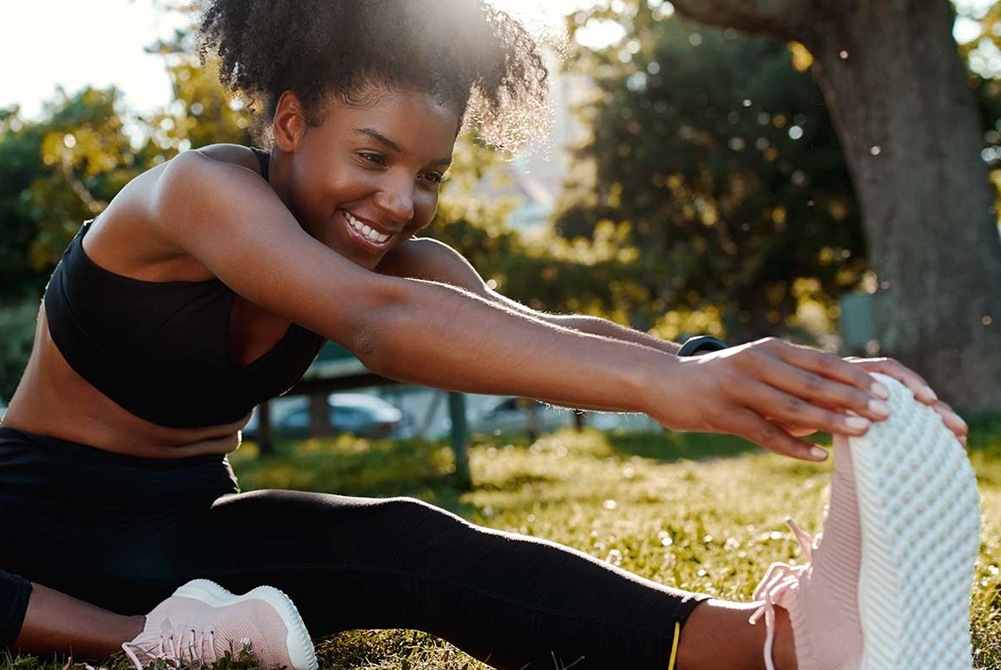
 One important thing to keep in mind is that dynamic stretching is best. It uses momentum to propel your muscles into an extended range of motion. Unlike static stretching, where you remain in an almost still position, a dynamic warm up is the best way to get your blood flowing and your heart rate pumping.
To get your muscles primed for activity, high knees, "butt kicks" and side shuffling are more effective than standing quad stretches. If you are doing an upright quad stretch, it's best to lean back a little to get the full benefit, since your quads originate from above the hip. Also, remember to always grab the ankle and not the toe.
Here are some other helpful hints on how to warm up the right way:
- For hamstrings: The hamstring muscle attaches to your bones below the knee at the back of the leg, so you want to avoid bending them (which ultimately shortens the muscle you’re trying to stretch). When bending at your back, make sure to keep your spine straight like a table to elongate those muscles. Keep your chin up. If you bend down to touch your toes, there’s no need to hover closer than six inches above the ground – unless you’re able to comfortably do so.
- For pectoral muscles: "Door stretches” offer the best stretch. Simply place your arms out on either side of you as if you were making a “T” with your body. Then, bend your arms up at your elbows so they each form a 90-degree angle. In this position, put your arms on either side of a door frame, with your body within the frame’s opening and walk forward slowly to open up the chest.
- For triceps: Make a gesture like you’re scratching your upper back and be sure to keep your elbows in for maximum benefit.
- For the torso: The iron cross stretch involves putting your arms out at your sides like a “T” and then rotating at your waist side to side. You can also drop down toward the floor and reach for your toes, one side at a time.
Other great tips to add to your stretching repertoire include:
- Don’t forget to keep breathing throughout your stretch. It will help keep your muscle tissue oxygenated.
- Hold each stretch for 10 to 20 seconds, aiming for three repetitions of each. If you prefer, you can split up your stretching throughout the day, or use props like foam rollers to help ease tension in your muscles and break up knots.
- Listen to your body while stretching. Slight pain is acceptable, but if your muscles start shaking, it's a warning for you to stop.
- Don't give up. Stretching progress can be slow, so comparing your progress to that of others will only discourage you. Pay attention to your own progress. Seeing your body become more flexible when you previously weren’t limber will help keep you motivated and is the ultimate reward.
To find a sports medicine doctor or athletic trainer at Henry Ford, visit henryford.com/athletes. Christina Chapski, Ed.D., AT, ATC, is the director of athletic training and community outreach at Henry Ford Health. Read more of Chapski's articles.