


Rivaling for a Cause
January 25, 2013
It’s impossible to include all the perspective we gain from every “Battle of the Fans” visit.
But this anecdote, although it didn't make Tuesday’s story about our Frankenmuth trip, tells of another great example for what student cheering sections can accomplish.
Frankenmuth and Millington are heated rivals, to say the least, separated by 13 miles and made more competitive by plenty of championship-deciding matchups over the years.
But for their boys basketball game Jan. 10 at Frankenmuth, student section leaders from both schools almost completely on their own set up the game as a cancer awareness night, complete with Frankenmuth students in black shirts and Millington’s wearing pink.
The idea was the brainchild of a of Frankenmuth section leader, who then received help from a local bank and contacted Millington to get the ball rolling.
Battle of the Fans has shown us the obvious – these student sections need strong leaders – but also the special things they can accomplish with additional initiative.
“Never Forgotten”
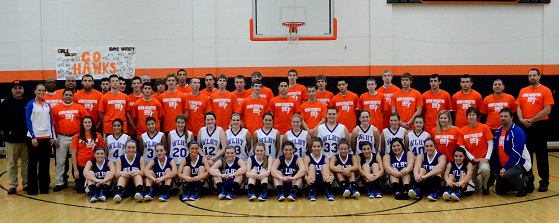 Two more rivals, Fennville and Saugatuck, met late last month for their second “Never Forgotten” boys and girls basketball games with proceeds going to the Wes Leonard Heart Team for the purchase of AEDs.
Players wore jerseys with names on the backs of friends and family members who had died, and those jerseys were then given to family members after the games. Officials Ace Cover, Chris Dennie and Kyle Bowen also donated their game checks to the Heart Team, as did the winner of that night’s 50-50 raffle.
Leonard died from sudden cardiac arrest after making the game-winning shot in a basketball game March 3, 2011. The two schools played their first “Never Forgotten” games last season.
More support for less specialization
I’m asked once a year at least about sport specialization – that is, athletes focusing on just one sport, often from an early age, and if it pays off some way down the road.
Most of my evidence to support my belief in the well-rounded athlete has been anecdotal, based on conversations with people at the high school and college levels over the years. But a British study published this fall in the Journal of Sport Sciences by University of Birmingham researchers provides some interesting empirical findings.
The study of 1,006 people from the United Kingdom showed that those who participated in three sports at ages 11, 13 and 15 were “significantly more likely to compete at a national rather than club standard” between ages 16-18 than those who had practiced only one sport.
In other words, the study found that those who played more sports at earlier ages played at a higher level during their high school-age years, which seems to contradict the one-sport focus philosophy.
Click for more perspective on the study from Chris Kennedy, the Superintendent of Schools in West Vancouver, British Columbia.
PHOTO: The boys and girls teams for Fennville and Saugatuck pose together after their "Never Forgotten" games Dec. 21 at Fennville High. (Photo courtesy of Al LaShell.)
From MSP Post to Postgame: Lieutenants Return to the (Football) Field
September 27, 2023
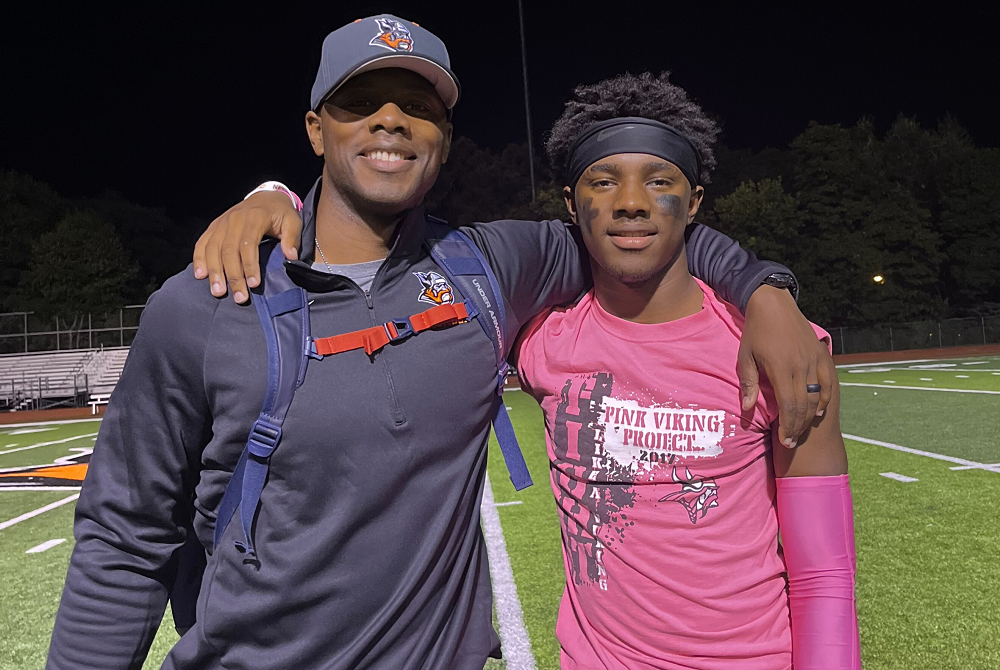
While fans are settling into another season, Michigan State Police Lt. Tedric Gibbs has been fully immersed in football for months.
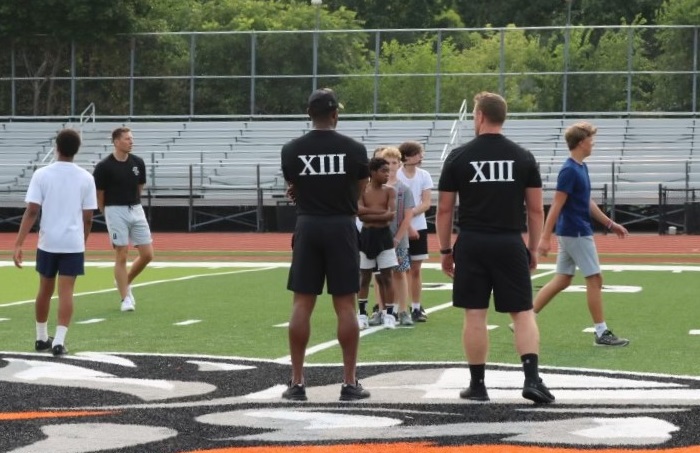
The Jackson Post’s assistant post commander serves as assistant coach for Jackson High School’s varsity football team and for the team at Parkside Middle School.
“I started coaching when my older son was in youth sports, as a way to do something together that we both love,” Gibbs said. “My younger son followed the same path, so I joined his team too. I grew up in Jackson and am grateful to be able to serve my hometown from the sidelines and at our post.”
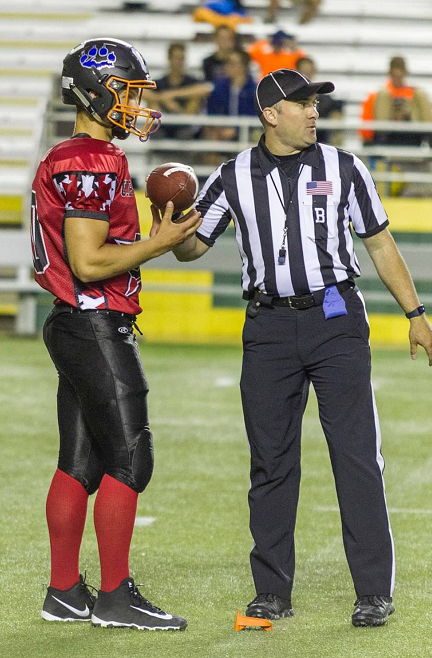 Some 400 miles north, Lt. Mark Giannunzio is also a familiar face in and on the field. The MSP Negaunee Post assistant post commander and Eighth District public information officer enforces the rules of the game as a high school and college football official, the latter for the Great Lakes Intercollegiate Athletic Conference.
“I started at the high school level to stay involved in athletics and make authentic connections in the community,” Giannunzio said. “It’s rewarding to help teach the game and share knowledge of the rules. I currently have a full 11-game schedule in the GLIAC Division II college conference, with high school games interspersed during the year.”
The correlation among coaching, officiating and policing translates.
“With my fellow troopers, I want to inspire, motivate and encourage to get the most out of them,” Gibbs said. “I take the same approach with my players to figure out what they need from me, as their designated leader, to be as successful as they can. In both capacities, I do the work alongside them. We do it together.”
This approach is especially important when tough times surface. Lieutenant Gibbs’ high school team experienced tragedy right before its first game when a player died in a car crash.
“We focused on adversity,” said Gibbs, who was in a unique position to talk from a police perspective too. “It’s a benefit to have that insight and background and share it with what they can control – make good decisions and wear your seatbelt.”
Lieutenant Gibbs incorporates his coworkers when he can, like during spring conditioning when fellow troopers join him and his players, helping all involved to make new connections and build strong bonds between the students and officers.
 “One of the most important attributes in both careers is communication,” Giannunzio said. “Communication can make or break an official and a police officer. Much like selling a citation to a motorist, I need to be able to sell the penalty in a calm and professional manner. Demeanor and attitude go together on both the football field and when we are out patrolling in the Blue Goose.”
Treating everyone with dignity and respect is something Lieutenants Gibbs and Giannunzio commit to as members of a modern police agency and in their areas of expertise on the football field.
“Both roles afford so many opportunities to develop culture and cultivate teamwork,” Gibbs said. “The best part is watching others flourish and playing a part in their growth.”
PHOTOS (Top) Michigan State Police Lt. Tedric Gibbs, left, serves as an assistant football coach for the Jackson High varsity. (Middle) Lt. Mark Giannunzio officiates at the high school and college levels. (Below) Gibbs also coaches at Jackson Parkside Middle School. (Photos provided by the Michigan State Police.)