


Rivaling for a Cause
January 25, 2013
It’s impossible to include all the perspective we gain from every “Battle of the Fans” visit.
But this anecdote, although it didn't make Tuesday’s story about our Frankenmuth trip, tells of another great example for what student cheering sections can accomplish.
Frankenmuth and Millington are heated rivals, to say the least, separated by 13 miles and made more competitive by plenty of championship-deciding matchups over the years.
But for their boys basketball game Jan. 10 at Frankenmuth, student section leaders from both schools almost completely on their own set up the game as a cancer awareness night, complete with Frankenmuth students in black shirts and Millington’s wearing pink.
The idea was the brainchild of a of Frankenmuth section leader, who then received help from a local bank and contacted Millington to get the ball rolling.
Battle of the Fans has shown us the obvious – these student sections need strong leaders – but also the special things they can accomplish with additional initiative.
“Never Forgotten”
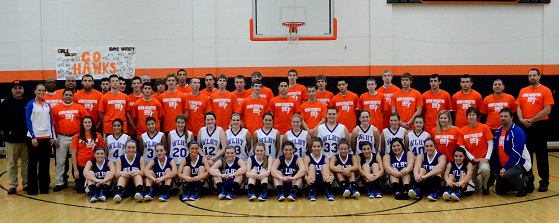 Two more rivals, Fennville and Saugatuck, met late last month for their second “Never Forgotten” boys and girls basketball games with proceeds going to the Wes Leonard Heart Team for the purchase of AEDs.
Players wore jerseys with names on the backs of friends and family members who had died, and those jerseys were then given to family members after the games. Officials Ace Cover, Chris Dennie and Kyle Bowen also donated their game checks to the Heart Team, as did the winner of that night’s 50-50 raffle.
Leonard died from sudden cardiac arrest after making the game-winning shot in a basketball game March 3, 2011. The two schools played their first “Never Forgotten” games last season.
More support for less specialization
I’m asked once a year at least about sport specialization – that is, athletes focusing on just one sport, often from an early age, and if it pays off some way down the road.
Most of my evidence to support my belief in the well-rounded athlete has been anecdotal, based on conversations with people at the high school and college levels over the years. But a British study published this fall in the Journal of Sport Sciences by University of Birmingham researchers provides some interesting empirical findings.
The study of 1,006 people from the United Kingdom showed that those who participated in three sports at ages 11, 13 and 15 were “significantly more likely to compete at a national rather than club standard” between ages 16-18 than those who had practiced only one sport.
In other words, the study found that those who played more sports at earlier ages played at a higher level during their high school-age years, which seems to contradict the one-sport focus philosophy.
Click for more perspective on the study from Chris Kennedy, the Superintendent of Schools in West Vancouver, British Columbia.
PHOTO: The boys and girls teams for Fennville and Saugatuck pose together after their "Never Forgotten" games Dec. 21 at Fennville High. (Photo courtesy of Al LaShell.)

Postseason, Playing Rules Modifications Taking Effect as Fall Practices Begin
By
Geoff Kimmerly
MHSAA.com senior editor
August 4, 2023
A series of changes, including adjustments to postseason qualification in multiple sports and several playing rules, will take effect Monday, Aug. 7, as more than 95,000 athletes statewide are anticipated to begin the Fall 2023 season across nine sports for which the Michigan High School Athletic Association sponsors postseason tournaments.
Teams in girls and boys cross country, football, Lower Peninsula girls golf, boys soccer, Lower Peninsula girls swimming & diving, Upper Peninsula girls tennis and Lower Peninsula boys tennis, and girls volleyball may begin practice Monday. Competition begins Aug. 14 for golf and tennis, Aug. 16 for cross country, soccer, swimming & diving and volleyball, and Aug. 24 for varsity football. Football teams at all levels must have 12 days of preseason practice – over a period of 16 calendar days – before their first game.
Qualification requirements for MHSAA Finals competition have been adjusted to provide more opportunities in two sports.
The Swimming & Diving Finals could enjoy larger fields this fall thanks to a change in the structuring of qualifying times. Moving forward, qualifying times will be determined based on the past five years of MHSAA race data, but also will account for past numbers of qualifiers in each swim race. This shift will allow for more athletes to advance to the Finals in events where fields have not been full over the previous five seasons.
In tennis, for the first time in Lower Peninsula play, a No. 1 doubles flight from a non-qualifying team will be able to advance from its Regional to Finals competition. To do so, that No. 1 doubles flight must finish first or second at its Regional, and the No. 1 singles player from that team also must have qualified for the Finals individually by finishing first or second in Regional play.
Also affecting MHSAA Tournament play, golfers now are required to participate in at least four competitions for the high school team prior to representing that school team in an MHSAA Regional or Final. Those four regular-season competitions may be 9 or 18-hole events.
A pair of significant changes have switched up the Finals schedules this fall in boys soccer and football. Instead of playing at multiple sites as in the past, all four Boys Soccer Finals will be played on the same day at the same site, Nov. 4 at Grand Ledge High School beginning with Division 4 and ending with Division 1.
The 11-Player Football Finals will start and finish a day later at Ford Field, concluding that sport’s season Saturday, Nov. 25 and Sunday, Nov. 26, instead of with the traditional Friday/Saturday schedule. This one-year adjustment is being made to accommodate the Michigan State/Penn State football game Friday, Nov. 24, at Ford Field.
Opportunities have been created as well beginning this fall for scheduling more out-of-state opponents in all sports, as teams are now able to play opponents from anywhere in the United States as long as those competitions are played in Michigan, contiguous states Illinois, Indiana, Ohio, Minnesota or Wisconsin, or Ontario. All out-of-state opponents must be members in good standing of their respective high school athletic association, and any multi-team event including schools from outside of Michigan or those contiguous states/province must receive approval by the MHSAA and each state high school association with a team involved in order for MHSAA member schools to be allowed to participate.
Rules changes will be literally visible in two sports as more flexibility will be allowed by new wardrobe exceptions in cross country and girls volleyball. In volleyball, small, secured studs or posts now may be worn above the chin. In cross country, athletes may now wear temporary body adornment (painted or fastened) during competition, and runners also may now wear any type of head attire during racing.
As is annually true, a series of playing rule changes also take effect with the new season. The following are among the most notable:
- The most significant in football changes how the ball is spotted after penalties by the offense that occur behind the line of scrimmage. Previously, those were marked from the spot of the foul; now those penalties will be marked from the previous spot – the line of scrimmage where that play began. This change was made to eliminate excessive penalties on the offense when an infraction took place well behind the line of scrimmage.
- In volleyball, teams will stay on the same bench for the duration of a match unless officials determine a clear disadvantage exists for the bench on one side of the court. In that case, teams will exchange sides of the court after each set.
- Another pair of changes affect where volleyball coaches may be positioned during matches. Coaches may stand in a new coaching zone, now defined by the libero replacement zone extending beyond the end line and sideline extended. During dead-ball situations, one assistant coach also may stand within the coaching zone to provide instruction; only one assistant coach can stand at a time, but the assistant coach who stands may change throughout the match.
- Two officiating-related changes will be especially noticeable on the soccer pitch. Officials now may stop the clock to check on an injured player without that player being required to leave the match – previously that player would have to sub out. Also, categories for fouls have been redefined: careless (which is a foul but does not receive a card), reckless (a foul with a yellow card) and excessive force (foul with red card).
- In swimming, stroke modifications were made in the backstroke and breaststroke events.
The 2023 Fall campaign culminates with postseason tournaments beginning with the Upper Peninsula Girls Tennis Finals during the week of Oct. 2 and wrapping up with the 11-Player Football Finals on Nov. 25 and 26. Here is a complete list of fall tournament dates:
Cross Country
U.P. Finals – Oct. 21
L.P. Regionals – Oct. 27 or 28
L.P. Finals – Nov. 4
11-Player Football
Selection Sunday – Oct. 22
Pre-Districts – Oct. 27 or 28
District Finals – Nov. 3 or 4
Regional Finals – Nov. 10 or 11
Semifinals – Nov. 18
Finals – Nov. 25-26
8-Player Football
Selection Sunday – Oct. 22
Regional Semifinals – Oct. 27 or 28
Regional Finals – Nov. 3 or 4
Semifinals – Nov. 11
Finals – Nov. 18
L.P. Girls Golf
Regionals – Oct. 9, 10, 11, 12, 13 or 14
Finals – Oct. 20-21
Soccer
L.P. Boys Districts – Oct. 11-21
L.P. Boys Regionals – Oct. 24-28
L.P. Boys Semifinals – Nov. 1
L.P. Boys Finals – Nov. 4
L.P. Girls Swimming & Diving
Diving Regionals – Nov. 9
Swimming/Diving Finals – Nov. 17-18
Tennis
U.P. Girls Finals – Oct. 4, 5, 6 or 7
L.P. Boys Regionals – Oct. 11, 12, 13 or 14
L.P. Boys Finals – Oct. 20-21
Girls Volleyball
Districts – Oct. 30-Nov. 4
Regionals – Nov. 7 & 9
Quarterfinals – Nov. 14
Semifinals – Nov. 16-17
Finals – Nov. 18
The MHSAA is a private, not-for-profit corporation of voluntary membership by more than 1,500 public and private senior high schools and junior high/middle schools which exists to develop common rules for athletic eligibility and competition. No government funds or tax dollars support the MHSAA, which was the first such association nationally to not accept membership dues or tournament entry fees from schools. Member schools which enforce these rules are permitted to participate in MHSAA tournaments, which attract more than 1.3 million spectators each year.