


Rivaling for a Cause
January 25, 2013
It’s impossible to include all the perspective we gain from every “Battle of the Fans” visit.
But this anecdote, although it didn't make Tuesday’s story about our Frankenmuth trip, tells of another great example for what student cheering sections can accomplish.
Frankenmuth and Millington are heated rivals, to say the least, separated by 13 miles and made more competitive by plenty of championship-deciding matchups over the years.
But for their boys basketball game Jan. 10 at Frankenmuth, student section leaders from both schools almost completely on their own set up the game as a cancer awareness night, complete with Frankenmuth students in black shirts and Millington’s wearing pink.
The idea was the brainchild of a of Frankenmuth section leader, who then received help from a local bank and contacted Millington to get the ball rolling.
Battle of the Fans has shown us the obvious – these student sections need strong leaders – but also the special things they can accomplish with additional initiative.
“Never Forgotten”
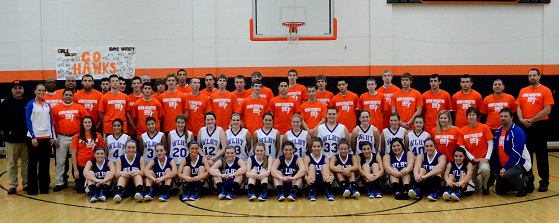 Two more rivals, Fennville and Saugatuck, met late last month for their second “Never Forgotten” boys and girls basketball games with proceeds going to the Wes Leonard Heart Team for the purchase of AEDs.
Players wore jerseys with names on the backs of friends and family members who had died, and those jerseys were then given to family members after the games. Officials Ace Cover, Chris Dennie and Kyle Bowen also donated their game checks to the Heart Team, as did the winner of that night’s 50-50 raffle.
Leonard died from sudden cardiac arrest after making the game-winning shot in a basketball game March 3, 2011. The two schools played their first “Never Forgotten” games last season.
More support for less specialization
I’m asked once a year at least about sport specialization – that is, athletes focusing on just one sport, often from an early age, and if it pays off some way down the road.
Most of my evidence to support my belief in the well-rounded athlete has been anecdotal, based on conversations with people at the high school and college levels over the years. But a British study published this fall in the Journal of Sport Sciences by University of Birmingham researchers provides some interesting empirical findings.
The study of 1,006 people from the United Kingdom showed that those who participated in three sports at ages 11, 13 and 15 were “significantly more likely to compete at a national rather than club standard” between ages 16-18 than those who had practiced only one sport.
In other words, the study found that those who played more sports at earlier ages played at a higher level during their high school-age years, which seems to contradict the one-sport focus philosophy.
Click for more perspective on the study from Chris Kennedy, the Superintendent of Schools in West Vancouver, British Columbia.
PHOTO: The boys and girls teams for Fennville and Saugatuck pose together after their "Never Forgotten" games Dec. 21 at Fennville High. (Photo courtesy of Al LaShell.)

Is My Student Athlete's Pain More Than Just Growing Pains?
February 14, 2023
There are a few factors that can make student athletes prone to injury. They might be overusing their muscles (thanks to a more rigorous exercise regimen), and they might not yet have developed the proper technique for their sport.
 “These factors, combined with the fact that student athletes have growing bodies that they’re still getting used to—especially after a growth spurt — can make them more prone to injury,” says Nancy White, M.D., a sports medicine physician with Henry Ford Health System.
However, just because your child is feeling pain doesn’t necessarily mean they’ve sustained an injury. There is such a thing as growing pains, although the term may be misleading. “Most experts feel that growth itself does not cause pain,” says Dr. White. “The most likely reason for ‘growing pains’ is overuse of the muscles, causing pain and soreness after an activity.”
These growing pains typically occur at the front of the thighs, the back of the knees and the calves, she says, and occur commonly in the late afternoon, evening, or night. If your child is experiencing pain outside of these areas or times of day, it might not be growing pains — and it’s a good idea to get it checked out by a doctor.
Tell-Tale Signs That Pain Should Be Examined
If the pain goes away by the next day — if your child has rested during night and feels better the next morning — there’s no need for concern. But you should head to the doctor if:
► the pain is lingering into the next day.
► the pain is also accompanied by bruising, swelling or redness.
► the pain is so intense that they’re unable to put weight on their legs.
“In these cases, don’t wait — the longer you wait, the more dangerous the injury can become,” says Dr. White.
How Student Athletes Can Help Prevent Injuries
Encourage your child to take proper precautions and maintain healthy habits, all of which can lower the likelihood that they’ll sustain an injury. Dr. White recommends the following tips:
- Maintain proper technique. “Knowing and understanding the movements needed for whatever sport they practice is so important,” says Dr. White. “Figure skating and gymnastics are two sports where I tend to see injuries more often during growth phases. These athletes are often learning difficult skills at a time in their lives when they’re going through a growth spurt, and that combination can lead to injury.”
- Stretch before and after playing a sport. “Try dynamic stretching — where you’re actually moving while stretching — instead of static stretching, where you’re holding the stretch,” says Dr. White. “Dynamic stretching is a great warm up. It can help improve flexibility and reduce the risk of injury.”
- Strength train, especially in the core and limbs. Doing so will help create stable, strong muscles to keep the body properly aligned and lessen the chances of injury.
- Eat a balanced diet and stay hydrated. While it’s normal for kids to have sugar every once in a while, filling the bulk of their diet with plenty of water, fresh fruits and vegetables, healthy protein, fats and carbohydrates will help them function to their best ability.
- Get enough rest each night. Sleep is necessary for health and well-being in general, but when it comes to athletes, rest is incredibly important to help their bodies recuperate. In general, kids need about 10 hours of sleep per night. So if your child plays a sport, you want to really be sure that they’re hitting that 10-hour mark, says Dr. White.
Dr. Nancy White is a sports medicine physician with Henry Ford Health System. She sees patients at Henry Ford Medical Center – Columbus in Novi, and Henry Ford Medical Center — Bloomfield Township.
Want to learn more? Henry Ford Health System sports medicine experts are treating the whole athlete, in a whole new way. From nutrition to neurology, and from injury prevention to treatment of sports-related conditions, they can give your athlete a unique game plan. To find a sports medicine physician at Henry Ford, visit henryford.com or call 1-800-436-7936.