

Rivaling for a Cause
January 25, 2013
It’s impossible to include all the perspective we gain from every “Battle of the Fans” visit.
But this anecdote, although it didn't make Tuesday’s story about our Frankenmuth trip, tells of another great example for what student cheering sections can accomplish.
Frankenmuth and Millington are heated rivals, to say the least, separated by 13 miles and made more competitive by plenty of championship-deciding matchups over the years.
But for their boys basketball game Jan. 10 at Frankenmuth, student section leaders from both schools almost completely on their own set up the game as a cancer awareness night, complete with Frankenmuth students in black shirts and Millington’s wearing pink.
The idea was the brainchild of a of Frankenmuth section leader, who then received help from a local bank and contacted Millington to get the ball rolling.
Battle of the Fans has shown us the obvious – these student sections need strong leaders – but also the special things they can accomplish with additional initiative.
“Never Forgotten”
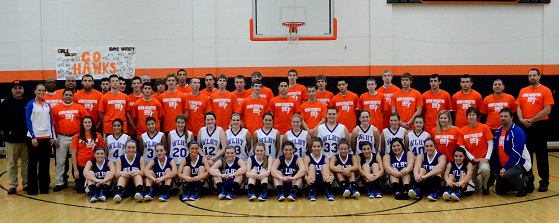 Two more rivals, Fennville and Saugatuck, met late last month for their second “Never Forgotten” boys and girls basketball games with proceeds going to the Wes Leonard Heart Team for the purchase of AEDs.
Players wore jerseys with names on the backs of friends and family members who had died, and those jerseys were then given to family members after the games. Officials Ace Cover, Chris Dennie and Kyle Bowen also donated their game checks to the Heart Team, as did the winner of that night’s 50-50 raffle.
Leonard died from sudden cardiac arrest after making the game-winning shot in a basketball game March 3, 2011. The two schools played their first “Never Forgotten” games last season.
More support for less specialization
I’m asked once a year at least about sport specialization – that is, athletes focusing on just one sport, often from an early age, and if it pays off some way down the road.
Most of my evidence to support my belief in the well-rounded athlete has been anecdotal, based on conversations with people at the high school and college levels over the years. But a British study published this fall in the Journal of Sport Sciences by University of Birmingham researchers provides some interesting empirical findings.
The study of 1,006 people from the United Kingdom showed that those who participated in three sports at ages 11, 13 and 15 were “significantly more likely to compete at a national rather than club standard” between ages 16-18 than those who had practiced only one sport.
In other words, the study found that those who played more sports at earlier ages played at a higher level during their high school-age years, which seems to contradict the one-sport focus philosophy.
Click for more perspective on the study from Chris Kennedy, the Superintendent of Schools in West Vancouver, British Columbia.
PHOTO: The boys and girls teams for Fennville and Saugatuck pose together after their "Never Forgotten" games Dec. 21 at Fennville High. (Photo courtesy of Al LaShell.)
Gaylord's Looker Shows 'Different Type of Tough' in Return from Knee Tear
By
Tom Spencer
Special for MHSAA.com
February 3, 2023
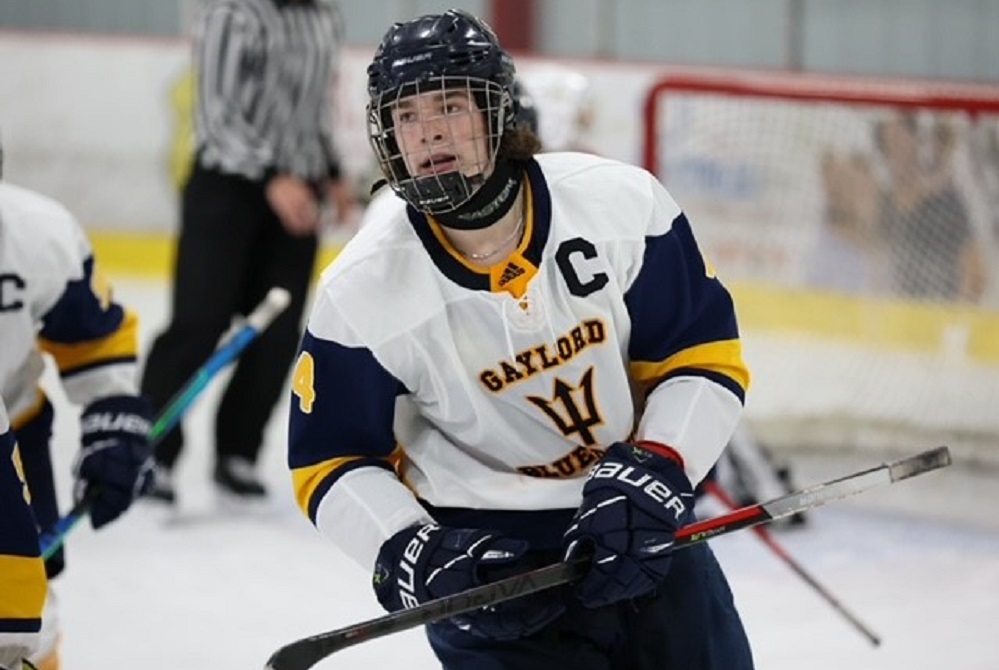
When Gage Looker went down with an ACL injury in Gaylord’s first football game this fall, Liz Harding – president of the Blue Devils’ hockey boosters – was absolutely devastated.
 Looker, an all-conference hockey defenseman last winter, was playing, as a senior, in his first-ever varsity football game. Harding, also Looker’s mom, was there.
“I caught the one and only picture of him playing football just before he injured himself,” Harding recalled. “I was devastated!”
Doctors indicated surgery was necessary and recovery would prevent Looker from getting back on the ice, the football field and the track where Looker had dreams of great success this year.
“Knowing hockey is his passion — and thoughts of him not playing did not set well with me — Gage started what I would call standard physical therapy a couple days after surgery and then added an additional blood flow therapy with our local trainer to his weekly routine,” Harding said. “Through his hard work and determination, he is back on the ice.”
The Blue Devils, after graduating their other four all-conference players from last winter, were 2-11 this year when Looker returned to the ice against Big North Conference rival Petoskey. Gaylord has won three of seven since.
Gaylord coach Jamie Voss believes Looker’s return was pretty much a miracle. And he thinks Looker is playing at about 80 percent despite being only a few months removed from the injury.
“Gage tore his ACL and was told by doctors his sports life was over,” Voss said. “Gage would not accept this, and he trained harder than any kid I have ever witnessed to prove the doctors wrong.”
Sans injury, Voss notes Looker was certain to graduate on several all-time Gaylord hockey record lists.
“The reports on his progress and rehab were literally off the charts for this type of injury,” Voss said. “His doctors reported early that they have never seen this occur before regarding the strength developments in the afflicted areas that support his ACL tear.”
Voss admitted he had to hold his breath a little – as many Gaylord supporters did – when Looker joined the starting lineup against Petoskey. That moment came after just a week on the ice, including full contact practices.
 “More important than records to Gage was his commitment and obligation to be our team leader as our compete level was predictably down this season,” Voss said. “Gage is one of the best athletes and citizens that I have ever been allowed to coach.
“He is not only a leader to the players on and off the ice, but Gage also is the kind of kid that coaches learn from,” Voss went on. “He is mature beyond his years.”
Looker, who started playing hockey at 4 years old, dabbled with football as a freshman although an eighth-grade hip injury kept him away from the field until this fall. Looker’s size – 6-foot-3, 245 pounds – led to many encouragements to give football another try.
“I went the rest of my high school career being told that I needed to play football,” Looker said. “So I said ‘why not’ my senior year because I could use the extra strength for hockey.”
Looker knew the morning after his one-and-only career football game that he needed medical attention promptly. A quick MRI showed extensive damage.
Looker was told he literally “blew apart” his ACL.
“My stomach dropped,” Looker said. “I was not ready for that at all.
“I was shown what my PCL looked like and then went to where my ACL should be, and it was gone — some say it was deleted,” Looker continued. “I was told I will not be able to play sports for about seven to nine months, and I was speechless.”
Two months after surgery and extensive physical therapy, Looker tried to skate. It went so well he began to entertain thoughts of playing hockey again. He may aspire to compete in track & field this spring.
“He runs a 56-second quarter mile and throws the shot put 48 feet, 10 inches,” Voss said of his dominating defender. “And although he is restricted from running, something tells me this kid will run track this spring.”
While it is not the senior hockey season it could have been without the injury, many are glad to just have Looker on the ice. His mom is among them.
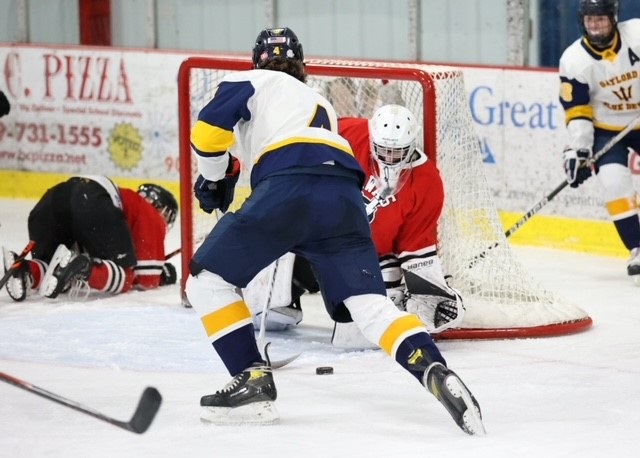 “I am overjoyed to have him back on the ice,” Harding said. “At least he is getting in a few games and is out there making a difference.
“The smile on his face is priceless,” she continued. “Perhaps he'll continue with track as he is set to break records there too.”
Rehab fresh out of surgery was “very boring,” so Looker started intensifying his recovery with therapy four days a week for a few months.
“It was a lot of commitment, but I needed my senior year of hockey,” Looker said. “I was doing the basic things, and then I had a machine that could stimulate my muscles and pump blood to my knee.
“It is called ARPneuro,” he continued. “I was skating with that on my leg as well as doing mini workouts at home.”
ARP — accelerated, recovery and performance — reportedly accelerates recovery time by decreasing chronic pain and increasing range of motion without the use of medications.
“I was always putting as much work in as I could,” Looker said. “It definitely paid off in the end.”
Looker’s coach agrees.
“I have never heard of this, nor witnessed it,” Voss said. “Gage Looker is an anomaly, and in my opinion a different type of tough.
“Gage returned to practice full contact three months after he tore his ACL,” Voss continued. “And he played his first hockey game logging 30 of 51 minutes a week later.”
Looker credits the support and effort of his medical team and his teammates for helping him get back on track. However, no one gets more credit that the booster president.
“My mom and teammates helped me through it,” he said. “My mom was always on me about doing my workouts and keeping me disciplined.”
 Tom Spencer is a longtime MHSAA-registered basketball and soccer official, and former softball and baseball official, and he also has coached in the northern Lower Peninsula area. He previously has written for the Saginaw News, Bay County Sports Page and Midland Daily News. He can be reached at [email protected] with story ideas for Manistee, Wexford, Missaukee, Roscommon, Ogemaw, Iosco, Alcona, Oscoda, Crawford, Kalkaska, Grand Traverse, Benzie, Leelanau, Antrim, Otsego, Montmorency, Alpena, Presque Isle, Cheboygan, Charlevoix and Emmet counties.
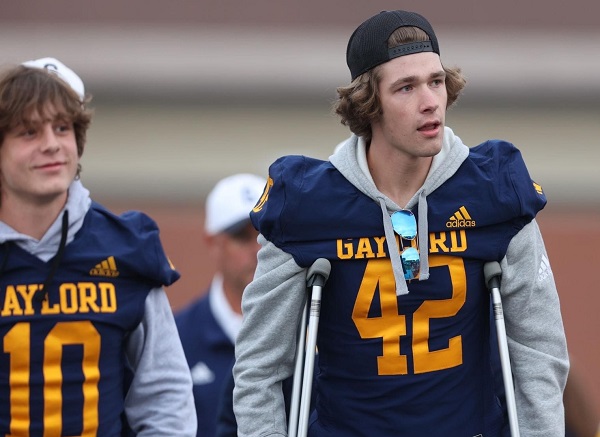
PHOTOS (Top) Gaylord’s Gage Looker has returned to the ice this season only a few months after a serious knee injury. (Middle) Looker, right, watches his football teammates from the sideline this fall. (Below) Looker tries to stuff the puck past Tawas’ goaltender. (Photos by Rob DeForge/RD Sports Photo.)