


Rivaling for a Cause
January 25, 2013
It’s impossible to include all the perspective we gain from every “Battle of the Fans” visit.
But this anecdote, although it didn't make Tuesday’s story about our Frankenmuth trip, tells of another great example for what student cheering sections can accomplish.
Frankenmuth and Millington are heated rivals, to say the least, separated by 13 miles and made more competitive by plenty of championship-deciding matchups over the years.
But for their boys basketball game Jan. 10 at Frankenmuth, student section leaders from both schools almost completely on their own set up the game as a cancer awareness night, complete with Frankenmuth students in black shirts and Millington’s wearing pink.
The idea was the brainchild of a of Frankenmuth section leader, who then received help from a local bank and contacted Millington to get the ball rolling.
Battle of the Fans has shown us the obvious – these student sections need strong leaders – but also the special things they can accomplish with additional initiative.
“Never Forgotten”
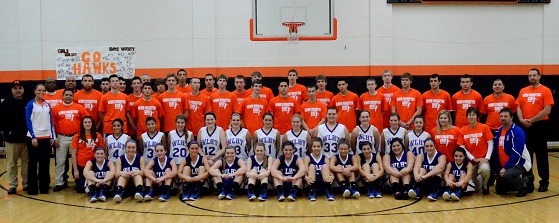 Two more rivals, Fennville and Saugatuck, met late last month for their second “Never Forgotten” boys and girls basketball games with proceeds going to the Wes Leonard Heart Team for the purchase of AEDs.
Players wore jerseys with names on the backs of friends and family members who had died, and those jerseys were then given to family members after the games. Officials Ace Cover, Chris Dennie and Kyle Bowen also donated their game checks to the Heart Team, as did the winner of that night’s 50-50 raffle.
Leonard died from sudden cardiac arrest after making the game-winning shot in a basketball game March 3, 2011. The two schools played their first “Never Forgotten” games last season.
More support for less specialization
I’m asked once a year at least about sport specialization – that is, athletes focusing on just one sport, often from an early age, and if it pays off some way down the road.
Most of my evidence to support my belief in the well-rounded athlete has been anecdotal, based on conversations with people at the high school and college levels over the years. But a British study published this fall in the Journal of Sport Sciences by University of Birmingham researchers provides some interesting empirical findings.
The study of 1,006 people from the United Kingdom showed that those who participated in three sports at ages 11, 13 and 15 were “significantly more likely to compete at a national rather than club standard” between ages 16-18 than those who had practiced only one sport.
In other words, the study found that those who played more sports at earlier ages played at a higher level during their high school-age years, which seems to contradict the one-sport focus philosophy.
Click for more perspective on the study from Chris Kennedy, the Superintendent of Schools in West Vancouver, British Columbia.
PHOTO: The boys and girls teams for Fennville and Saugatuck pose together after their "Never Forgotten" games Dec. 21 at Fennville High. (Photo courtesy of Al LaShell.)

Snap, Crackle & Pop: Why Do My Knees Make Noises - And Should I See a Doctor?
April 5, 2022

Do you ever just go about your daily life and then, seemingly out of nowhere, your knee makes a noise?
You might call it a weird idiosyncrasy and not think twice about it—or you might turn to the Internet to try and find all of the potential issues that might be wrong with your knee.
But if your knee pops or cracks once in a while, it’s usually no cause for concern. After all, joints sometimes make noises, and knees are no exception (especially when you squat or sit down.)
“Infrequent knee pops and cracks are more common in the younger population, says Nancy White, M.D., a sports medicine physician at Henry Ford Health. “When you feel that ‘pop,’ it means your kneecap was pulled a bit outside of where it’s supposed to be, and so it’s correcting itself and getting back into position. You can kind of feel that something moved.”
If, however, pain or swelling accompanies a noisy knee, you should have it evaluated by a sports medicine provider. And if your knee is popping or cracking regularly, that's another sign you should have it checked out.
“If you let it go, your knee could get worse,” says Dr. White. “There are recommendations a doctor can make to prevent this from happening, such as strengthening and flexibility exercises.”
What Is Knee Crepitus?
If your knee sounds like Rice Krispies crackling (or you experience a grinding sensation) it likely means you have knee crepitus, which can signify the beginning of osteoarthritis behind the kneecap.
“Knee crepitus is primarily caused by an issue called patellofemoral dysfunction,” says Dr. White. That sounds like a mouthful, but it means that your knee isn’t tracking straight up and down like it’s supposed to.
“There’s cartilage on the back of your kneecap and on the front part of your thigh, and the cartilage on the front part of your thighbone makes a groove so the kneecap can glide straight up and down in a floating position,” says Dr. White. “If the cartilage is worn down (and inflamed, worn-down cartilage signifies osteoarthritis), the kneecap can’t smoothly glide up and down, causing knee crepitus.”
If you are experiencing knee crepitus, you should see a sports medicine primary care physician, especially if it is accompanied by pain. They can recommend a variety of treatments, such as physical therapy and cortisone injections.
Still not sure if your noisy knees are cause for concern? When in doubt, call your doctor. After all, the sooner your doctor can examine it, the sooner you can prevent an issue from getting worse.
To learn more about your orthopedic condition or to find a provider, visit henryford.com/ortho.
Dr. Nancy White is a sports medicine physician with Henry Ford Health. She sees patients at Henry Ford Medical Center – Novi, and Henry Ford Medical Center – Bloomfield Township.