


Rivaling for a Cause
January 25, 2013
It’s impossible to include all the perspective we gain from every “Battle of the Fans” visit.
But this anecdote, although it didn't make Tuesday’s story about our Frankenmuth trip, tells of another great example for what student cheering sections can accomplish.
Frankenmuth and Millington are heated rivals, to say the least, separated by 13 miles and made more competitive by plenty of championship-deciding matchups over the years.
But for their boys basketball game Jan. 10 at Frankenmuth, student section leaders from both schools almost completely on their own set up the game as a cancer awareness night, complete with Frankenmuth students in black shirts and Millington’s wearing pink.
The idea was the brainchild of a of Frankenmuth section leader, who then received help from a local bank and contacted Millington to get the ball rolling.
Battle of the Fans has shown us the obvious – these student sections need strong leaders – but also the special things they can accomplish with additional initiative.
“Never Forgotten”
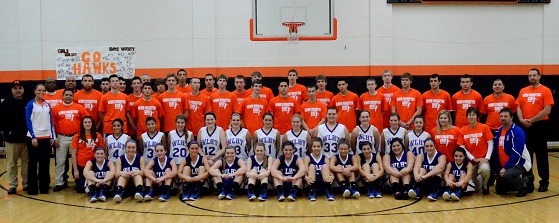 Two more rivals, Fennville and Saugatuck, met late last month for their second “Never Forgotten” boys and girls basketball games with proceeds going to the Wes Leonard Heart Team for the purchase of AEDs.
Players wore jerseys with names on the backs of friends and family members who had died, and those jerseys were then given to family members after the games. Officials Ace Cover, Chris Dennie and Kyle Bowen also donated their game checks to the Heart Team, as did the winner of that night’s 50-50 raffle.
Leonard died from sudden cardiac arrest after making the game-winning shot in a basketball game March 3, 2011. The two schools played their first “Never Forgotten” games last season.
More support for less specialization
I’m asked once a year at least about sport specialization – that is, athletes focusing on just one sport, often from an early age, and if it pays off some way down the road.
Most of my evidence to support my belief in the well-rounded athlete has been anecdotal, based on conversations with people at the high school and college levels over the years. But a British study published this fall in the Journal of Sport Sciences by University of Birmingham researchers provides some interesting empirical findings.
The study of 1,006 people from the United Kingdom showed that those who participated in three sports at ages 11, 13 and 15 were “significantly more likely to compete at a national rather than club standard” between ages 16-18 than those who had practiced only one sport.
In other words, the study found that those who played more sports at earlier ages played at a higher level during their high school-age years, which seems to contradict the one-sport focus philosophy.
Click for more perspective on the study from Chris Kennedy, the Superintendent of Schools in West Vancouver, British Columbia.
PHOTO: The boys and girls teams for Fennville and Saugatuck pose together after their "Never Forgotten" games Dec. 21 at Fennville High. (Photo courtesy of Al LaShell.)

NFHS Voice: Regardless of Future Direction, Multiple Sports/Activities is Best Choice
By
Karissa Niehoff
NFHS Executive Director
May 7, 2021
The values of participating in high school activities – sports, speech and debate, music, theatre and other programs – are well-documented.
A majority of the 12 million-plus participants in education-based activities have higher grade-point averages, are more disciplined and self-confident. In addition, research indicates that participation in high school activities is often a predictor of later success – in college, a career and becoming a contributing member of society.
This past year, the importance of these activities was demonstrated further through the consequences that occurred when these programs suddenly were unavailable.
The social, emotional and mental health of students was affected. When sports and activities no longer were available, many students self-reported symptoms of depression and anxiety. With less physical activity and no involvement in these programs, there were state-reported higher incidences of youth suicide. The research is sobering, and the link between participation in activities and overall health has arguably never been so clear.
So, there is a hope that the expected return to full programming this fall will begin the healing process.
And, if the opportunity to play one sport or activity is a positive step, the chance for involvement in multiple sports or activities throughout the entire school year has untold benefits – for the majority of students who are involved in high school activities to compete with their friends for fun, as well as those who are hoping to play sports at higher levels.
For many students, the experience of playing on a high school team may be the most positive aspect of their lives, and the high school coach or director of a speech or music group may be the most positive role model they have.
So, the return of these activities in schools nationwide is crucial. These programs provide a welcoming place and a means for support, guidance and direction. And when one sport or activity season ends, students should be encouraged to become involved in another activity the next season. Students can also enjoy multiple activities concurrently, such as participating on a sports team while also belonging to a performing arts group.
In a recent article in High School Today magazine, counselors at a school in Delaware reported that the most successful students applying to college and for scholarships are those involved in multiple sports, band, debate and other activities.
In some cases, the opportunity to participate in activities is the chief motivator to attend classes, graduate from high school, obtain a job and begin a career. Playing multiple sports and/or being a part of multiple arts and activities keeps students engaged throughout the school year.
Playing multiple sports is also the best direction for the 3 to 5 percent of high school athletes who will play at the college level. Many parents believe for their son or daughter to earn a college scholarship, they have to specialize in one sport year-round. This is simply not true.
As opposed to playing one sport year-round, playing multiple sports often affords student-athletes a better chance of landing a college athletic scholarship or, for the most elite athletes, having their name called in the NFL or NBA draft.
Consider this year’s NFL draft. Of the 32 first-round draft picks, 27 played one additional sport other than football in high school, and 10 of the 32 played two other sports. Amazingly, one individual – Jaelan Phillips – played five sports (football, basketball, baseball, volleyball and track & field) at Redlands (California) High School.
The list of high-profile professional athletes who played multiple sports in high school rather than focusing on one sport year-round includes the likes of Patrick Mahomes, Tom Brady, Aaron Rodgers, Joe Mauer, Bo Jackson, Alex Rodriguez and John Elway among numerous others.
The advantages of playing multiple sports rather than specializing in one sport are numerous. Students who play multiple sports have a reduced risk of overuse injuries, are able to learn from multiple coaches, participate in cross-training which leads to better athleticism, have better mental development and teamwork skills, and have a reduced chance of burnout in sports.
A number of successful business men and women were highly involved in high school and college sports or performing arts as well. Meg Whitman, CEO of Hewlett-Packard, was the captain of her swimming team and also played lacrosse, tennis and basketball. Former Whole Foods CEO Walter Robb was the captain of the Stanford soccer team. Bank of America CEO Brian Moynihan played rugby at Brown University.
Whether the goal is to participate in high school sports and activities to have fun with their peers, or to achieve a college athletic scholarship, or to be a lifelong participant, the best route to achieving a successful, healthy balance in life is to participate in multiple sports and other activities.
Dr. Karissa L. Niehoff is in her third year as executive director of the National Federation of State High School Associations (NFHS) in Indianapolis, Indiana. She is the first female to head the national leadership organization for high school athletics and performing arts activities and the sixth full-time executive director of the NFHS, which celebrated its 100th year of service during the 2018-19 school year. She previously was executive director of the Connecticut Association of Schools-Connecticut Interscholastic Athletic Conference for seven years.