


Rivaling for a Cause
January 25, 2013
It’s impossible to include all the perspective we gain from every “Battle of the Fans” visit.
But this anecdote, although it didn't make Tuesday’s story about our Frankenmuth trip, tells of another great example for what student cheering sections can accomplish.
Frankenmuth and Millington are heated rivals, to say the least, separated by 13 miles and made more competitive by plenty of championship-deciding matchups over the years.
But for their boys basketball game Jan. 10 at Frankenmuth, student section leaders from both schools almost completely on their own set up the game as a cancer awareness night, complete with Frankenmuth students in black shirts and Millington’s wearing pink.
The idea was the brainchild of a of Frankenmuth section leader, who then received help from a local bank and contacted Millington to get the ball rolling.
Battle of the Fans has shown us the obvious – these student sections need strong leaders – but also the special things they can accomplish with additional initiative.
“Never Forgotten”
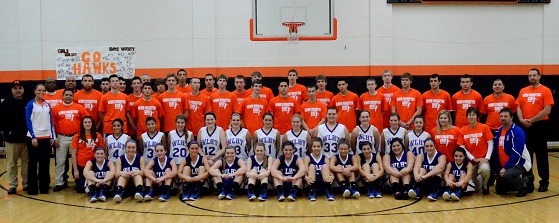 Two more rivals, Fennville and Saugatuck, met late last month for their second “Never Forgotten” boys and girls basketball games with proceeds going to the Wes Leonard Heart Team for the purchase of AEDs.
Players wore jerseys with names on the backs of friends and family members who had died, and those jerseys were then given to family members after the games. Officials Ace Cover, Chris Dennie and Kyle Bowen also donated their game checks to the Heart Team, as did the winner of that night’s 50-50 raffle.
Leonard died from sudden cardiac arrest after making the game-winning shot in a basketball game March 3, 2011. The two schools played their first “Never Forgotten” games last season.
More support for less specialization
I’m asked once a year at least about sport specialization – that is, athletes focusing on just one sport, often from an early age, and if it pays off some way down the road.
Most of my evidence to support my belief in the well-rounded athlete has been anecdotal, based on conversations with people at the high school and college levels over the years. But a British study published this fall in the Journal of Sport Sciences by University of Birmingham researchers provides some interesting empirical findings.
The study of 1,006 people from the United Kingdom showed that those who participated in three sports at ages 11, 13 and 15 were “significantly more likely to compete at a national rather than club standard” between ages 16-18 than those who had practiced only one sport.
In other words, the study found that those who played more sports at earlier ages played at a higher level during their high school-age years, which seems to contradict the one-sport focus philosophy.
Click for more perspective on the study from Chris Kennedy, the Superintendent of Schools in West Vancouver, British Columbia.
PHOTO: The boys and girls teams for Fennville and Saugatuck pose together after their "Never Forgotten" games Dec. 21 at Fennville High. (Photo courtesy of Al LaShell.)
Council Approves Winter Start, Guidance
October 23, 2020
By Geoff Kimmerly
Second Half editor
The Representative Council of the Michigan High School Athletic Association confirmed during its meeting Thursday (Oct. 22) that 2020-21 Winter sports will begin on time, and also approved a series of guidelines for those sports that schools must follow as they continue to work toward limiting the spread of COVID-19 while still providing opportunities for athletes to compete.
Most high school sports traditionally begin practice during the first three weeks of November, with competition starting during mid-November and the first weeks of December. The starts of middle school Winter sports seasons are determined by local leagues and conferences; many are slated to begin during the next few weeks.
Sport-specific guidelines for all Winter sports will be posted early next week to their respective sport pages on the MHSAA Website. A number of precautions have been put in place addressing competition limits, numbers of spectators allowed and wearing of face coverings, among a variety of topics. The guidance also specifically addresses equipment and facilities for each sport.
“The Council believes it is safer to begin Winter practices on time, and keep athletes in school programs where safety precautions are always in effect,” MHSAA Executive Director Mark Uyl said. “With the vastly different circumstances faced by schools in different regions all over the state, an on-time start still allows schools to decide when they feel most comfortable beginning activity – and allows all of them to slowly ramp up their frequency of activity and numbers of spectators attending competitions.
“But let’s be clear: Our statewide COVID-19 numbers have to get better. In order for our schools to continue playing sports this winter, and in order for fans to be there to cheer them on, we must continue working to slow down this virus.”
As with Fall sports, scrimmages will not be allowed for Winter sports to limit mixing of communities outside of official competitions. The numbers of teams at regular-season competitions also will be limited, like during Fall, with a maximum of four schools/teams allowed in competitive cheer, gymnastics, swimming & diving and wrestling. Bowling and skiing competitions will be restricted to a maximum of 72 competitors at one event.
There are no school/team limits for basketball and ice hockey, as only two teams are able to play each other at one time and those sports may play only one game per day – with fans leaving after their game is complete. Host sites must strictly enforce spectator capacity limits on a game-by-game basis. The Council approved as part of these guidelines an allowance of two spectators per participant at all contests to begin the regular season. This guideline could be reconsidered by the Council later in the winter season, with a possibility of allowing more spectators later while still staying within possible Emergency Orders from the Michigan Department of Health and Human Services (MDHHS).
As per MDHHS requirements, face coverings must be worn by athletes practicing and competing in basketball, competitive cheer, ice hockey and wrestling. They are not required for athletes practicing and competing in bowling, gymnastics, skiing and swimming & diving, which all allow for appropriate social distancing – but face coverings are required for those athletes when not involved in active participation.