


Rivaling for a Cause
January 25, 2013
It’s impossible to include all the perspective we gain from every “Battle of the Fans” visit.
But this anecdote, although it didn't make Tuesday’s story about our Frankenmuth trip, tells of another great example for what student cheering sections can accomplish.
Frankenmuth and Millington are heated rivals, to say the least, separated by 13 miles and made more competitive by plenty of championship-deciding matchups over the years.
But for their boys basketball game Jan. 10 at Frankenmuth, student section leaders from both schools almost completely on their own set up the game as a cancer awareness night, complete with Frankenmuth students in black shirts and Millington’s wearing pink.
The idea was the brainchild of a of Frankenmuth section leader, who then received help from a local bank and contacted Millington to get the ball rolling.
Battle of the Fans has shown us the obvious – these student sections need strong leaders – but also the special things they can accomplish with additional initiative.
“Never Forgotten”
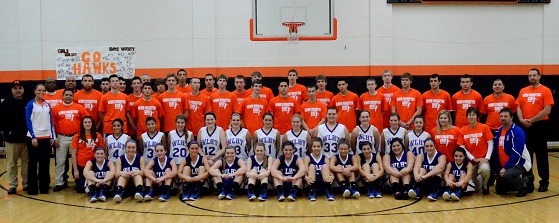 Two more rivals, Fennville and Saugatuck, met late last month for their second “Never Forgotten” boys and girls basketball games with proceeds going to the Wes Leonard Heart Team for the purchase of AEDs.
Players wore jerseys with names on the backs of friends and family members who had died, and those jerseys were then given to family members after the games. Officials Ace Cover, Chris Dennie and Kyle Bowen also donated their game checks to the Heart Team, as did the winner of that night’s 50-50 raffle.
Leonard died from sudden cardiac arrest after making the game-winning shot in a basketball game March 3, 2011. The two schools played their first “Never Forgotten” games last season.
More support for less specialization
I’m asked once a year at least about sport specialization – that is, athletes focusing on just one sport, often from an early age, and if it pays off some way down the road.
Most of my evidence to support my belief in the well-rounded athlete has been anecdotal, based on conversations with people at the high school and college levels over the years. But a British study published this fall in the Journal of Sport Sciences by University of Birmingham researchers provides some interesting empirical findings.
The study of 1,006 people from the United Kingdom showed that those who participated in three sports at ages 11, 13 and 15 were “significantly more likely to compete at a national rather than club standard” between ages 16-18 than those who had practiced only one sport.
In other words, the study found that those who played more sports at earlier ages played at a higher level during their high school-age years, which seems to contradict the one-sport focus philosophy.
Click for more perspective on the study from Chris Kennedy, the Superintendent of Schools in West Vancouver, British Columbia.
PHOTO: The boys and girls teams for Fennville and Saugatuck pose together after their "Never Forgotten" games Dec. 21 at Fennville High. (Photo courtesy of Al LaShell.)

NFHS Voice: Participants Show Resilience
September 28, 2020
By Karissa Niehoff
NFHS Executive Director
The resiliency of players, coaches and leaders in high school activity programs the past seven months has been amazing. As attempts continue to offer all sports and performing arts this year, these individuals are making the most of tough times and demonstrating great resolve to change.
No doubt, high school juniors and seniors involved in high school sports and performing arts would have preferred a less turbulent end to their high school days, but many have been willing to go to great lengths to have an opportunity to participate.
In Michigan, when football was initially moved to the spring, student-athletes had two choices: be upset that their sport was postponed or seize the moment and look for new opportunities. Royce Daugherty of Watervliet High School chose the latter.
A 6-foot-3, 300-pound two-way starter last year as a freshman on the Watervliet football team, Daugherty opted to join the cross country team! He said he decided to run cross country because it would help him get tougher mentally and physically.
Daugherty’s decision was perhaps predictable given that he played four sports – football, wrestling, basketball and baseball – as a freshman. Although the switch was short-lived with Michigan reinstating football a couple of weeks ago, Daugherty’s resilience is remarkable and a good predictor of future success.
In Colorado, with football on hold this fall, members of the Limon High School two-time defending Class 1A state football championship team petitioned the school administration to resurrect the golf program.
“Sports are our lifeline,” said Andy Love, the school’s baseball coach who agreed to coach the golf team, in an article posted on CHSAANow. “Our community follows our sports so strongly. It gives our kids this great atmosphere and environment whether it’s the football field, the basketball court or whatever. Our community rallies around our kids.”
Turning a problem into an opportunity, the Limon High School football players and staff demonstrated the never-give-up spirit of high school activities.
In Kansas, with the heading of “the show must go on,” the Goodland High School athletic director and superintendent stepped in to coach the football team a few weeks ago because the head coach and assistant coach were quarantined during the week. The result? Goodland, a Class 3A school, defeated Liberal High School, a Class 5A school!
Coaches have demonstrated resiliency as well by finding new ways to conduct competition and keep students engaged. In Minnesota, at a swimming meet between Chaska High School and Bloomington Kennedy High School, Chaska swimmers occupied lanes 1 to 4, while Kennedy swimmers were in lanes 5 to 8 for social distancing purposes.
In the same state, the South Suburban Conference decided to conduct virtual swim meets this fall. Each team competes in 11 races in their own pool, and the coaches compare times to determine scoring. Two methods in the same state, both done to keep students engaged but to minimize risks of the virus.
On the performing arts side, teachers and leaders have benefited from an aerosol study conducted by the NFHS and more than 125 other organizations to determine best practices. In some cases, band and other music programs were moved to the spring, but leaders continued to engage with students in many innovative ways.
Larry Friend, assistant principal of Caesar Rodney High School in Camden, Delaware, in a Dover Post article, told his students, “This is not the time to put the instruments aside. This is not the time to stop singing. This is not the time to run away from your passion. This is an opportunity to run toward your passion and to find what it is that motivates you to reconnect.”
Band directors in Michigan – like those in many other states – are finding new ways to keep music going during the pandemic – from outdoor band camps to all-virtual rehearsals.
“We have some really incredible band directors doing some really neat things locally,” said Josh Bartz, director of bands at Portage Northern High School in an interview with WWMT-TV in Kalamazoo.
In the same interview, Chris Ludwa, assistant professor of music at Kalamazoo College, said, “I think you will always find ways to make art. Oftentimes, when in society there is deep need, deep pain, struggle, oppression – that’s the time when art flourishes.”
These are but a few of the great stories that have occurred across the country as players, coaches, administrators, officials, parents and fans are making the most of tough times. While these student participants may not become stellar athletes at the next level or excel at higher levels in the arts, their resiliency through these tough times will play a major role in their future success.
High school activity programs – building resilient people for the future of our nation.
Dr. Karissa L. Niehoff is starting her third year as executive director of the National Federation of State High School Associations (NFHS) in Indianapolis, Indiana. She is the first female to head the national leadership organization for high school athletics and performing arts activities and the sixth full-time executive director of the NFHS, which celebrated its 100th year of service during the 2018-19 school year. She previously was executive director of the Connecticut Association of Schools-Connecticut Interscholastic Athletic Conference for seven years.