


Rivaling for a Cause
January 25, 2013
It’s impossible to include all the perspective we gain from every “Battle of the Fans” visit.
But this anecdote, although it didn't make Tuesday’s story about our Frankenmuth trip, tells of another great example for what student cheering sections can accomplish.
Frankenmuth and Millington are heated rivals, to say the least, separated by 13 miles and made more competitive by plenty of championship-deciding matchups over the years.
But for their boys basketball game Jan. 10 at Frankenmuth, student section leaders from both schools almost completely on their own set up the game as a cancer awareness night, complete with Frankenmuth students in black shirts and Millington’s wearing pink.
The idea was the brainchild of a of Frankenmuth section leader, who then received help from a local bank and contacted Millington to get the ball rolling.
Battle of the Fans has shown us the obvious – these student sections need strong leaders – but also the special things they can accomplish with additional initiative.
“Never Forgotten”
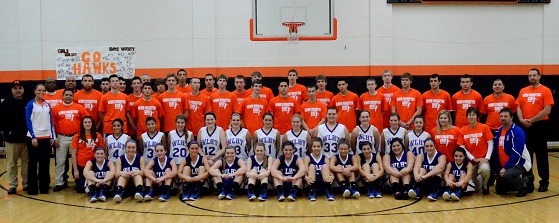 Two more rivals, Fennville and Saugatuck, met late last month for their second “Never Forgotten” boys and girls basketball games with proceeds going to the Wes Leonard Heart Team for the purchase of AEDs.
Players wore jerseys with names on the backs of friends and family members who had died, and those jerseys were then given to family members after the games. Officials Ace Cover, Chris Dennie and Kyle Bowen also donated their game checks to the Heart Team, as did the winner of that night’s 50-50 raffle.
Leonard died from sudden cardiac arrest after making the game-winning shot in a basketball game March 3, 2011. The two schools played their first “Never Forgotten” games last season.
More support for less specialization
I’m asked once a year at least about sport specialization – that is, athletes focusing on just one sport, often from an early age, and if it pays off some way down the road.
Most of my evidence to support my belief in the well-rounded athlete has been anecdotal, based on conversations with people at the high school and college levels over the years. But a British study published this fall in the Journal of Sport Sciences by University of Birmingham researchers provides some interesting empirical findings.
The study of 1,006 people from the United Kingdom showed that those who participated in three sports at ages 11, 13 and 15 were “significantly more likely to compete at a national rather than club standard” between ages 16-18 than those who had practiced only one sport.
In other words, the study found that those who played more sports at earlier ages played at a higher level during their high school-age years, which seems to contradict the one-sport focus philosophy.
Click for more perspective on the study from Chris Kennedy, the Superintendent of Schools in West Vancouver, British Columbia.
PHOTO: The boys and girls teams for Fennville and Saugatuck pose together after their "Never Forgotten" games Dec. 21 at Fennville High. (Photo courtesy of Al LaShell.)
MHSAA Provides Reopening Guidelines
May 29, 2020
By Geoff Kimmerly
Second Half editor
The Michigan High School Athletic Association today submitted to its member schools a series of updated timelines and recommendations to guide the return of sports, which have been suspended since mid-March to alleviate the potential spread of COVID-19.
The state’s current “Safer-at-Home” order runs through Friday, June 12. There can be no use of any school facilities (indoor and outdoor) and there can be no organized on-site athletic activity, including conditioning or competition, until the current stay-at-home order expires or is lifted by Governor Gretchen Whitmer. When the “Safer-at-Home” order expires or is lifted, the return-to-activity recommendations may be implemented locally by school district leadership, provided the district declares its facilities open to students and staff and the 2019-20 school year has ended for that district (based on its last originally-scheduled school day).
The “MHSAA/NFHS Guidance for Re-Opening School Sports” is based primarily on direction provided by the MHSAA and National Federation of State High School Associations’ (NFHS) Sports Medicine Advisory Committees, in addition to reopening plans provided by the Michigan and federal governments and recommendations from the Center for Disease Control and Prevention (CDC). Concepts from the United States Olympic & Paralympic Committee also were consulted.
The MHSAA/NFHS plan recommends a three-step process to returning to full athletic participation, and for each step outlines actions to be taken in five major areas: pre-workout/contest screening of athletes and coaches for sickness, limitations of the number of participants who may be involved in a gathering, proper cleaning for facilities, the use of equipment during activity and best practices for keeping participants safely hydrated. The plan also places sports into categories based on risk for transmitting the virus (low/moderate/high), with adjusted return-to-activity steps based on that level of risk.
The MHSAA serves more than 1,500 public and private schools, including 750 high schools.
“The MHSAA and its Representative Council believe restarting school sports is essential to the physical and mental well-being of students, and the guidelines outlined for schools today provide the ‘How’ for schools to return to athletics when they’ve received the go-ahead from state and county health officials,” MHSAA Executive Director Mark Uyl said. “We are thankful for our state government, state education and health departments, our medical partners and the NFHS for their guidance these last few months, and we will continue to follow and pass on their recommendations as we prepare our schools to bring back this part of student life that’s been sorely missed.”
At the present time, the only activity allowed continues to be individual, outdoor recreational activity including walking, hiking, running, etc. (as announced in Executive Order 2020-96). If this type of conditioning activity takes place with more than one person present, it must be in groups of fewer than 10 people with social distancing followed, and the activity cannot involve school coaches, be school sponsored or occur at any school facility (indoor or outdoor) until at least June 13.
Voluntary virtual (not in-person) communication and instruction from coaches to any number of students is permitted under MHSAA rules in all sports during the summer.
“The concept is that students can continue to individually condition themselves (by walking, hiking, running), but there should be no organized, group activity by any person until at least June 13. We must all continue do our part to flatten the curve in hopes of increased activity over the coming weeks,” Uyl said. “Again, it is important to note that this document addresses ‘How’ schools can return to activity; the decision on ‘When’ schools can return to activity will be done under the direction of state government and health department officials. As government actions impact this timeline, the MHSAA will continue to update all involved.”
The return-to-activity guidelines are aimed to provide direction for schools as they continue to limit potential exposure to respiratory droplets, the primary avenue for transferring COVID-19. Specifically, the MHSAA/NFHS plan addresses social distancing, use of cloth and other face coverings, event scheduling and transportation, and the possibility that schools may have to break from or completely discontinue activity including competition during the fall or winter because of recurrent outbreaks of the coronavirus.
School district administrators will determine at which step in the MHSAA/NFHS plan their schools are operating based on the number of people allowed to gather by state medical officials.
The document in full is available from the MHSAA Website. Further guidance will be provided over the weeks ahead as new information is available and the prevalence of COVID-19 changes. Updates to the MHSAA/NFHS guidelines will continue to be in accordance with those published by the Governor’s office.
The MHSAA has remained in regular contact with the Governor’s office, Michigan Department of Health & Human Services and Michigan Department of Education throughout the pandemic, in addition to leadership from the state’s superintendents, school principals, athletic administrators and school boards associations.
The MHSAA is a private, not-for-profit corporation of voluntary membership by more than 1,500 public and private senior high schools and junior high/middle schools which exists to develop common rules for athletic eligibility and competition. No government funds or tax dollars support the MHSAA, which was the first such association nationally to not accept membership dues or tournament entry fees from schools. Member schools which enforce these rules are permitted to participate in MHSAA tournaments, which attract more than 1.4 million spectators each year.