


Rivaling for a Cause
January 25, 2013
It’s impossible to include all the perspective we gain from every “Battle of the Fans” visit.
But this anecdote, although it didn't make Tuesday’s story about our Frankenmuth trip, tells of another great example for what student cheering sections can accomplish.
Frankenmuth and Millington are heated rivals, to say the least, separated by 13 miles and made more competitive by plenty of championship-deciding matchups over the years.
But for their boys basketball game Jan. 10 at Frankenmuth, student section leaders from both schools almost completely on their own set up the game as a cancer awareness night, complete with Frankenmuth students in black shirts and Millington’s wearing pink.
The idea was the brainchild of a of Frankenmuth section leader, who then received help from a local bank and contacted Millington to get the ball rolling.
Battle of the Fans has shown us the obvious – these student sections need strong leaders – but also the special things they can accomplish with additional initiative.
“Never Forgotten”
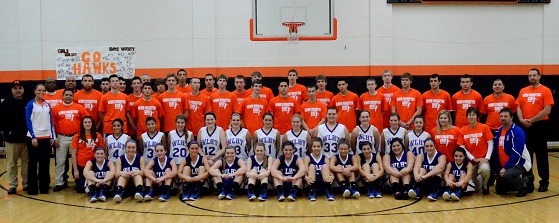 Two more rivals, Fennville and Saugatuck, met late last month for their second “Never Forgotten” boys and girls basketball games with proceeds going to the Wes Leonard Heart Team for the purchase of AEDs.
Players wore jerseys with names on the backs of friends and family members who had died, and those jerseys were then given to family members after the games. Officials Ace Cover, Chris Dennie and Kyle Bowen also donated their game checks to the Heart Team, as did the winner of that night’s 50-50 raffle.
Leonard died from sudden cardiac arrest after making the game-winning shot in a basketball game March 3, 2011. The two schools played their first “Never Forgotten” games last season.
More support for less specialization
I’m asked once a year at least about sport specialization – that is, athletes focusing on just one sport, often from an early age, and if it pays off some way down the road.
Most of my evidence to support my belief in the well-rounded athlete has been anecdotal, based on conversations with people at the high school and college levels over the years. But a British study published this fall in the Journal of Sport Sciences by University of Birmingham researchers provides some interesting empirical findings.
The study of 1,006 people from the United Kingdom showed that those who participated in three sports at ages 11, 13 and 15 were “significantly more likely to compete at a national rather than club standard” between ages 16-18 than those who had practiced only one sport.
In other words, the study found that those who played more sports at earlier ages played at a higher level during their high school-age years, which seems to contradict the one-sport focus philosophy.
Click for more perspective on the study from Chris Kennedy, the Superintendent of Schools in West Vancouver, British Columbia.
PHOTO: The boys and girls teams for Fennville and Saugatuck pose together after their "Never Forgotten" games Dec. 21 at Fennville High. (Photo courtesy of Al LaShell.)

NFHS Voice: Nationally, Lost Spring Ends
May 8, 2020
By Karissa Niehoff
NFHS Executive Director
On Monday, the New Jersey State Interscholastic Athletic Association became the 51st and final NFHS member state high school association to cancel its spring sports championships due to the Coronavirus pandemic.
The cancellation announcements began in late March and stretched to early May as states made every attempt possible to conduct spring sports and other activity programs.
Driven by a desire to offer perhaps a few weeks of competition – particularly for graduating seniors – many states waited as long as possible to move from postponed to cancelled, ultimately forced to make decisions when schools were closed to in-person learning for the remainder of the academic year.
While the leaders of our state associations knew that spring activities could not occur if schools did not re-open, and that the health and safety of the millions of participants ultimately drove these decisions, having to make these announcements was perhaps the most difficult task they had experienced as state leaders.
“We are disappointed for the thousands of New Jersey student-athletes who will be unable to compete this spring,” said Larry White, executive director of the New Jersey State Interscholastic Athletic Association. “While we remained hopeful to the end, and left open every possibility, competition simply is not feasible given the circumstances. It has been a harrowing time for everyone, and we know our student-athletes are extremely disappointed. That said, these unfortunate circumstances may have put an intriguing challenge in the path of our young people. As New Jersey’s own Vince Lombardi once said, ‘It's not whether you get knocked down, it's whether you get up.’ We’re confident all our kids will get back up and stand tall.”
Rhonda Blanford-Green, commissioner of the Colorado High School Activities Association, showed her emotions in making the difficult decision in her state:
“This decision, unlike the many decisions our office makes over the course of a year, has been extremely difficult because we are personally connected as former participants and officials, current parents and grandparents of graduating seniors, as well as educators and members of our high school communities. Our hats are off to the many seniors who have shown maturity and resolve as their culminating year of high school has been impacted beyond activities and athletics due to the worldwide COVID-19 pandemic. The Class of 2020 will not be forgotten.”
Craig Anderson, executive director of the Illinois High School Association, said, “Our thoughts are with all the impacted students, coaches and communities, especially the seniors. It will be difficult for them to find a silver lining in all of this, but we stress that even if they don’t get the chance to compete again at the high school level, they are better for having been a part of their respective high school teams. They were exposed to life lessons in teamwork, leadership and overcoming adversity that are difficult to replicate elsewhere.”
What was at stake and who was affected by these cancellation announcements? More than 500 girls and boys spring sports championships in about 18 sports and involving about three million student-athletes. Along with multiple classes for both boys and girls in track & field, other sports affected this spring were baseball, softball, lacrosse, golf, tennis, soccer, flag football, boys volleyball, water polo, weightlifting, gymnastics, riflery, judo, Unified track & field and ultimate Frisbee. Also grounded were perhaps another million participants in band, choir, orchestra, speech, debate, robotics and other activity programs.
And last, but far from least, we remember the thousands of volunteers who make these events happen every year – ticket-takers, concession stand workers, booster club parents, meet officials and the leaders in communities throughout the country where these events were planned. We thank these individuals for their faithful service year after year, and we look forward to the day we are all back together again.
Dr. Karissa L. Niehoff is in her second year as executive director of the National Federation of State High School Associations (NFHS) in Indianapolis, Indiana. She is the first female to head the national leadership organization for high school athletics and performing arts activities and the sixth full-time executive director of the NFHS, which celebrated its 100th year of service during the 2018-19 school year. She previously was executive director of the Connecticut Association of Schools-Connecticut Interscholastic Athletic Conference for seven years.