


Rivaling for a Cause
January 25, 2013
It’s impossible to include all the perspective we gain from every “Battle of the Fans” visit.
But this anecdote, although it didn't make Tuesday’s story about our Frankenmuth trip, tells of another great example for what student cheering sections can accomplish.
Frankenmuth and Millington are heated rivals, to say the least, separated by 13 miles and made more competitive by plenty of championship-deciding matchups over the years.
But for their boys basketball game Jan. 10 at Frankenmuth, student section leaders from both schools almost completely on their own set up the game as a cancer awareness night, complete with Frankenmuth students in black shirts and Millington’s wearing pink.
The idea was the brainchild of a of Frankenmuth section leader, who then received help from a local bank and contacted Millington to get the ball rolling.
Battle of the Fans has shown us the obvious – these student sections need strong leaders – but also the special things they can accomplish with additional initiative.
“Never Forgotten”
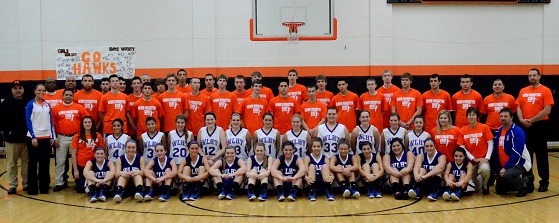 Two more rivals, Fennville and Saugatuck, met late last month for their second “Never Forgotten” boys and girls basketball games with proceeds going to the Wes Leonard Heart Team for the purchase of AEDs.
Players wore jerseys with names on the backs of friends and family members who had died, and those jerseys were then given to family members after the games. Officials Ace Cover, Chris Dennie and Kyle Bowen also donated their game checks to the Heart Team, as did the winner of that night’s 50-50 raffle.
Leonard died from sudden cardiac arrest after making the game-winning shot in a basketball game March 3, 2011. The two schools played their first “Never Forgotten” games last season.
More support for less specialization
I’m asked once a year at least about sport specialization – that is, athletes focusing on just one sport, often from an early age, and if it pays off some way down the road.
Most of my evidence to support my belief in the well-rounded athlete has been anecdotal, based on conversations with people at the high school and college levels over the years. But a British study published this fall in the Journal of Sport Sciences by University of Birmingham researchers provides some interesting empirical findings.
The study of 1,006 people from the United Kingdom showed that those who participated in three sports at ages 11, 13 and 15 were “significantly more likely to compete at a national rather than club standard” between ages 16-18 than those who had practiced only one sport.
In other words, the study found that those who played more sports at earlier ages played at a higher level during their high school-age years, which seems to contradict the one-sport focus philosophy.
Click for more perspective on the study from Chris Kennedy, the Superintendent of Schools in West Vancouver, British Columbia.
PHOTO: The boys and girls teams for Fennville and Saugatuck pose together after their "Never Forgotten" games Dec. 21 at Fennville High. (Photo courtesy of Al LaShell.)

NFHS Voice: Viewership Continues to Climb
February 28, 2020
By Karissa Niehoff
NFHS Executive Director
Often, the public’s concept of high school sports is a football or basketball game televised on a national cable channel between highly-ranked prep teams from different parts of the country – or the game-by-game tracking of “star” players like LeBron James or Zion Williamson by national media sources.
And why not? That is the way we follow college and professional sports. While there are certainly fans with loyalties to hometown teams, most viewers want to watch the best teams. When it comes to prime-time games, the networks are only going to feature the top teams and players.
The answer to the above question, very simply, is that high school sports are different. While there are about three percent of the almost eight million participants in high school sports who may play in those marquee college or professional games on television, the true stories of education-based athletics reside with the other 97 percent.
As the national leader and advocate for high school sports and performing arts programs in the United States, the NFHS is always looking for ways to showcase education-based activities in our nation’s schools and to demonstrate the accomplishments of the millions of participants in all sports.
And for the past seven years through the NFHS Network, we have been doing just that. In addition to the estimated 350 million fans who attend high school games annually, the NFHS has added opportunities for millions of others to watch high school sports through the streaming of more than 100,000 events last year at www.NFHSNetwork.com.
While viewers – and there were more than 14 million visits to the site last year – may be able to watch future college and pro players on the NFHS Network, that’s not the focus of those watching games on their phones, tablets or computers. Instead, the Network provides an opportunity for individuals to support their high school teams – perhaps in another part of the country years after graduating from high school. With the 100,000-plus events last year featuring numerous sports and events and divided 50-50 between girls and boys sports, the Network also offers parents or grandparents the chance to watch their kids’ and grandkids’ games when distances prevent attending games.
Although there was concern by some when we started this venture that streaming high school games on the Internet would adversely affect in-stadium attendance, such has not been the case. About 70 percent of NFHS Network subscribers watch games from beyond a drivable distance.
And the best stories are when the driving distances are REALLY not favorable – as in some other parts of the world. Easily the most heartwarming aspect of the NFHS Network has been the opportunity for men and women overseas in the military to watch their sons and daughters play high school sports. These are truly priceless moments.
While there is still nothing like actually watching a high school game in person, we recognize that technology has provided options for people in all areas of daily life. So, the opportunity to bring high school sports right into the home through the NFHS Network has been a dream come true.
Dr. Karissa L. Niehoff is in her second year as executive director of the National Federation of State High School Associations (NFHS) in Indianapolis, Indiana. She is the first female to head the national leadership organization for high school athletics and performing arts activities and the sixth full-time executive director of the NFHS, which celebrated its 100th year of service during the 2018-19 school year. She previously was executive director of the Connecticut Association of Schools-Connecticut Interscholastic Athletic Conference for seven years.