


Rivaling for a Cause
January 25, 2013
It’s impossible to include all the perspective we gain from every “Battle of the Fans” visit.
But this anecdote, although it didn't make Tuesday’s story about our Frankenmuth trip, tells of another great example for what student cheering sections can accomplish.
Frankenmuth and Millington are heated rivals, to say the least, separated by 13 miles and made more competitive by plenty of championship-deciding matchups over the years.
But for their boys basketball game Jan. 10 at Frankenmuth, student section leaders from both schools almost completely on their own set up the game as a cancer awareness night, complete with Frankenmuth students in black shirts and Millington’s wearing pink.
The idea was the brainchild of a of Frankenmuth section leader, who then received help from a local bank and contacted Millington to get the ball rolling.
Battle of the Fans has shown us the obvious – these student sections need strong leaders – but also the special things they can accomplish with additional initiative.
“Never Forgotten”
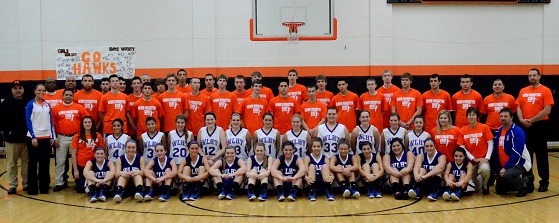 Two more rivals, Fennville and Saugatuck, met late last month for their second “Never Forgotten” boys and girls basketball games with proceeds going to the Wes Leonard Heart Team for the purchase of AEDs.
Players wore jerseys with names on the backs of friends and family members who had died, and those jerseys were then given to family members after the games. Officials Ace Cover, Chris Dennie and Kyle Bowen also donated their game checks to the Heart Team, as did the winner of that night’s 50-50 raffle.
Leonard died from sudden cardiac arrest after making the game-winning shot in a basketball game March 3, 2011. The two schools played their first “Never Forgotten” games last season.
More support for less specialization
I’m asked once a year at least about sport specialization – that is, athletes focusing on just one sport, often from an early age, and if it pays off some way down the road.
Most of my evidence to support my belief in the well-rounded athlete has been anecdotal, based on conversations with people at the high school and college levels over the years. But a British study published this fall in the Journal of Sport Sciences by University of Birmingham researchers provides some interesting empirical findings.
The study of 1,006 people from the United Kingdom showed that those who participated in three sports at ages 11, 13 and 15 were “significantly more likely to compete at a national rather than club standard” between ages 16-18 than those who had practiced only one sport.
In other words, the study found that those who played more sports at earlier ages played at a higher level during their high school-age years, which seems to contradict the one-sport focus philosophy.
Click for more perspective on the study from Chris Kennedy, the Superintendent of Schools in West Vancouver, British Columbia.
PHOTO: The boys and girls teams for Fennville and Saugatuck pose together after their "Never Forgotten" games Dec. 21 at Fennville High. (Photo courtesy of Al LaShell.)

NFHS Voice: Give Thanks for Officials
February 19, 2020
By Karissa Niehoff
NFHS Executive Director
While the behavior of parents and other fans at high school games is still a work in progress, there is some good news on the officiating front.
Last fall, we reported on a growing shortage of officials nationwide – even reaching a crisis stage in some areas as games were being cancelled. Through a nationwide recruitment effort, progress is being made in attracting more people to the high school officiating avocation.
Thanks to the NFHS’ #BecomeAnOfficial campaign that was launched in the spring of 2017, more than 4,000 men and women across the country have registered and become certified officials. Many of these individuals are former high school athletes who want to remain involved in sports, earn some extra income and stay in shape, including first responders such as police officers, firefighters and EMTs.
On the flip side, however, is the fear that any gains in new officials coming in the front door are being offset by other officials heading out the back door because of the continued boorish behavior on the part of parents and other fans.
Rickey Neaves, associate director of the Mississippi High School Activities Association, is struggling to cover all basketball games in his state in his role as officials’ coordinator.
“Fans and coaches alike feel freer to downgrade officials, and holler and scream at them, as opposed to the way it was 10 years ago,” Neaves said. “You can see where it is getting worse and worse with parents and coaches blaming officials or staying on an official to the point where they’re just not going to take it, so they just get out.”
Unfortunately, we continue to hear reports like this from across the country. A recent survey conducted by Officially Human: Behind the Stripes that was completed by about 19,000 respondents in 14 states indicated that the problem persists, with fans who do not know the rules being the main culprit.
If efforts by the NFHS at the national level – and others at state and local levels – to attract more people to officiating are to be successful, unsportsmanlike behavior on the part of parents and other fans must cease or we will lose some of these new officials within two years.
While we recognize the task of improving the culture at high school events is challenging and is one more item on the busy plates of school administrators, it is essential if we are to retain officials.
Brenda Hilton, founder of Officially Human: Beyond the Stripes, said, “The time is now for all of us to realize that officials are human and their existence and hard work at sporting events allows all of us to enjoy the games that we love. We must start to humanize officials now before the whistles fall silent.”
Recognition and thanks should also be a part of the game plan. We must regularly share our appreciation for the men and women who officiate high school sports.
Dana Pappas, commissioner of officials for the New Mexico Officials Association, shared the following with officials in her state during a special appreciation week:
“Never think that what you do as an official doesn’t matter because it does. Never let one contest where the fans are exceedingly brutal and the scrutiny is overly intense derail your love for what you do. Never think that you are not making a difference because you most definitely are. You are educators, role models and guardians of the integrity of the sport you officiate. You officiate because you care about kids, you care about your chosen sport and you care about your community.”
Instead of viewing these officiating issues as a crisis, let’s see them as an opportunity to impact lives through education-based athletics.
Dr. Karissa L. Niehoff is in her second year as executive director of the National Federation of State High School Associations (NFHS) in Indianapolis, Indiana. She is the first female to head the national leadership organization for high school athletics and performing arts activities and the sixth full-time executive director of the NFHS, which celebrated its 100th year of service during the 2018-19 school year. She previously was executive director of the Connecticut Association of Schools-Connecticut Interscholastic Athletic Conference for seven years.