


Rivaling for a Cause
January 25, 2013
It’s impossible to include all the perspective we gain from every “Battle of the Fans” visit.
But this anecdote, although it didn't make Tuesday’s story about our Frankenmuth trip, tells of another great example for what student cheering sections can accomplish.
Frankenmuth and Millington are heated rivals, to say the least, separated by 13 miles and made more competitive by plenty of championship-deciding matchups over the years.
But for their boys basketball game Jan. 10 at Frankenmuth, student section leaders from both schools almost completely on their own set up the game as a cancer awareness night, complete with Frankenmuth students in black shirts and Millington’s wearing pink.
The idea was the brainchild of a of Frankenmuth section leader, who then received help from a local bank and contacted Millington to get the ball rolling.
Battle of the Fans has shown us the obvious – these student sections need strong leaders – but also the special things they can accomplish with additional initiative.
“Never Forgotten”
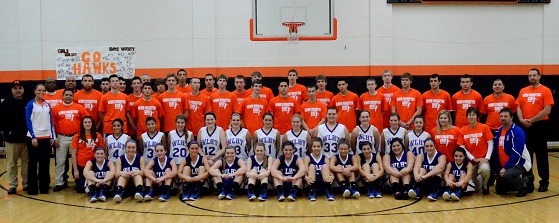 Two more rivals, Fennville and Saugatuck, met late last month for their second “Never Forgotten” boys and girls basketball games with proceeds going to the Wes Leonard Heart Team for the purchase of AEDs.
Players wore jerseys with names on the backs of friends and family members who had died, and those jerseys were then given to family members after the games. Officials Ace Cover, Chris Dennie and Kyle Bowen also donated their game checks to the Heart Team, as did the winner of that night’s 50-50 raffle.
Leonard died from sudden cardiac arrest after making the game-winning shot in a basketball game March 3, 2011. The two schools played their first “Never Forgotten” games last season.
More support for less specialization
I’m asked once a year at least about sport specialization – that is, athletes focusing on just one sport, often from an early age, and if it pays off some way down the road.
Most of my evidence to support my belief in the well-rounded athlete has been anecdotal, based on conversations with people at the high school and college levels over the years. But a British study published this fall in the Journal of Sport Sciences by University of Birmingham researchers provides some interesting empirical findings.
The study of 1,006 people from the United Kingdom showed that those who participated in three sports at ages 11, 13 and 15 were “significantly more likely to compete at a national rather than club standard” between ages 16-18 than those who had practiced only one sport.
In other words, the study found that those who played more sports at earlier ages played at a higher level during their high school-age years, which seems to contradict the one-sport focus philosophy.
Click for more perspective on the study from Chris Kennedy, the Superintendent of Schools in West Vancouver, British Columbia.
PHOTO: The boys and girls teams for Fennville and Saugatuck pose together after their "Never Forgotten" games Dec. 21 at Fennville High. (Photo courtesy of Al LaShell.)

NFHS Voice: MLK Provides Reminder
January 22, 2020
By Karissa Niehoff
NFHS Executive Director
On Monday, the nation observed Martin Luther King Jr. Day for the 35th time. This annual remembrance of the civil rights leader and his remarkable efforts in the 1950s and 1960s to combat racism in the United States continues as one of the most significant days on the calendar every year.
King’s “I Have a Dream” speech in Washington, D.C. in 1963 – one of the most iconic speeches in history – was the defining moment of the civil rights movement and led to the Civil Rights Act of 1964, which made desegregation a prerequisite to school funding and further strengthened the Supreme Court’s 1954 ruling in Brown v. Board of Education of Topeka.
As a result, separate schools for African Americans ended and King’s dream of equality for everyone began to occur.
Thanks, in part, to the efforts of King, who was a member of his school’s debate team at Booker T. Washington High School in Atlanta, blacks and whites were assimilated in schools and in athletics and other activities such as speech and debate.
A few years later in the early 1970s with the passage of Title IX, girls – both white and black – were provided the opportunity to participate in high school sports. With this landmark legislation on the heels of the civil rights movement, high school sports and activities were for EVERYONE.
Amazingly, participation in high school sports increased from 3.9 million to 6.4 million in seven years between 1971-72 and 1977-78 – a jump of about 2.5 million. Why? The opportunity to participate was now available to all.
High school athletes – male and female, black and white and other races – began to work together and excel both individually and as teams. Many have seized these opportunities and had a profound impact within their communities and nationally.
In the past five classes of the NFHS National High School Hall of Fame, 13 of the 22 athletes were minority males and females, including the likes of Derrick Brooks, Dusty Baker, Seimone Augustus, Nicole Powell, Lisa Fernandez, Nikki McCray and Marlin Briscoe. Other females were Tracey Fuchs, Carrie Tollefson, Missy West, Joni Huntley, Jackie Stiles and Cindy Brogdon.
In previous classes, there were Ozzie Newsome, Chauncey Billups, Kevin Johnson, Janet Evans, Sean Elliott, Cheryl Miller, Archie Griffin, Jackie Joyner-Kersee and Kim Mulkey.
Can you imagine the storied history of high school sports without these individuals?
Thanks to the efforts of many people in the 1960s and 1970s, there are more women and minorities in leadership positions today. Nine of our member state high school associations are led by minorities, including three females – Que Tucker of North Carolina, Sally Marquez of New Mexico and Rhonda Blanford-Green of Colorado.
Despite these advances in opportunities the past 50-plus years, the late Dr. King would be disappointed to hear about some of the disrespectful behavior in and around high school sports the past few years. Since our column in late October, we have heard of other racially-related incidents. Indeed, pain still occurs.
As we reflect on the tremendous efforts of Dr. Martin Luther King Jr. to bring everyone together, let it be a further reminder that all student activity participants – regardless of race, religion, political views or gender identity – should be treated with respect.
Dr. Karissa L. Niehoff is in her second year as executive director of the National Federation of State High School Associations (NFHS) in Indianapolis, Indiana. She is the first female to head the national leadership organization for high school athletics and performing arts activities and the sixth full-time executive director of the NFHS, which celebrated its 100th year of service during the 2018-19 school year. She previously was executive director of the Connecticut Association of Schools-Connecticut Interscholastic Athletic Conference for seven years.