


Rivaling for a Cause
January 25, 2013
It’s impossible to include all the perspective we gain from every “Battle of the Fans” visit.
But this anecdote, although it didn't make Tuesday’s story about our Frankenmuth trip, tells of another great example for what student cheering sections can accomplish.
Frankenmuth and Millington are heated rivals, to say the least, separated by 13 miles and made more competitive by plenty of championship-deciding matchups over the years.
But for their boys basketball game Jan. 10 at Frankenmuth, student section leaders from both schools almost completely on their own set up the game as a cancer awareness night, complete with Frankenmuth students in black shirts and Millington’s wearing pink.
The idea was the brainchild of a of Frankenmuth section leader, who then received help from a local bank and contacted Millington to get the ball rolling.
Battle of the Fans has shown us the obvious – these student sections need strong leaders – but also the special things they can accomplish with additional initiative.
“Never Forgotten”
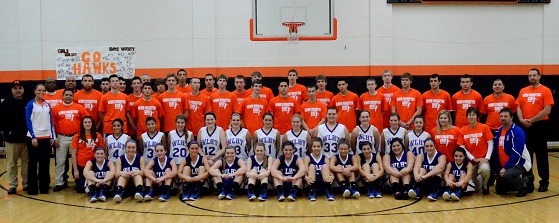 Two more rivals, Fennville and Saugatuck, met late last month for their second “Never Forgotten” boys and girls basketball games with proceeds going to the Wes Leonard Heart Team for the purchase of AEDs.
Players wore jerseys with names on the backs of friends and family members who had died, and those jerseys were then given to family members after the games. Officials Ace Cover, Chris Dennie and Kyle Bowen also donated their game checks to the Heart Team, as did the winner of that night’s 50-50 raffle.
Leonard died from sudden cardiac arrest after making the game-winning shot in a basketball game March 3, 2011. The two schools played their first “Never Forgotten” games last season.
More support for less specialization
I’m asked once a year at least about sport specialization – that is, athletes focusing on just one sport, often from an early age, and if it pays off some way down the road.
Most of my evidence to support my belief in the well-rounded athlete has been anecdotal, based on conversations with people at the high school and college levels over the years. But a British study published this fall in the Journal of Sport Sciences by University of Birmingham researchers provides some interesting empirical findings.
The study of 1,006 people from the United Kingdom showed that those who participated in three sports at ages 11, 13 and 15 were “significantly more likely to compete at a national rather than club standard” between ages 16-18 than those who had practiced only one sport.
In other words, the study found that those who played more sports at earlier ages played at a higher level during their high school-age years, which seems to contradict the one-sport focus philosophy.
Click for more perspective on the study from Chris Kennedy, the Superintendent of Schools in West Vancouver, British Columbia.
PHOTO: The boys and girls teams for Fennville and Saugatuck pose together after their "Never Forgotten" games Dec. 21 at Fennville High. (Photo courtesy of Al LaShell.)

Minding Our Business: Focus on Mental Health
December 30, 2019
By Mark Uyl
MHSAA Executive Director
For as long as I can remember, rules have played an important role in my life.
My father officiated high school and youth sports. So my brother and I did the same, and were fortunate enough to earn the right to work contests at the collegiate level. Today, my sons are officiating high school and youth sports.
I was hired by the MHSAA as an assistant director in large part due to my officiating background. Rules and regulations remain the backbone of athletics specifically, and society in general, as I learned more acutely when I entered the working world as a teacher and coach, then school administrator.
What also became abundantly clear to me within that framework was that it is our responsibility to provide our students not only the opportunity for competition, but also for our games and practices to take place under the safest conditions possible. From preseason physicals to equipment inventory and facility maintenance, a premium was placed on the well-being of participants and spectators.
Throughout my time at the MHSAA, various initiatives continued to target the growing list of health and safety concerns. My predecessor, Jack Roberts, often pointed to the “4 Hs” of the MHSAA’s health and safety campaign: Health Histories (Physicals), Heat and Hydration, Heads, and Hearts. Those pillars still hold the bulk of the content and resources on the Health & Safety resource pages of MHSAA.com. A few years ago, an extensive section promoting multi-sport participation was developed as an increasing amount of overuse injuries among single-sport athletes was being reported.
This fall, another section has been added as a sub-category to “Heads.” While attending an NCAA meeting in the summer of 2017, the topic of concussions came up, which I assumed to be the No. 1 issue concerning health and safety of student-athletes. It was quickly pointed out that student mental health – not concussions – had become the top health concern among our young people. That knocked me back.
Medical personnel have determined that depression, anxiety and other issues related to mental health are the No. 1 concern among adolescent-age children. There’s a real opportunity to provide some leadership and guidance in this area.
We need to offer resources on the subject, and also be prepared to provide guidance for our membership. The MHSAA has developed a Mental Health Speakers Bureau (please visit our Health & Safety page online). The first statewide Student Mental Health Summit scheduled for Lansing in October provided an opportunity for school principals, counselors, student leadership advisers and student leaders to convene on the topic.
The gathering was quickly sold out, indicating not only the growing nature of concern for this issue, but once again displaying the willingness of our educational leaders to recognize and react to another challenge.
This week, Second Half will publish the latest benchmarks report on the MHSAA’s mental health initiatives and those being undertaken by other states as well.