


Rivaling for a Cause
January 25, 2013
It’s impossible to include all the perspective we gain from every “Battle of the Fans” visit.
But this anecdote, although it didn't make Tuesday’s story about our Frankenmuth trip, tells of another great example for what student cheering sections can accomplish.
Frankenmuth and Millington are heated rivals, to say the least, separated by 13 miles and made more competitive by plenty of championship-deciding matchups over the years.
But for their boys basketball game Jan. 10 at Frankenmuth, student section leaders from both schools almost completely on their own set up the game as a cancer awareness night, complete with Frankenmuth students in black shirts and Millington’s wearing pink.
The idea was the brainchild of a of Frankenmuth section leader, who then received help from a local bank and contacted Millington to get the ball rolling.
Battle of the Fans has shown us the obvious – these student sections need strong leaders – but also the special things they can accomplish with additional initiative.
“Never Forgotten”
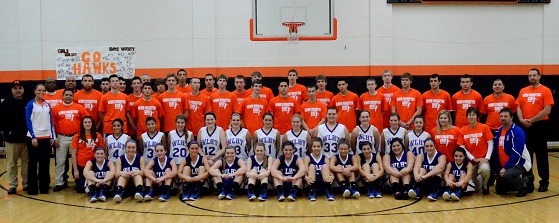 Two more rivals, Fennville and Saugatuck, met late last month for their second “Never Forgotten” boys and girls basketball games with proceeds going to the Wes Leonard Heart Team for the purchase of AEDs.
Players wore jerseys with names on the backs of friends and family members who had died, and those jerseys were then given to family members after the games. Officials Ace Cover, Chris Dennie and Kyle Bowen also donated their game checks to the Heart Team, as did the winner of that night’s 50-50 raffle.
Leonard died from sudden cardiac arrest after making the game-winning shot in a basketball game March 3, 2011. The two schools played their first “Never Forgotten” games last season.
More support for less specialization
I’m asked once a year at least about sport specialization – that is, athletes focusing on just one sport, often from an early age, and if it pays off some way down the road.
Most of my evidence to support my belief in the well-rounded athlete has been anecdotal, based on conversations with people at the high school and college levels over the years. But a British study published this fall in the Journal of Sport Sciences by University of Birmingham researchers provides some interesting empirical findings.
The study of 1,006 people from the United Kingdom showed that those who participated in three sports at ages 11, 13 and 15 were “significantly more likely to compete at a national rather than club standard” between ages 16-18 than those who had practiced only one sport.
In other words, the study found that those who played more sports at earlier ages played at a higher level during their high school-age years, which seems to contradict the one-sport focus philosophy.
Click for more perspective on the study from Chris Kennedy, the Superintendent of Schools in West Vancouver, British Columbia.
PHOTO: The boys and girls teams for Fennville and Saugatuck pose together after their "Never Forgotten" games Dec. 21 at Fennville High. (Photo courtesy of Al LaShell.)
Rep Council Wrap-up: Fall 2019
December 16, 2019
By Geoff Kimmerly
Second Half editor
The adoption of an enhanced strength-of-schedule formula to determine 8-Player Football Playoff qualifiers beginning with the 2020 season was the most notable action taken by the Representative Council of the Michigan High School Athletic Association during its Fall Meeting on Dec. 6 in East Lansing.
Generally, the Council takes only a few actions during its Fall Meeting, with topics often introduced for additional consideration and action during its meetings in winter and spring. This Fall Meeting saw the Council take only two actions, while the majority of discussion centered on topics expected to receive more specific consideration at MHSAA sport committee meetings this winter.
The decision to alter the playoff selection process for 8-player football makes playoff selection consistent across both formats of the sport; 11-player football will begin using the enhanced strength-of-schedule formula as well in 2020, per Council approval at its Spring Meeting this past May. The new playoff selection formula places greater weight on the success of a team’s opponents and sets playoff divisions during the school classification process in March, instead of after the conclusion of the regular season as done previously in both 11 and 8-player football. Also similarly, teams will not be allowed to opt-up into a larger division in either format. The one difference for 8-player is that points assigned for defeating an opponent will be the same for teams in both divisions; in 11-player, more points are awarded on an escalating scale for defeating teams in larger-school divisions.
The Council also approved the permanent use of a policy for non-traditional draws in basketball and volleyball that has guided the scheduling of postseason play for those sports during the 2018-19 and 2019-20 school years. Non-traditional draws allow games to be played at a school’s home or closer neutral site instead of all teams at the same site to alleviate travel distance and time for teams facing long trips during the District and Regional rounds. The policy approved for continuation allows for non-traditional draws to be used for Districts made up of all Upper Peninsula teams, a combination of Upper and Lower Peninsula teams or Districts made up of seven or eight teams from any location; and for geographically-neutral sites to be selected for Regionals that include more than one District located entirely in the Upper Peninsula. For the two District scenarios including Upper Peninsula teams, a traditional draw still may be conducted if all participating teams agree to it.
A number of remaining discussions focused on results from this fall’s Update Meeting survey completed by administrators during the MHSAA’s annual presentations across the state. The Council at its Spring Meeting requested study by staff on a variety of topics – most notably amateur status, out-of-season coaching issues, use of football equipment in out-of-season activities and the MHSAA travel limitation both during the summer and in-season. A number of Update survey questions addressed those subjects, and conversations on those topics will continue at the separate sport committee meetings over the next few months in advance of further Council discussion in March and May.
The Council discussed efforts to promote and grow football, and staff reported on the upcoming Youth Football Summit to be held Jan. 19, 2020, at the MHSAA in partnership with USA Football and the Michigan High School Football Coaches Association. Those efforts, along with the history of use of football equipment out-of-season, are scheduled for further conversation at the MHSAA Football Committee meeting in January.
Additionally, MHSAA staff reported on current mental health initiatives – including the Association’s rules meeting partnership with the Mental Health Foundation of West Michigan and its “be nice.” education program – and on the first meeting of the Sports Medicine Advisory Council. Staff relayed feedback received this fall during the first season under the new sport-specific transfer rule, and also observations from the first-time use of limited District seeding in boys soccer during the recently-completed season. An update also was presented on officials registration and retention.
The Fall Meeting saw the addition of William McCoy, athletic director of Romulus Summit Academy North, to the 19-person Council. He was appointed to a two-year term. McCoy fills the position formerly held by Courtney Hawkins, athletic director of Flint Beecher High School, whose term ended. Also, Kris Isom, athletic director at Adrian Madison High School, was appointed to a two-year term. She replaces Justin Jennings, who previously served as superintendent for Muskegon Public Schools and vacated his Council appointment after leaving Muskegon for a position in Ohio this summer.
The Council reelected Scott Grimes, assistant superintendent of human services for Grand Haven Area Public Schools, as its president; and Vic Michaels, director of physical education and athletics for the Archdiocese of Detroit, as secretary-treasurer. Clare Middle School principal Steve Newkirk was elected Council vice president.
The Representative Council is the legislative body of the MHSAA. All but five members are elected by member schools. Four members are appointed by the Council to facilitate representation of females and minorities, and the 19th position is occupied by the Superintendent of Public Instruction or designee.
The MHSAA is a private, not-for-profit corporation of voluntary membership by more than 1,500 public and private senior high schools and junior high/middle schools which exists to develop common rules for athletic eligibility and competition. No government funds or tax dollars support the MHSAA, which was the first such association nationally to not accept membership dues or tournament entry fees from schools. Member schools which enforce these rules are permitted to participate in MHSAA tournaments, which attract more than 1.4 million spectators each year.