


Rivaling for a Cause
January 25, 2013
It’s impossible to include all the perspective we gain from every “Battle of the Fans” visit.
But this anecdote, although it didn't make Tuesday’s story about our Frankenmuth trip, tells of another great example for what student cheering sections can accomplish.
Frankenmuth and Millington are heated rivals, to say the least, separated by 13 miles and made more competitive by plenty of championship-deciding matchups over the years.
But for their boys basketball game Jan. 10 at Frankenmuth, student section leaders from both schools almost completely on their own set up the game as a cancer awareness night, complete with Frankenmuth students in black shirts and Millington’s wearing pink.
The idea was the brainchild of a of Frankenmuth section leader, who then received help from a local bank and contacted Millington to get the ball rolling.
Battle of the Fans has shown us the obvious – these student sections need strong leaders – but also the special things they can accomplish with additional initiative.
“Never Forgotten”
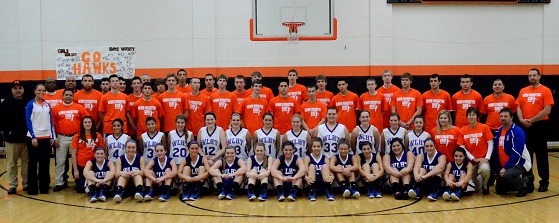 Two more rivals, Fennville and Saugatuck, met late last month for their second “Never Forgotten” boys and girls basketball games with proceeds going to the Wes Leonard Heart Team for the purchase of AEDs.
Players wore jerseys with names on the backs of friends and family members who had died, and those jerseys were then given to family members after the games. Officials Ace Cover, Chris Dennie and Kyle Bowen also donated their game checks to the Heart Team, as did the winner of that night’s 50-50 raffle.
Leonard died from sudden cardiac arrest after making the game-winning shot in a basketball game March 3, 2011. The two schools played their first “Never Forgotten” games last season.
More support for less specialization
I’m asked once a year at least about sport specialization – that is, athletes focusing on just one sport, often from an early age, and if it pays off some way down the road.
Most of my evidence to support my belief in the well-rounded athlete has been anecdotal, based on conversations with people at the high school and college levels over the years. But a British study published this fall in the Journal of Sport Sciences by University of Birmingham researchers provides some interesting empirical findings.
The study of 1,006 people from the United Kingdom showed that those who participated in three sports at ages 11, 13 and 15 were “significantly more likely to compete at a national rather than club standard” between ages 16-18 than those who had practiced only one sport.
In other words, the study found that those who played more sports at earlier ages played at a higher level during their high school-age years, which seems to contradict the one-sport focus philosophy.
Click for more perspective on the study from Chris Kennedy, the Superintendent of Schools in West Vancouver, British Columbia.
PHOTO: The boys and girls teams for Fennville and Saugatuck pose together after their "Never Forgotten" games Dec. 21 at Fennville High. (Photo courtesy of Al LaShell.)
Hoops, Hockey Prep for Playoff Changes
December 12, 2019
By Geoff Kimmerly
Second Half editor
The introduction of limited seeding at the District level for girls and boys basketball, and a shift in the postseason schedule for ice hockey, are among changes that will be noticed most this season by those who compete in and follow the 12 winter sports for which the Michigan High School Athletic Association sponsors postseason tournaments.
Girls basketball’s first games tipped off Dec. 2, followed by boys basketball openers Dec. 9. This winter, for the first time, the top two teams in every basketball District will be seeded and placed on the opposite sides of their bracket, making the District Final the earliest round they could play each other. Those top-seeded teams will be determined using the Michigan Power Ratings (MPR) computer formula based on regular-season results against other MHSAA Tournament-eligible teams and opponents’ strength of schedule. (Games against out-of-state or non-MHSAA opponents will not count in the MPR formula.)
The MHSAA will draw all brackets 15 days before the start of District play. After the top seeds are determined and separated to opposite sides of the bracket, the draw process will place the remaining teams on the bracket based on a randomly-selected order determined earlier in the season. MPR also was used to similarly seed Districts for boys soccer for the first time this past fall and in the spring for boys lacrosse.
Also undergoing a change this winter, the MHSAA Ice Hockey Tournament will be played over three weeks rather than two as in previous seasons. The traditional dates for the start of the regular season and Finals will remain the same, as will the total number of regular-season games allowed. However, the MHSAA Tournament will begin on the third Monday before the Finals instead of two weeks before, and the extended postseason schedule places the maximum of six games that may be played from the start of Regionals through Finals over 20 days instead of the previous 13.
While those changes will affect tournament structures, a handful of others affecting daily competition will be particularly noticeable as well this winter:
• As with Lower Peninsula girls swimming & diving season in the fall, a pair of changes for LP boys and Upper Peninsula girls will take effect this winter. For swimmers, the definition of a legal finish has changed to include a competitor touching any part of the finish end of the lane, not just the touch pad. In diving, the degree of difficulty was adjusted for back and reverse somersaults to provide consistency with difficulty of other dives.
• In hockey, the allowed stick length for a non-goaltender has been extended to 65 inches with a blade no more than 12.5 inches long and between 2-3 inches high. The allowances for a goaltender’s stick also were adjusted – the widened portion up to 28 inches from the heel and to 3.5 inches in width, with a blade at maximum 15.5 inches in length. These changes were made to accommodate the greater average height of today’s athletes.
• In girls competitive cheer, non-braced static inversions will be allowed only with the following stipulations: the original base or spotter maintains constant contact with the flyer, prior to the static inverted position the flyer must originate from below shoulder level, and the inversion must dismount to the cheering surface, cradle, any waist-level position or a non-inverted stunt at shoulder level. Also, twists from inversions and inversions released to extended level are illegal.
• A new rule in wrestling will allow for additional time to evaluate head and neck injuries. If an injury occurs involving the head, neck, cervical column and/or nervous system and an appropriate health care professional is present, that caregiver may request the traditional 90 seconds of injury time be extended up to a maximum of five minutes to evaluate the injury. Before that time expires, the wrestler must be ready and able to continue the match or it will be defaulted.
• Also for wrestling, a new criteria has been added to the tie-breaking system used when a dual meet finishes in a tied score. The new sixth criteria “f” states that the team giving up the fewest forfeits during a match shall be declared the winner.
The 2019-20 Winter campaign culminates with postseason tournaments beginning with Girls & Boys Skiing Regionals on Feb. 10, and wraps up with the Boys Basketball Finals on March 28. Here is a complete list of winter tournament dates:
Girls Basketball
Districts – March 2, 4 & 6
Regionals – March 10 & 12
Quarterfinals – March 17
Semifinals – March 19-20
Finals – March 21
Boys Basketball
Districts – March 9, 11 & 13
Regionals – March 16 & 18
Quarterfinals – March 24
Semifinals – March 26-27
Finals – March 28
Girls & Boys Bowling
Team Regionals – Feb. 28
Singles Regionals – Feb. 29
Team Finals – March 6
Singles Finals – March 7
Girls Competitive Cheer
Districts – Feb. 21-22
Regionals – Feb. 29
Finals: March 6-7
Girls Gymnastics
Regionals – March 7
Team Finals – March 13
Individual Finals – March 14
Ice Hockey
Regionals – Feb. 24-March 4
Quarterfinals – March 7
Semifinals – March 12-13
Finals – March 14
Girls and Boys Skiing
Regionals – Feb. 10-14
Finals – Feb. 24
Girls & Boys Swimming & Diving
U.P. Girls & Boys Finals – Feb. 15
L.P. Boys Diving Qualification Meets – March 5
L.P. Boys Finals – March 13-14
Wrestling
Team Districts – Feb. 12-13
Individual Districts – Feb. 15
Team Regionals – Feb. 19
Individual Regionals – Feb. 22
Team Quarterfinals – Feb. 28
Team Semifinals & Finals – Feb. 29
Individual Finals – March 6-7