


Rivaling for a Cause
January 25, 2013
It’s impossible to include all the perspective we gain from every “Battle of the Fans” visit.
But this anecdote, although it didn't make Tuesday’s story about our Frankenmuth trip, tells of another great example for what student cheering sections can accomplish.
Frankenmuth and Millington are heated rivals, to say the least, separated by 13 miles and made more competitive by plenty of championship-deciding matchups over the years.
But for their boys basketball game Jan. 10 at Frankenmuth, student section leaders from both schools almost completely on their own set up the game as a cancer awareness night, complete with Frankenmuth students in black shirts and Millington’s wearing pink.
The idea was the brainchild of a of Frankenmuth section leader, who then received help from a local bank and contacted Millington to get the ball rolling.
Battle of the Fans has shown us the obvious – these student sections need strong leaders – but also the special things they can accomplish with additional initiative.
“Never Forgotten”
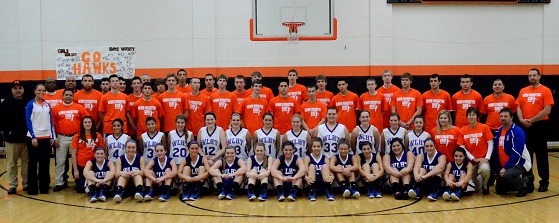 Two more rivals, Fennville and Saugatuck, met late last month for their second “Never Forgotten” boys and girls basketball games with proceeds going to the Wes Leonard Heart Team for the purchase of AEDs.
Players wore jerseys with names on the backs of friends and family members who had died, and those jerseys were then given to family members after the games. Officials Ace Cover, Chris Dennie and Kyle Bowen also donated their game checks to the Heart Team, as did the winner of that night’s 50-50 raffle.
Leonard died from sudden cardiac arrest after making the game-winning shot in a basketball game March 3, 2011. The two schools played their first “Never Forgotten” games last season.
More support for less specialization
I’m asked once a year at least about sport specialization – that is, athletes focusing on just one sport, often from an early age, and if it pays off some way down the road.
Most of my evidence to support my belief in the well-rounded athlete has been anecdotal, based on conversations with people at the high school and college levels over the years. But a British study published this fall in the Journal of Sport Sciences by University of Birmingham researchers provides some interesting empirical findings.
The study of 1,006 people from the United Kingdom showed that those who participated in three sports at ages 11, 13 and 15 were “significantly more likely to compete at a national rather than club standard” between ages 16-18 than those who had practiced only one sport.
In other words, the study found that those who played more sports at earlier ages played at a higher level during their high school-age years, which seems to contradict the one-sport focus philosophy.
Click for more perspective on the study from Chris Kennedy, the Superintendent of Schools in West Vancouver, British Columbia.
PHOTO: The boys and girls teams for Fennville and Saugatuck pose together after their "Never Forgotten" games Dec. 21 at Fennville High. (Photo courtesy of Al LaShell.)

NFHS Voice: Coaches, ADs Keys to Success
December 3, 2019
By Karissa Niehoff
NFHS Executive Director
This fall, one school canceled the remainder of its football season after reports of hazing surfaced. There have been several incidents of high school student-athletes using racial slurs against members of the opposing teams. As we have noted previously, there have also been multiple reports of parents verbally and – in some cases – physically abusing officials, along with several cases of coaches allegedly running up scores. And then there was the bizarre case of a suspended player appearing in a game disguised as another player.
On the positive side, there was a cross country runner who stopped at the one-mile mark of a race to assist a competing runner who had collapsed and was unresponsive. He didn’t finish the race, but he saved the life of the competing runner.
After the completion of a recent football game, one player on the winning team found his friend on the other team who had just lost his mother to cancer to comfort and pray with him. There have also been cases of schools helping other schools that were hit with tragedies, such as the fires in California.
And earlier this year a high school golfer who, after signing her scorecard, noticed on the app that her partner had entered an incorrect score for her on one hole. She could have kept quiet and retained her top-10 finish, and most likely no one would have noticed. Instead, she reported the error and was disqualified. She later was honored by her school for doing the right thing.
Fortunately, there are far more good acts of sportsmanship that happen in high school athletics and activity programs; however, the unsportsmanlike displays tend to make more headlines and sometimes overshadow the great things that are occurring.
The key individuals in schools who are responsible for making education the central theme of the athletic program are the athletic directors and coaches. If coaches are more committed to helping student-athletes become responsible citizens than helping them perfect an athletic skill, and if athletic directors are committed to an education-based philosophy, the likelihood of unsportsmanlike incidents such as those mentioned above is minimal.
What’s the measure of success for a high school coach – winning 80 percent of the games, bringing home multiple state championships, being named coach of the year several times? As long as success on the fields or courts is done in accordance with an education-based philosophy, this would be an award-winning biographical sketch.
The win-loss record aside, however, how about also considering the consistent teaching of values, character and lifelong lessons that would place his or her teams in consideration for sportsmanship awards and his or her student-athletes on the paths to successful lives after high school?
The NFHS has several free online education courses to assist coaches and athletic directors in leading an effective education-based program. “Engaging Effectively with Parents,” “Sportsmanship” and “Bullying, Hazing and Inappropriate Behaviors” are among the many courses at www.NFHSLearn.com. In addition, “Fundamentals of Coaching” is the core course that every interscholastic coach should complete.
When a school district is looking to hire a high school athletic director or coach, we would suggest finding someone more committed to an education-based philosophy than hardware in the trophy case.
Dr. Karissa L. Niehoff is in her second year as executive director of the National Federation of State High School Associations (NFHS) in Indianapolis, Indiana. She is the first female to head the national leadership organization for high school athletics and performing arts activities and the sixth full-time executive director of the NFHS, which celebrated its 100th year of service during the 2018-19 school year. She previously was executive director of the Connecticut Association of Schools-Connecticut Interscholastic Athletic Conference for seven years.