


Rivaling for a Cause
January 25, 2013
It’s impossible to include all the perspective we gain from every “Battle of the Fans” visit.
But this anecdote, although it didn't make Tuesday’s story about our Frankenmuth trip, tells of another great example for what student cheering sections can accomplish.
Frankenmuth and Millington are heated rivals, to say the least, separated by 13 miles and made more competitive by plenty of championship-deciding matchups over the years.
But for their boys basketball game Jan. 10 at Frankenmuth, student section leaders from both schools almost completely on their own set up the game as a cancer awareness night, complete with Frankenmuth students in black shirts and Millington’s wearing pink.
The idea was the brainchild of a of Frankenmuth section leader, who then received help from a local bank and contacted Millington to get the ball rolling.
Battle of the Fans has shown us the obvious – these student sections need strong leaders – but also the special things they can accomplish with additional initiative.
“Never Forgotten”
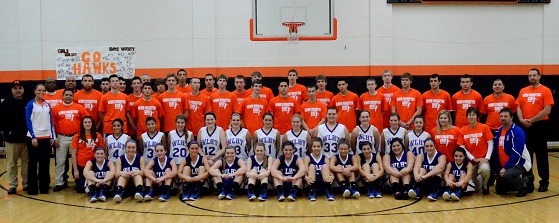 Two more rivals, Fennville and Saugatuck, met late last month for their second “Never Forgotten” boys and girls basketball games with proceeds going to the Wes Leonard Heart Team for the purchase of AEDs.
Players wore jerseys with names on the backs of friends and family members who had died, and those jerseys were then given to family members after the games. Officials Ace Cover, Chris Dennie and Kyle Bowen also donated their game checks to the Heart Team, as did the winner of that night’s 50-50 raffle.
Leonard died from sudden cardiac arrest after making the game-winning shot in a basketball game March 3, 2011. The two schools played their first “Never Forgotten” games last season.
More support for less specialization
I’m asked once a year at least about sport specialization – that is, athletes focusing on just one sport, often from an early age, and if it pays off some way down the road.
Most of my evidence to support my belief in the well-rounded athlete has been anecdotal, based on conversations with people at the high school and college levels over the years. But a British study published this fall in the Journal of Sport Sciences by University of Birmingham researchers provides some interesting empirical findings.
The study of 1,006 people from the United Kingdom showed that those who participated in three sports at ages 11, 13 and 15 were “significantly more likely to compete at a national rather than club standard” between ages 16-18 than those who had practiced only one sport.
In other words, the study found that those who played more sports at earlier ages played at a higher level during their high school-age years, which seems to contradict the one-sport focus philosophy.
Click for more perspective on the study from Chris Kennedy, the Superintendent of Schools in West Vancouver, British Columbia.
PHOTO: The boys and girls teams for Fennville and Saugatuck pose together after their "Never Forgotten" games Dec. 21 at Fennville High. (Photo courtesy of Al LaShell.)

NFHS Voice: Respect Everyone
November 4, 2019
By Karissa Niehoff
NFHS Executive Director
Case studies have revealed that kids want to participate in high school sports because they are fun. Being a part of a team gives them an identity, a sense of self-worth and, in some cases, a reason for engaging in academics. They are included, accepted and feel like a valued member of a community.
This describes the ideal and the goal of high school sports. Fortunately, that atmosphere exists at a majority of the 19,500-plus high schools within the NFHS family. And since it is the desire of high school leadership throughout the country that these ideals continue, we are concerned about the growing decline in respect, integrity and unacceptable behavior in and around high school sports.
Racism is one of our greatest concerns nationwide. We have heard of students posting videos to social media with racist comments. We read about racial comments by team members of nearly all-white schools to opposing players from schools composed of nearly all minority students. There have been cases of white players disrespecting Native American players on the opposing team by addressing them in an unacceptable manner.
This type of behavior could be a reflection of events occurring in our society, or due to lack of a respectful environment at home. Regardless, they are not defensible reasons for the occurrence of these horrible acts within education-based high school sports and activities.
High school sports and activities exist to lift people up, not demean or tear people down. National politics or lack of role modeling by adults at home aside, coaches, administrators and other leaders in high schools nationwide must direct programs with respect, acceptance and dignity and demand the same from the school participants.
More than 50 years ago, Special Olympics began a global movement to break down barriers and end discrimination against people with intellectual disabilities. Since then, lives have been changed for the better all around the world. Many schools have implemented Unified programs in sports, performing arts and even physical education.
We must do the same for everyone. All student-athletes – regardless of race, religion, political views or gender identity – should be treated equally. As baseball Hall of Famer Jackie Robinson said, “I’m not concerned with your liking or disliking me. ... All I ask is that you respect me as a human being.”
As schools hire individuals to fill coaching positions, character must be the top prerequisite for the job. They must be guided by honesty, integrity and ethics, and they must be positive role models for students. And this is certainly not a new idea.
H. V. Porter, the first full-time executive director of the NFHS, had the following to say in 1950: “The amount of success (in improving sportsmanship) is largely dependent on the degree to which attention is constantly given to the matter by the school staff.”
We certainly agree with Mr. Porter but also believe that everyone must pay attention.
The NFHS has several free online education courses through the Learning Center (www.NFHSLearn.com) that can assist in establishing a program that teaches and models respect for self and respect for others. We suggest that “Teaching and Modeling Behavior,” “Sportsmanship” and “Bullying, Hazing and Inappropriate Behaviors” be required courses for everyone working with student-athletes.
High schools must establish a culture that values the worth of every single person – both players on the school’s team and players on the opposing team. There must be a no-tolerance policy regarding behavior that shows disrespect for another individual.
Kids today are looking for a community, and high school sports and activities must be that community that is fun, respectful and supportive of everyone.
Dr. Karissa L. Niehoff is in her second year as executive director of the National Federation of State High School Associations (NFHS) in Indianapolis, Indiana. She is the first female to head the national leadership organization for high school athletics and performing arts activities and the sixth full-time executive director of the NFHS, which celebrated its 100th year of service during the 2018-19 school year. She previously was executive director of the Connecticut Association of Schools-Connecticut Interscholastic Athletic Conference for seven years.