


Rivaling for a Cause
January 25, 2013
It’s impossible to include all the perspective we gain from every “Battle of the Fans” visit.
But this anecdote, although it didn't make Tuesday’s story about our Frankenmuth trip, tells of another great example for what student cheering sections can accomplish.
Frankenmuth and Millington are heated rivals, to say the least, separated by 13 miles and made more competitive by plenty of championship-deciding matchups over the years.
But for their boys basketball game Jan. 10 at Frankenmuth, student section leaders from both schools almost completely on their own set up the game as a cancer awareness night, complete with Frankenmuth students in black shirts and Millington’s wearing pink.
The idea was the brainchild of a of Frankenmuth section leader, who then received help from a local bank and contacted Millington to get the ball rolling.
Battle of the Fans has shown us the obvious – these student sections need strong leaders – but also the special things they can accomplish with additional initiative.
“Never Forgotten”
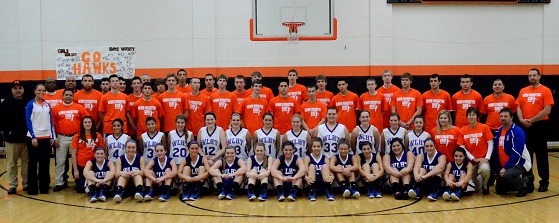 Two more rivals, Fennville and Saugatuck, met late last month for their second “Never Forgotten” boys and girls basketball games with proceeds going to the Wes Leonard Heart Team for the purchase of AEDs.
Players wore jerseys with names on the backs of friends and family members who had died, and those jerseys were then given to family members after the games. Officials Ace Cover, Chris Dennie and Kyle Bowen also donated their game checks to the Heart Team, as did the winner of that night’s 50-50 raffle.
Leonard died from sudden cardiac arrest after making the game-winning shot in a basketball game March 3, 2011. The two schools played their first “Never Forgotten” games last season.
More support for less specialization
I’m asked once a year at least about sport specialization – that is, athletes focusing on just one sport, often from an early age, and if it pays off some way down the road.
Most of my evidence to support my belief in the well-rounded athlete has been anecdotal, based on conversations with people at the high school and college levels over the years. But a British study published this fall in the Journal of Sport Sciences by University of Birmingham researchers provides some interesting empirical findings.
The study of 1,006 people from the United Kingdom showed that those who participated in three sports at ages 11, 13 and 15 were “significantly more likely to compete at a national rather than club standard” between ages 16-18 than those who had practiced only one sport.
In other words, the study found that those who played more sports at earlier ages played at a higher level during their high school-age years, which seems to contradict the one-sport focus philosophy.
Click for more perspective on the study from Chris Kennedy, the Superintendent of Schools in West Vancouver, British Columbia.
PHOTO: The boys and girls teams for Fennville and Saugatuck pose together after their "Never Forgotten" games Dec. 21 at Fennville High. (Photo courtesy of Al LaShell.)
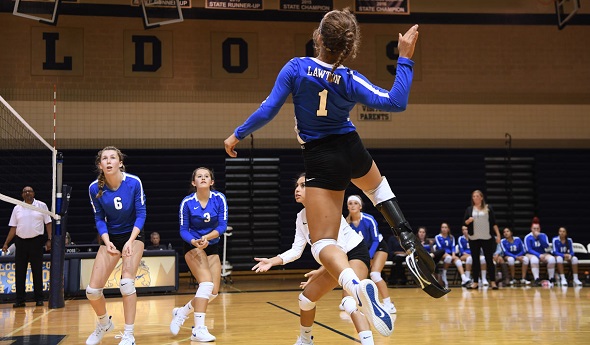
Junior Hitter's Spirit, Skill Give Lawton Lift
By
Pam Shebest
Special for MHSAA.com
September 25, 2019
LAWTON — Olivia Cramer wears her friends proudly — on her leg.
 When she is not wearing a blade to play volleyball or basketball, the Lawton High School junior wears a prosthetic, but it’s not just any leg.
“I’ve had pictures of my friends on it for a couple years, and there’s the homecoming court my freshman year, softball game, at work,” she said.
While the decoration of the prosthetic leg is a novelty, the need for the limb certainly isn’t.
Cramer was born with non-genetic proximal femoral focal deficiency (PFFD), a condition that has resulted in her right leg measuring inches shorter than her left.
It is an uncommon condition that affects about 1 in every 200,000 children, according to statistics from the Children’s Hospital of Philadelphia.
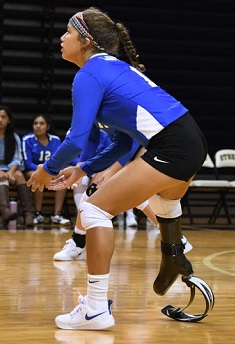
The prosthetic leg assists with everyday life. But when it comes to athletics, she wears a blade, similar to those worn by runners.
“We call it my running blade,” Cramer said. “Mine is designed a little differently than an amputee because I still have my leg bones and foot.”
The custom-made blade, officially called the Freedom Innovations Catapult, is made of carbon fiber and has a rubber tread on the bottom so it will not damage the court.
“It’s about a two-week process and it was a little bit of a challenge to make,” said Tim Darling, a certified prosthetist at Hanger Clinic in Kalamazoo who fashioned the leg and blade.
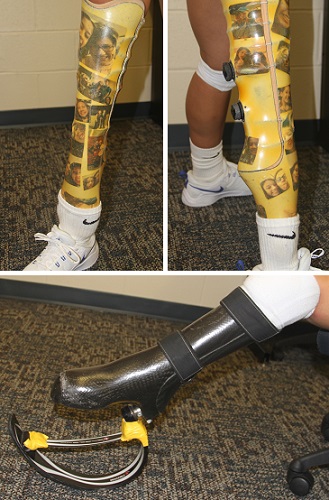 He also was instrumental in adding the photos. “She provided the photos printed on a T-shirt and we used materials to reinforce it and then used an acrylic lamination,” Darling added.
Instead of Velcro straps to keep the leg attached, Cramer has two dials that tighten the leg.
“It has string made of Kevlar and you can tighten them so I don’t have to have straps covering my leg anymore,” she said. “Before, it was just Velcro and came loose a lot.”
Darling said it is a relatively new process for a prosthetic.
100 Percent
“Working with her is humbling,” Lawton volleyball coach Megan McCorry said. “When you see someone with a physical disability like that and you see that same person is also the most positive and most encouraging, it really makes you do a gut check.
“It gives you some perspective in life that what you have going on may not really be that bad, and you need to work harder at putting your best foot forward.”
Cramer was pulled up from junior varsity during the District last year and practiced but did not play.
This season, she sees court time and, “She’s honestly one of those kids that you can’t not have on your team,” McCorry said.
“I mean she is always 100-percent positive. She is going to be the loudest one on the court, loudest one on the bench. She’s always supporting her team, and she’s just so determined to get better individually and make her teammates better.”
Since she jumps off her stronger left leg, the blade does not give Cramer any advantage, but at least once caused a gaffe.
“During a match, my friend Madison Lawson and I were going for a block on the outside and we fought for the block and we came back down,” Cramer said. “Madison landed on my blade and snapped it.
“We didn’t know what happened at first because there was this huge (sound) right in the middle of the match and I was like, ‘What just happened?’ We even stopped playing because of it. I went to step and my leg didn’t spring like it usually does.”
 The junior said her teammates are very supportive.
“She holds herself accountable for everything she does,” senior Gabi Martinez said. “Everything she does basically makes us realize she can do everything we can do. It doesn’t stop her from anything.
“We do watch out for her leg to make sure she doesn’t hurt it, but usually even if she falls down, she gets right back up and she’s usually the one picking everybody else up.”
Cramer’s mother, Megan Cramer, said when she was pregnant, her first ultrasound showed an abnormality in the leg, so she was prepared when Olivia was born.
When learning to walk, Olivia would walk on her short leg and balance on the knee of her good leg, her mother said.
As Olivia grew older, doctors gave her mother two choices: amputation or rotationplasty (fusing the knee on her shorter leg and rotating her foot around to where her knee joint would be). That new joint is where her prosthetic would have connected.
Her mother chose neither.
“I was a young mother, and I was scared to death and I was, ‘You’re not cutting her foot off,’” she said.
They visited several hospitals and finally went to the Shriners Hospital for Children in Chicago.
“That was the first place we went where they said let her be,” Megan said.
That is what her mother did.
“I am glad that they never had it amputated, and I never had rotationplasty,” Olivia Cramer said. “My condition is pretty rare, and because I didn’t do any of the amputation that makes me even more special than it already was, so I really appreciate it.”
She goes to the Shriners Hospital every six months for checkups and gets a new leg and blade when she outgrows the old ones.
Driving and Striving
Golf is Cramer’s true love, and she hopes to pursue it in college.
When playing, she wears her regular prosthetic, not the blade, and, last year, was captain of the school’s boys team (Lawton has no girls team).
 She also played the Lakeshore Junior Golf Association tour during the summer, carrying a 12 handicap and winning the 16-18 girls division.
“Those accomplishments are all special, of course,” Lawton golf coach Barry Shanley said. “But what makes her truly remarkable is her spirit. If you didn't see her prosthetic, you would never know she even has one.
“For now it's actually an advantage for her college goal to play on a high school boys team. The boys play from the men's tees, which is the typical length for collegiate women, so college coaches know her scores now already match what length their own players are using.”
Shanley said the only way her prosthetic affects her swing is that her hip alignment can be a little unbalanced.
“Once she stops growing and her prosthetic is matched to her other leg permanently, there won't be any issue at all,” he said.
“Because it's difficult to keep them matched, which now can cause her some pain if she walks the typical 5.6 miles in 18 holes or the 2.8 miles for 9 holes, we wrote and received permission from the MHSAA to let her take a golf cart during matches.”
Right now, though, Cramer is focused on volleyball, with her team’s record 13-9 midway through the season. The Blue Devils will host an MHSAA Division 3 District beginning Nov. 4.
Other players on the volleyball team are senior Jessica Grear, juniors are Mackenzie Nickrent, Kiana Auton, Caitlen Romo, Josie Buchkowski, Wendy Guerra and Dezare’ Smith; and sophomores Sarah Dekoning and Lily Grear.
No matter the sport, Cramer said she follows her grandfather’s advice.
“My grandpa always has said, ‘Don’t ever say “can’t” in this household. That’s a word that’s not in our dictionary.’
“I guess that’s shaped me into who I am today, being able to persevere through all the difficulties, even though I like to think I have it just as fair as everybody else does, that we’re on an equal playing level.”
Cramer has one hope:
“I hope that if anybody sees this and is down in the dumps for any kind of condition they have, just persevere through it and prove to other people that you are better than they can ever think that you can be.”
 Pam Shebest served as a sportswriter at the Kalamazoo Gazette from 1985-2009 after 11 years part-time with the Gazette while teaching French and English at White Pigeon High School. She can be reached at [email protected] with story ideas for Calhoun, Kalamazoo and Van Buren counties.
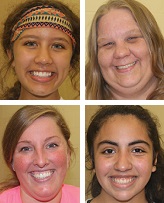
PHOTOS: (Top) Lawton’s Olivia Cramer loads for a kill attempt during a match this fall. (Middle top) Cramer’s prosthetic leg, front and back, and the blade she wears for sports. (Middle) From top left: Olivia Cramer, mother Megan Cramer, teammate Gabi Martinez and volleyball coach Megan McCorry. (Below) Cramer awaits the opponent’s serve. (Action photos by Gary Shook; prosthetic photos and head shots by Pam Shebest.)