


Rivaling for a Cause
January 25, 2013
It’s impossible to include all the perspective we gain from every “Battle of the Fans” visit.
But this anecdote, although it didn't make Tuesday’s story about our Frankenmuth trip, tells of another great example for what student cheering sections can accomplish.
Frankenmuth and Millington are heated rivals, to say the least, separated by 13 miles and made more competitive by plenty of championship-deciding matchups over the years.
But for their boys basketball game Jan. 10 at Frankenmuth, student section leaders from both schools almost completely on their own set up the game as a cancer awareness night, complete with Frankenmuth students in black shirts and Millington’s wearing pink.
The idea was the brainchild of a of Frankenmuth section leader, who then received help from a local bank and contacted Millington to get the ball rolling.
Battle of the Fans has shown us the obvious – these student sections need strong leaders – but also the special things they can accomplish with additional initiative.
“Never Forgotten”
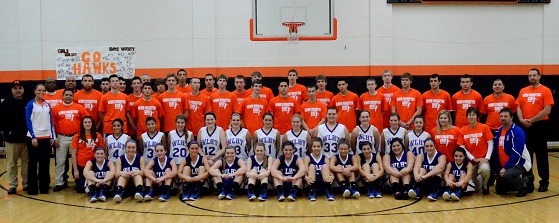 Two more rivals, Fennville and Saugatuck, met late last month for their second “Never Forgotten” boys and girls basketball games with proceeds going to the Wes Leonard Heart Team for the purchase of AEDs.
Players wore jerseys with names on the backs of friends and family members who had died, and those jerseys were then given to family members after the games. Officials Ace Cover, Chris Dennie and Kyle Bowen also donated their game checks to the Heart Team, as did the winner of that night’s 50-50 raffle.
Leonard died from sudden cardiac arrest after making the game-winning shot in a basketball game March 3, 2011. The two schools played their first “Never Forgotten” games last season.
More support for less specialization
I’m asked once a year at least about sport specialization – that is, athletes focusing on just one sport, often from an early age, and if it pays off some way down the road.
Most of my evidence to support my belief in the well-rounded athlete has been anecdotal, based on conversations with people at the high school and college levels over the years. But a British study published this fall in the Journal of Sport Sciences by University of Birmingham researchers provides some interesting empirical findings.
The study of 1,006 people from the United Kingdom showed that those who participated in three sports at ages 11, 13 and 15 were “significantly more likely to compete at a national rather than club standard” between ages 16-18 than those who had practiced only one sport.
In other words, the study found that those who played more sports at earlier ages played at a higher level during their high school-age years, which seems to contradict the one-sport focus philosophy.
Click for more perspective on the study from Chris Kennedy, the Superintendent of Schools in West Vancouver, British Columbia.
PHOTO: The boys and girls teams for Fennville and Saugatuck pose together after their "Never Forgotten" games Dec. 21 at Fennville High. (Photo courtesy of Al LaShell.)
Northern Schools Find Solution in NMFL
September 6, 2019
By Chris Dobrowolski
Special for Second Half
With 17 schools spread across 11 counties, the Northern Michigan Football League has created an indelible footprint since it was born into existence five years ago.
 The conference, made up of three divisions of schools in varying size, has been able to sustain and evolve despite an ever-changing football landscape up north that has made for a revolving door of membership from year to year.
“It continues to morph,” said Frankfort athletic director Dave Jackson, the conference’s commissioner and one of the founders of the league.
From the biggest schools in the Legends division — Benzie Central, Boyne City, Cheboygan, Grayling, Kalkaska, Kingsley and Traverse City St. Francis — to the smaller schools in the Leaders (Charlevoix, Elk Rapids, Frankfort, Mancelona and Maple City Glen Lake) and Legacy divisions (Harbor Springs, East Jordan, Inland Lakes, Johannesburg-Lewiston and St. Ignace) the NMFL has provided easy avenues for scheduling as well as good, competitive balance for the programs that call it home.
“The scheduling aspect is where I go back to it,” said Johannesburg-Lewiston football coach and athletic director Joe Smokevitch. “It’s just been huge for us. Going into 2020 and 2021 my schedule is full, basically with teams from within the conference. They’re not all division games. I am crossing over and playing those other schools. It’s really helped with scheduling. Not having to go far away to play somebody. You look at our schedule. We play some quality opponents. I think the conference is very strong from top to bottom.”
The idea for the league was hatched in 2012 between schools in the Lake Michigan and Northwest conferences. Both leagues were seeing problems from smaller schools trying to compete with larger ones, and neither side benefitting from the affiliation. So, the two merged as a 13-team league comprised of two divisions of similar-sized enrollments.
The league has rarely stayed intact from year to year, switching to the three-division alignment with the growth to 20 teams in 2016 when it absorbed the remaining teams in the Ski Valley Conference, as well as withstanding the loss of six schools to 8-player football in the span of four years.
“We’ve taken schools in the league that didn’t last very long,” said Jackson. “We took in Newberry and they lasted just a year, then suddenly they’re 8-man. We took in Gaylord St. Mary. We took in Central Lake. Those teams were just a year or two and suddenly they’re gone. Our constitution calls for a two-year process of getting out, but those teams that had to go 8-man, they’re out for the next year. So, suddenly you’re scrambling again, which is the one thing we were trying to keep from having to do because there is no planning when that last-minute 8-man decision comes along and schools decide to make that plunge. There’s nothing you can really do when a school says they’re going to do that. You can’t say, ‘Well, the constitution says … .’ They’re going to do what they need to do.”
 Fortunately for the league, it has been able to find suitable replacements at every turn. In fact, Ogemaw Heights and Sault Ste. Marie are set to join in 2020 to become part of the Legends division, bolstering the league to a robust 19 schools. Kalkaska and Boyne City will slide over to the Leaders division and Frankfort — one of the smallest 11-player football teams in the state — is moving to the Legacy division.
“It made sense to apply,” said Ogemaw Heights athletic director Jon Studley, noting four future conference foes already are on this year’s schedule. “We’re very excited about the opportunity to be a part of that. We’re going to be able to create some rivalries.
“I think fans of northern Michigan football benefit the most. They’re seeing competitive football week in and week out.”
As the NMFL has shown, the quality of football being played within the conference is at a high level, too. At least one team from the league has reached the Semifinal round of the MHSAA playoffs every season. Boyne City was a semifinalist in Division 6 in 2014, while St. Francis has represented the league in the Semifinals in 2015, 2017 and 2018. In 2016 two teams advanced that far — St. Ignace in Division 8 and Maple City Glen Lake in Division 6 — with Glen Lake reaching the Finals before falling to Jackson Lumen Christi 26-14.
“I think we’re really starting to get some respect,” said Glen Lake coach Jerry Angers. “I’ve talked to the teams downstate that we’ve played, they want to come up and play us. They’re not saying, ‘This is going to be an easy game.’ They’re saying, ‘This is going to be a fun game, and they’re going to give us something.’”
There remains the possibility the league will undergo more changes before it more comfortably stabilizes. Some schools have expressed interest in joining, and the threat of losing members to 8-player football remains for a few of the smallest schools. It’s nothing the league hasn’t dealt with before, however. Jackson said it comes down to maintaining a commitment to the schools that are in the conference and carefully examining any growth that could occur.
“We had our big meeting in December, and one thing we talked about is how we have to look out for each other,” said Jackson. “We’re trying to guarantee that the league will provide eight of your nine games. In most cases the league is providing all nine of the games. So, you know you’re going to have somebody to play and you’re not going to have to go looking. There’s a time we may control 11-man football for everything north of Lansing. I don’t know. It continues to grow because teams are looking for that stability and consistency year in and year out, so they know who their games are with and they know who they play.”
 Chris Dobrowolski has covered northern Lower Peninsula sports since 1999 at the Ogemaw County Herald, Alpena News, Traverse City Record-Eagle and currently as sports editor at the Antrim Kalkaska Review since 2016. He can be reached at [email protected] with story ideas for Manistee, Wexford, Missaukee, Roscommon, Ogemaw, Iosco, Alcona, Oscoda, Crawford, Kalkaska, Grand Traverse, Benzie, Leelanau, Antrim, Otsego, Montmorency, Alpena, Presque Isle, Cheboygan, Charlevoix and Emmet counties.
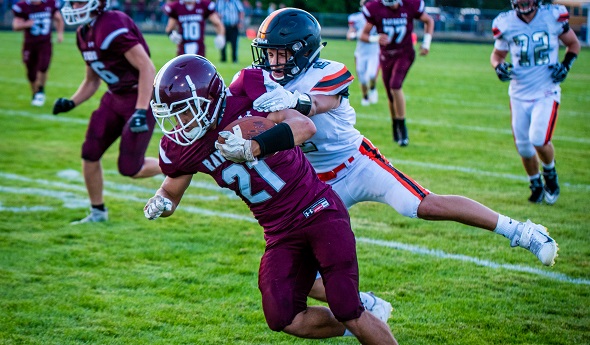
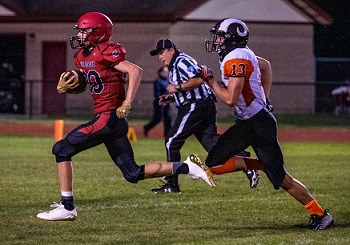
PHOTOS: (Top) Charlevoix, carrying the ball, opened this season with a 40-26 win over Elk Rapids. (Middle) East Jordan got a step on Harbor Springs on this play last week, but the Rams emerged with a slim 34-33 win. (Photos by Sports in Motion.)