


Rivaling for a Cause
January 25, 2013
It’s impossible to include all the perspective we gain from every “Battle of the Fans” visit.
But this anecdote, although it didn't make Tuesday’s story about our Frankenmuth trip, tells of another great example for what student cheering sections can accomplish.
Frankenmuth and Millington are heated rivals, to say the least, separated by 13 miles and made more competitive by plenty of championship-deciding matchups over the years.
But for their boys basketball game Jan. 10 at Frankenmuth, student section leaders from both schools almost completely on their own set up the game as a cancer awareness night, complete with Frankenmuth students in black shirts and Millington’s wearing pink.
The idea was the brainchild of a of Frankenmuth section leader, who then received help from a local bank and contacted Millington to get the ball rolling.
Battle of the Fans has shown us the obvious – these student sections need strong leaders – but also the special things they can accomplish with additional initiative.
“Never Forgotten”
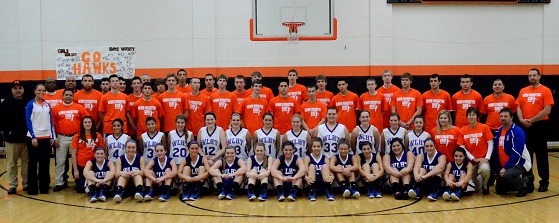 Two more rivals, Fennville and Saugatuck, met late last month for their second “Never Forgotten” boys and girls basketball games with proceeds going to the Wes Leonard Heart Team for the purchase of AEDs.
Players wore jerseys with names on the backs of friends and family members who had died, and those jerseys were then given to family members after the games. Officials Ace Cover, Chris Dennie and Kyle Bowen also donated their game checks to the Heart Team, as did the winner of that night’s 50-50 raffle.
Leonard died from sudden cardiac arrest after making the game-winning shot in a basketball game March 3, 2011. The two schools played their first “Never Forgotten” games last season.
More support for less specialization
I’m asked once a year at least about sport specialization – that is, athletes focusing on just one sport, often from an early age, and if it pays off some way down the road.
Most of my evidence to support my belief in the well-rounded athlete has been anecdotal, based on conversations with people at the high school and college levels over the years. But a British study published this fall in the Journal of Sport Sciences by University of Birmingham researchers provides some interesting empirical findings.
The study of 1,006 people from the United Kingdom showed that those who participated in three sports at ages 11, 13 and 15 were “significantly more likely to compete at a national rather than club standard” between ages 16-18 than those who had practiced only one sport.
In other words, the study found that those who played more sports at earlier ages played at a higher level during their high school-age years, which seems to contradict the one-sport focus philosophy.
Click for more perspective on the study from Chris Kennedy, the Superintendent of Schools in West Vancouver, British Columbia.
PHOTO: The boys and girls teams for Fennville and Saugatuck pose together after their "Never Forgotten" games Dec. 21 at Fennville High. (Photo courtesy of Al LaShell.)
Participation Again Outpaces Population
August 26, 2019
By Geoff Kimmerly
Second Half editor
For the third straight school year, Michigan in 2018-19 had the eighth-most participants in high school sports nationally according to statistics recently released by the National Federation of State High School Associations, again outpacing the state’s national ranking of 10th for total number of residents of high school age.
Michigan’s participation ranking was based on a number of 292,947, with 126,342 girls and 166,605 boys taking part in high school athletics, and included sports in which the Michigan High School Athletic Association does not conduct postseason tournaments. The totals count students once for each sport in which he or she participates, meaning students who are multiple-sport athletes are counted more than once.
The state’s girls participation ranked eighth nationally for the third straight year, while boys participation fell back to eighth, after moving up one spot to seventh during 2017-18. However, as with overall population, Michigan continued to rank 10th for both females and males ages 14-17 according to the latest U.S. Census Bureau estimates from 2018.
A total of 19 sports bested the state’s overall national participation ranking of eighth by placing seventh or higher on their respective lists. Four Michigan sports improved in national ranking during 2018-19, while the state fell in the rankings of five sports.
Perhaps the most notable improvement among Michigan sports came in boys bowling, where Michigan moved up one spot to second – its highest ranking in any of the 28 sports under MHSAA administration. Michigan previously ranked second nationally in boys bowling as recently as 2013-14 before falling to third for the last four years. Michigan’s boys tennis participation moved up one spot as well to fifth on its ranking list, while girls track & field moved up one spot to seventh and girls lacrosse moved up one spot to 13th after a one-year drop back in 2017-18.
Three of five sports that fell on participation lists still outpaced Michigan’s overall participation rank – girls volleyball fell one spot to fifth, while girls golf and girls competitive cheer both fell one spot to sixth on their respective rankings lists. Other Michigan sports that ranked eighth or higher in 2018-19 were baseball (eighth), girls basketball (sixth), boys basketball (seventh), girls bowling (fourth), girls and boys cross country (both seventh), 11 and 8-player football (sixth and seventh, respectively), boys golf (sixth), boys ice hockey (fourth), girls and boys skiing (both third), girls softball (seventh), girls tennis (third) and boys track & field (seventh).
Boys lacrosse, girls soccer and boys and girls swimming & diving participation all slotted ninth on their respective lists, holding to their 2017-18 rankings and placing still ahead of where Michigan slotted for high school-aged population. Michigan wrestling participation fell two spots to ninth nationally, but still outpaced population, and boys soccer fell one spot to 10th. Girls gymnastics participation ranked 11th nationally for the second straight year.
National participation in high school sports in 2018-19 declined for the first time in 30 years – but the total of 7,937,491 participants still ranked third highest all-time, consisting of 4,534,758 boys and 3,402,733 girls.
Girls volleyball saw the largest increase in participants nationally with 6,225 more this past year over 2017-18, followed by boys track & field (+5,257), girls soccer (+3,623) and girls lacrosse (+3,164).
Football, despite a 5.8-percent decrease from 2017-18, remained the most-played high school sport nationally with 1,006,013 participants. Boys track & field (605,354), boys basketball (540,769), girls track & field (488,267), baseball (482,740), boys soccer (459,077) and girls volleyball (452,808) all saw at least 400,000 participants, while girls basketball (399,067) and girls soccer (394,105) approached that total.
The top 10 states by participants remained the same in 2018-19. Texas and California topped the list again with 825,924 and 824,709 participants, respectively, followed by New York (369,266), Ohio (339,158), Illinois (333,838), Pennsylvania (316,429), Florida (308,173), Michigan (292,947), New Jersey (281,058) and Minnesota (240,487). Only Texas, California and Minnesota reported higher figures than the previous year.
The participation survey has been compiled in its current form by the NFHS since 1971 through numbers it receives from its 51 member state associations, including the District of Columbia. Click to see the complete 2018-19 High School Athletics Participation Survey.
The NFHS, based in Indianapolis, Indiana, is the national leadership organization for high school sports and performing arts activities. Since 1920, the NFHS has led the development of education-based interscholastic sports and performing arts activities that help students succeed in their lives. The NFHS sets direction for the future by building awareness and support, improving the participation experience, establishing consistent standards and rules for competition, and helping those who oversee high school sports and activities. The NFHS writes playing rules for 16 sports for boys and girls at the high school level. Through its 50 member state associations and the District of Columbia, the NFHS reaches more than 19,500 high schools and 12 million participants in high school activity programs, including almost 8 million in high school sports. As the recognized national authority on interscholastic activity programs, the NFHS conducts national meetings, sanctions interstate events, offers online publications and services for high school coaches and officials, sponsors professional organizations for high school coaches, officials, speech and debate coaches, and music adjudicators; serves as the national source for interscholastic coach training and serves as a national information resource of interscholastic athletics and activities.
The MHSAA is a private, not-for-profit corporation of voluntary membership by more than 1,500 public and private senior high schools and junior high/middle schools which exists to develop common rules for athletic eligibility and competition. No government funds or tax dollars support the MHSAA, which was the first such association nationally to not accept membership dues or tournament entry fees from schools. Member schools which enforce these rules are permitted to participate in MHSAA tournaments, which attract more than 1.4 million spectators each year.