


Rivaling for a Cause
January 25, 2013
It’s impossible to include all the perspective we gain from every “Battle of the Fans” visit.
But this anecdote, although it didn't make Tuesday’s story about our Frankenmuth trip, tells of another great example for what student cheering sections can accomplish.
Frankenmuth and Millington are heated rivals, to say the least, separated by 13 miles and made more competitive by plenty of championship-deciding matchups over the years.
But for their boys basketball game Jan. 10 at Frankenmuth, student section leaders from both schools almost completely on their own set up the game as a cancer awareness night, complete with Frankenmuth students in black shirts and Millington’s wearing pink.
The idea was the brainchild of a of Frankenmuth section leader, who then received help from a local bank and contacted Millington to get the ball rolling.
Battle of the Fans has shown us the obvious – these student sections need strong leaders – but also the special things they can accomplish with additional initiative.
“Never Forgotten”
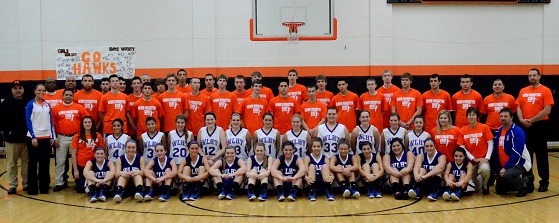 Two more rivals, Fennville and Saugatuck, met late last month for their second “Never Forgotten” boys and girls basketball games with proceeds going to the Wes Leonard Heart Team for the purchase of AEDs.
Players wore jerseys with names on the backs of friends and family members who had died, and those jerseys were then given to family members after the games. Officials Ace Cover, Chris Dennie and Kyle Bowen also donated their game checks to the Heart Team, as did the winner of that night’s 50-50 raffle.
Leonard died from sudden cardiac arrest after making the game-winning shot in a basketball game March 3, 2011. The two schools played their first “Never Forgotten” games last season.
More support for less specialization
I’m asked once a year at least about sport specialization – that is, athletes focusing on just one sport, often from an early age, and if it pays off some way down the road.
Most of my evidence to support my belief in the well-rounded athlete has been anecdotal, based on conversations with people at the high school and college levels over the years. But a British study published this fall in the Journal of Sport Sciences by University of Birmingham researchers provides some interesting empirical findings.
The study of 1,006 people from the United Kingdom showed that those who participated in three sports at ages 11, 13 and 15 were “significantly more likely to compete at a national rather than club standard” between ages 16-18 than those who had practiced only one sport.
In other words, the study found that those who played more sports at earlier ages played at a higher level during their high school-age years, which seems to contradict the one-sport focus philosophy.
Click for more perspective on the study from Chris Kennedy, the Superintendent of Schools in West Vancouver, British Columbia.
PHOTO: The boys and girls teams for Fennville and Saugatuck pose together after their "Never Forgotten" games Dec. 21 at Fennville High. (Photo courtesy of Al LaShell.)
43 Percent of Athletes are Multi-Sport
August 19, 2019
By Geoff Kimmerly
Second Half editor
Nearly 43 percent of athletes at MHSAA member high schools continued to participate in two or more sports in 2018-19, according to the Multi-Sport Participation Survey, reinforcing similar data collected for the first time two years ago and providing a foundation for work by the MHSAA’s Multi-Sport Task Force as it prepares to continue efforts this fall to promote the multi-sport high school experience.
Early and intense sport specialization has become one of the most serious issues related to health and safety at all levels of youth sports, as overuse injuries and burnout among athletes have been tied to chronic injuries and health-related problems later in life. In early 2016, the MHSAA appointed the Task Force on Multi-Sport Participation as part of a continued effort to promote and protect participant health and address the issues leading to early sport specialization.
The multi-sport participation survey was created in 2018 to provide data on the prevalence of sport specialization at MHSAA member high schools. This year’s survey received responses from 82.9 percent of member high schools and measured how multi-sport participation exists at schools. The collection of survey results annually is expected to show how schools are succeeding in promoting a multi-sport high school experience, providing another tool as schools work to guide students toward a well-rounded interscholastic sports career.
From schools that responded to this year’s survey, 42.9 percent of students participated in athletics in 2018-19 – 46.3 percent of boys and 39.5 percent of girls. The overall participation number was up nearly half a percent from 2017-18 (42.5), with the boys percentage holding steady and the girls increasing nearly a full percent from a year ago. Class D schools – those with the smallest enrollments – again enjoyed the highest percentage of athletes among the entire student body, at 57.1 percent, followed by Class C (50.7), Class B (45.8) and Class A (39.4).
Of those athletes counted by responding schools, 43 percent participated in more than one sport – including 45.1 percent of boys and 40.4 percent of girls – with all three of those percentages nearly identical to those derived from the first survey a year ago. Class D again enjoyed the highest percentage of multi-sport athletes, 61.8 percent, followed by Class C (56.7), Class B (48.7) and Class A (35.4).
Similar results for overall sport participation and multi-sport participation relative to enrollment size were seen by further breaking down Class A into schools of fewer than 1,000 students, 1,000-1,500 students, 1,501-2,000 students and more than 2,000 students. Similarly to 2017-18 for both sport participation as a whole and multi-sport participation specifically, the smallest Class A schools continued to enjoy the highest percentages, while percentages then decreased for every larger size group of schools.
Also of note, the percentage of two-sport athletes at every school measure around one-third of athletes – from 29.2 percent at Class A schools to 35.7 at Class B, 37.2 at Class C and 35.6 at Class D. However the number of athletes participating in three sports decreased substantially relative to the increase in school enrollment, with 22.5 percent of Class D athletes playing three sports, 18.2 in Class C, 12.4 in Class B and 6.0 percent in Class A.
The MHSAA Task Force on Multi-Sport Participation will be meeting this fall to discuss creating a program to measure multi-sport participation at MHSAA member schools and to recognize “achievers” – that is, schools that surpass the norm given their enrollment and other factors that affect school sports participation.
For 2018-19, in Class A, Marquette posted the highest percentage of multi-sport athletes with 85.9 percent, up 3.3 percent from its top-ranking Class A percentage from 2017-18. Grand Rapids Northview also topped 80 percent multi-sport participation, with 83.1 percent of its athletes playing two or more sports. Orchard Lake St. Mary’s, Detroit East English and Gibraltar Carlson all saw multi-sport participation from at least 70 percent of their athletes.
In Class B, four schools again achieved at least 80 percent multi-sport participation – Coloma (87.2 percent), Gladstone (86.7), Flat Rock (83.2) and Dundee (80.2), while 10 schools had 70 percent or more athletes playing at least two sports.
Six Class C schools reported more than 80 percent of its athletes taking part in more than one sport – Schoolcraft (87.1), Mayville (86.2), Manton (85.3), Houghton Lake (84.9), Cass City (84.7) and Decatur (83.5) – and 12 schools total with 75 percent or more athletes participating in multiple sports. There were 14 Class D schools with multi-sport participation at 80.9 percent or higher, with Gaylord St. Mary (93.2), Waterford Our Lady of the Lakes (91.5) and Watersmeet (90.3) topping the survey not just for Class D but among all schools that responded.
The full summary report on the Multi-Sport Participation Survey is available on the “Health & Safety” page of the MHSAA Website.