


Rivaling for a Cause
January 25, 2013
It’s impossible to include all the perspective we gain from every “Battle of the Fans” visit.
But this anecdote, although it didn't make Tuesday’s story about our Frankenmuth trip, tells of another great example for what student cheering sections can accomplish.
Frankenmuth and Millington are heated rivals, to say the least, separated by 13 miles and made more competitive by plenty of championship-deciding matchups over the years.
But for their boys basketball game Jan. 10 at Frankenmuth, student section leaders from both schools almost completely on their own set up the game as a cancer awareness night, complete with Frankenmuth students in black shirts and Millington’s wearing pink.
The idea was the brainchild of a of Frankenmuth section leader, who then received help from a local bank and contacted Millington to get the ball rolling.
Battle of the Fans has shown us the obvious – these student sections need strong leaders – but also the special things they can accomplish with additional initiative.
“Never Forgotten”
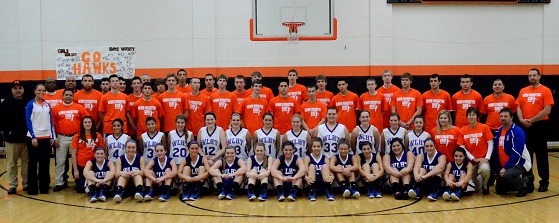 Two more rivals, Fennville and Saugatuck, met late last month for their second “Never Forgotten” boys and girls basketball games with proceeds going to the Wes Leonard Heart Team for the purchase of AEDs.
Players wore jerseys with names on the backs of friends and family members who had died, and those jerseys were then given to family members after the games. Officials Ace Cover, Chris Dennie and Kyle Bowen also donated their game checks to the Heart Team, as did the winner of that night’s 50-50 raffle.
Leonard died from sudden cardiac arrest after making the game-winning shot in a basketball game March 3, 2011. The two schools played their first “Never Forgotten” games last season.
More support for less specialization
I’m asked once a year at least about sport specialization – that is, athletes focusing on just one sport, often from an early age, and if it pays off some way down the road.
Most of my evidence to support my belief in the well-rounded athlete has been anecdotal, based on conversations with people at the high school and college levels over the years. But a British study published this fall in the Journal of Sport Sciences by University of Birmingham researchers provides some interesting empirical findings.
The study of 1,006 people from the United Kingdom showed that those who participated in three sports at ages 11, 13 and 15 were “significantly more likely to compete at a national rather than club standard” between ages 16-18 than those who had practiced only one sport.
In other words, the study found that those who played more sports at earlier ages played at a higher level during their high school-age years, which seems to contradict the one-sport focus philosophy.
Click for more perspective on the study from Chris Kennedy, the Superintendent of Schools in West Vancouver, British Columbia.
PHOTO: The boys and girls teams for Fennville and Saugatuck pose together after their "Never Forgotten" games Dec. 21 at Fennville High. (Photo courtesy of Al LaShell.)
Changes Accompany Start of Fall Practice
August 8, 2019
By Geoff Kimmerly
Second Half editor
An assortment of game rules, preseason policy and postseason tournament changes will greet more than 100,000 high school student-athletes as 2019-20 Fall practices begin next week for nine sports for which the MHSAA sponsors postseason tournaments.
The most immediately noticeable adjustment will allow boys soccer, girls and boys cross country, boys tennis and girls golf teams to begin practice Monday, Aug. 12, along with football teams across the state.
Football practice traditionally begins before the rest of fall sports, by rule on the 16th Monday before Thanksgiving. However, a change approved by the MHSAA Representative Council will allow sports with MHSAA Finals tied to a specific weekend every fall – for example, Lower Peninsula Cross Country Finals always are the first weekend in November – the opportunity to begin practice on that 16th Monday as well, which will keep those teams from losing about a week of practice and competition during “late” Thanksgiving years when the holiday is during the fourth full week of November. Volleyball and Lower Peninsula girls swimming & diving – which, like football, have Finals tied to Thanksgiving – are not affected by the lateness of the holiday and will begin practice Wednesday, Aug. 14, keeping with their traditional starts.
Football teams must have 12 days of preseason practice at all levels before their first game, over a period of 16 calendar days before the first kickoff, with the first games this falls scheduled for the weekend of Aug. 29-31. Competition this fall may begin Aug. 16 for cross country, golf, soccer and tennis and Aug. 23 for volleyball and swimming & diving.
The most publicized change in MHSAA policy this fall likely will be the addition of limited seeding for Lower Peninsula Boys Soccer District play, using a Michigan Power Ratings (MPR) formula that debuted to assist in Boys Lacrosse Regional seeding this past spring and will be utilized as well for Districts in girls and boys basketball this winter and girls soccer beginning in 2020. The MPR formula ranks teams based on success and strength of schedule, with the top two teams in each District then placed on opposite sides of the bracket on the draw date for that sport. For boys soccer this fall, all games reported to the MHSAA through Sept. 28 will be used for MPR, with brackets announced Sept. 29. For more information on MPR and the boys soccer selection process, go to the MHSAA Website’s Boys Soccer page and see the information under “Tracking the Tournament."
Football remains the most played sport among MHSAA member school student-athletes and will introduce this season a series of in-game and practice-related changes. To improve pace of play, all varsity games will be played with a 40-second play clock that begins after the conclusion of the previous play except when there is an exception (penalty, timeout, etc.). In those circumstances, a 25-second clock will start with the referee’s ready-to-play whistle. Also beginning this football season, at the MHSAA Finals level, instant replay will be used to review all scoring plays and turnovers or potential scoring plays and turnovers (that is, when an official’s decision may have prevented or awarded a score or turnover). Replay review will be automatic in these situations.
The other notable rules changes in football continue a focus on safety. Tripping a ball carrier – that is, intentionally using the lower leg or foot to obstruct a runner below the knees – now will result in a 15-yard penalty. The definition of a horse-collar tackle also has been expanded to include grabbing of the name plate area on the back of the jersey (along with the inside of the neck area of the jersey or shoulder pads) to bring a runner to the ground. Horse-collar tackling also is penalized with a 15-yard personal foul.
Also beginning this season, the amount of practice “collision” contact will be defined in minutes instead of allowed days. Teams will be allowed no more than six hours of full-pads collision contact per week during the preseason and no more than 30 minutes of collision contact during a week of in-season (after games begin) practice. “Collision” is defined as contact at game speed, with the execution of full tackles at a competitive pace, taking players to the ground. Although “collision” contact will be limited, “thud” contact will be unlimited. “Thud” is not considered collision contact and defined as full speed but above the waist only, with no player taken to the ground and no winner or loser.
All fall sports face at least minor rules changes this season, and a few of the other most noticeable in-game adjustments will come in girls golf, volleyball, girls swimming & diving and boys soccer.
• In golf, athletes will be allowed to use cell phones in four situations – to call a coach or tournament administrator for a health and safety issue, for use in inputting scores for live scoring or other scoring applications, to contact a rules official with questions, and for use as a distance-measuring device.
• Also in golf, a new rule sets the maximum allowable score per hole at 12 strokes.
• In volleyball, attempted serves that make contact with a backboard or other support device hanging from the ceiling over the serving area now will be illegal serves instead of faults (which previously allowed the server another attempt). Also, when a ball in play strikes the cables or diagonal poles used to retract baskets or similar apparatus to the ceiling, the game official will stop play and determine if the ball was playable -- if it is ruled playable before making contact with the apparatus, there will be a replay; if the ball is deemed to have not been playable, it will be ruled out of bounds.
• Also in volleyball, a change regarding uniforms will make the libero more recognizable. A libero’s uniform top must clearly contrast with those of the rest of her teammates by using another predominant color. The libero’s uniform may be trimmed with the predominant color of her non-libero teammates’ uniforms, and vice versa. Also regarding volleyball uniforms, “00” may no longer be used as a jersey number, only numbers 0-99 to eliminate confusion.
• In swimming, the definition of a legal finish has changed to include a competitor touching any part of the finish end of the lane, not just the touch pad. In diving, the degree of difficulty was adjusted for back and reverse somersaults to provide consistency with difficulty of other dives.
• The game clock will stop in boys soccer beginning this fall when the team leading the game makes a substitution during the final five minutes of the second period of regulation or second part of overtime. This stoppage aims to prevent the team in the lead from using substitutions as a way to run time off the clock.
The 2019 Fall campaign culminates with postseason tournaments beginning with the Upper Peninsula Girls Tennis Finals during the first week of October and wraps up with the 11-Player Football Finals on Nov. 29 and 30. Here is a complete list of fall tournament dates:
Cross Country
U.P. Finals – Oct. 19
L.P. Regionals – Oct. 25 or 26
L.P. Finals – Nov. 2
11-Player Football
Selection Sunday – Oct. 27
Pre-Districts – Nov. 1 or 2
District Finals – Nov. 8 or 9
Regional Finals – Nov. 15 or 16
Semifinals – Nov. 23
Finals – Nov. 29-30
8-Player Football
Selection Sunday – Oct. 27
Regional Semifinals – Nov. 1 or 2
Regional Finals – Nov. 8 or 9
Semifinals – Nov. 16
Finals – Nov. 23
L.P. Girls Golf
Regionals – Oct. 7, 8, 9, 10, 11 or 12
Finals – Oct. 18-19
Soccer
Boys L.P. Districts – Oct. 9-11 & 14-19
Boys L.P. Regionals – Oct. 22-26
Boys L.P. Semifinals – Oct. 30
Boys L.P. Finals – Nov. 2
L.P. Girls Swimming & Diving
Diving Regionals – Nov.14
Swimming/Diving Finals – Nov. 22-23
Tennis
U.P. Girls Finals – Oct. 2, 3, 4 or 5
L.P. Boys Regionals – Oct. 10, 11 or 12
L.P. Finals – Oct. 18-19
Girls Volleyball
Districts – Nov. 4-9
Regionals – Nov. 12 &14
Quarterfinals – Nov. 19
Semifinals – Nov. 21-22
Finals – Nov. 23
The MHSAA is a private, not-for-profit corporation of voluntary membership by more than 1,500 public and private senior high schools and junior high/middle schools which exists to develop common rules for athletic eligibility and competition. No government funds or tax dollars support the MHSAA, which was the first such association nationally to not accept membership dues or tournament entry fees from schools. Member schools which enforce these rules are permitted to participate in MHSAA tournaments, which attract more than 1.4 million spectators each year.