


Rivaling for a Cause
January 25, 2013
It’s impossible to include all the perspective we gain from every “Battle of the Fans” visit.
But this anecdote, although it didn't make Tuesday’s story about our Frankenmuth trip, tells of another great example for what student cheering sections can accomplish.
Frankenmuth and Millington are heated rivals, to say the least, separated by 13 miles and made more competitive by plenty of championship-deciding matchups over the years.
But for their boys basketball game Jan. 10 at Frankenmuth, student section leaders from both schools almost completely on their own set up the game as a cancer awareness night, complete with Frankenmuth students in black shirts and Millington’s wearing pink.
The idea was the brainchild of a of Frankenmuth section leader, who then received help from a local bank and contacted Millington to get the ball rolling.
Battle of the Fans has shown us the obvious – these student sections need strong leaders – but also the special things they can accomplish with additional initiative.
“Never Forgotten”
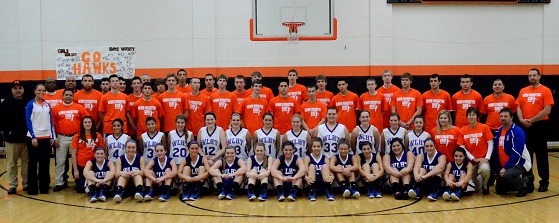 Two more rivals, Fennville and Saugatuck, met late last month for their second “Never Forgotten” boys and girls basketball games with proceeds going to the Wes Leonard Heart Team for the purchase of AEDs.
Players wore jerseys with names on the backs of friends and family members who had died, and those jerseys were then given to family members after the games. Officials Ace Cover, Chris Dennie and Kyle Bowen also donated their game checks to the Heart Team, as did the winner of that night’s 50-50 raffle.
Leonard died from sudden cardiac arrest after making the game-winning shot in a basketball game March 3, 2011. The two schools played their first “Never Forgotten” games last season.
More support for less specialization
I’m asked once a year at least about sport specialization – that is, athletes focusing on just one sport, often from an early age, and if it pays off some way down the road.
Most of my evidence to support my belief in the well-rounded athlete has been anecdotal, based on conversations with people at the high school and college levels over the years. But a British study published this fall in the Journal of Sport Sciences by University of Birmingham researchers provides some interesting empirical findings.
The study of 1,006 people from the United Kingdom showed that those who participated in three sports at ages 11, 13 and 15 were “significantly more likely to compete at a national rather than club standard” between ages 16-18 than those who had practiced only one sport.
In other words, the study found that those who played more sports at earlier ages played at a higher level during their high school-age years, which seems to contradict the one-sport focus philosophy.
Click for more perspective on the study from Chris Kennedy, the Superintendent of Schools in West Vancouver, British Columbia.
PHOTO: The boys and girls teams for Fennville and Saugatuck pose together after their "Never Forgotten" games Dec. 21 at Fennville High. (Photo courtesy of Al LaShell.)
#TBT: 2002 Ends with Lights-Out Finals
July 12, 2019
By Rob Kaminski
MHSAA benchmarks editor
The Flint IMA had been to the MHSAA Ice Hockey Finals what Joe Louis Arena was to the Detroit Red Wings since it began hosting high school championships in the state in 1977.
For parts of four decades, the facility set the scene for many memorable moments on ice for scholastic skaters.
So it would have been fitting as the curtain was closing on an era March 9, 2002, if there’d been an overtime championship game or two to commemorate the last MHSAA Finals at the building.
In 2003, the MHSAA Semifinals and Finals would move to Compuware Arena in Plymouth – now USA Hockey Arena – where the event has been played ever since.
There would be no overtimes during the IMA’s swan song, but the arena wasn’t about to let go without a fight. Following the morning’s Division 2 Final, won by Grosse Pointe North over local qualifier Davison, things got strange.
As if by divine intervention, a significant power outage hit the Flint area between the first and second periods of the Division 3 Final, necessitating a return to the building for an encore performance that Monday.
Following is an account from then-MHSAA Assistant Director Randy Allen, administrator of the sport at that time.
 “East Grand Rapids and (Dearborn) Divine Child were between the first and second periods when the power went out at what must’ve been around three in the afternoon. Some of the house lights went on, but there was no huge generator. The power company told us it could be quite a while before the power came back, so the decision was made pretty quickly to come back Monday. (Editor’s Note: MHSAA regulations at that time prohibited Sunday competition, thus play would resume Monday)
“Finishing the game in progress Monday was really a no-brainer, but now there were a couple of immediate challenges. First, how were we going to let people know, and second, what was going to happen to the (Detroit) Catholic Central-Marquette Division 1 game coming up later in the day?
“Well, knowing what I knew about the TV business (Allen’s background in Wisconsin included sportscasting), I grabbed one of the television reporters there, probably from Grand Rapids, and asked him to come down to the ice with me. It was totally dark; I figured once he put his camera lights on, it would get the attention of the crowd, which it did. So there’s about 2 or 3 thousand people in the arena – in the dark – and I’m standing in front of a light from a TV camera, and at the top of my voice I explain the situation and let them know we’re coming back Monday.
“Anyone wanting to come back, admission was free of charge, and we’d trust they were at the game. If they wanted a refund, they could mail their ticket stub to MHSAA and we'd send a refund. We obviously couldn’t use the box office without power. I don’t recall more than a couple dozen refund requests coming to our office later.
“Now the real challenge is the Division 1 game. Marquette very, very much wanted to go home and come back a week later. They’d been on the road all week (Marquette won a Quarterfinal in Traverse City that Wednesday). Jack (Roberts, former MHSAA executive director) was there, and he and Marquette’s AD (Scott Koski) and their superintendent debated a bit. In the end, the regulations of the day were upheld, and the game would be Monday.
“As it turned out, someone in the Marquette entourage had a contact in the Detroit Pistons front office, so the team was entertained in a suite at The Palace of Auburn Hills on Sunday night, so that was quite a happy ending from their standpoint.
“Many of the Marquette people were either in the arena or at a single hotel or two in the area, so alerting them to the change was not difficult.
“But then we started to think, ‘What about the Detroit CC people who would be driving up for their game later? Remember, social media was not as prevalent as it is today, or even the dependence on the internet.
“So, Saturday night, I sat there at the entrance to the IMA with my car running and lights on to inform the CC fans and anyone else who pulled up that the game had changed ... ‘Power’s out; game’s on Monday.’ They'd say thanks, and out they'd go. No one really got angry; there wasn’t anything anyone could do. I sat there an hour and a half with a steady stream, and shortly after the scheduled game time I called it a night.”
And, the IMA called it the end of an era, but not before hanging on for one more night, when Divine Child and Detroit CC would raise the last trophies in that building ... under the lights.
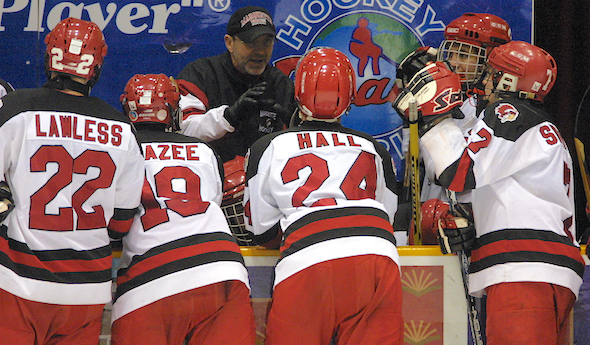
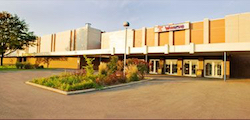
PHOTOS: (Top) Marquette was among teams that needed to stick around Flint two more days to play in the 2002 MHSAA Ice Hockey Finals. (Middle) Flint’s IMA arena.