


Rivaling for a Cause
January 25, 2013
It’s impossible to include all the perspective we gain from every “Battle of the Fans” visit.
But this anecdote, although it didn't make Tuesday’s story about our Frankenmuth trip, tells of another great example for what student cheering sections can accomplish.
Frankenmuth and Millington are heated rivals, to say the least, separated by 13 miles and made more competitive by plenty of championship-deciding matchups over the years.
But for their boys basketball game Jan. 10 at Frankenmuth, student section leaders from both schools almost completely on their own set up the game as a cancer awareness night, complete with Frankenmuth students in black shirts and Millington’s wearing pink.
The idea was the brainchild of a of Frankenmuth section leader, who then received help from a local bank and contacted Millington to get the ball rolling.
Battle of the Fans has shown us the obvious – these student sections need strong leaders – but also the special things they can accomplish with additional initiative.
“Never Forgotten”
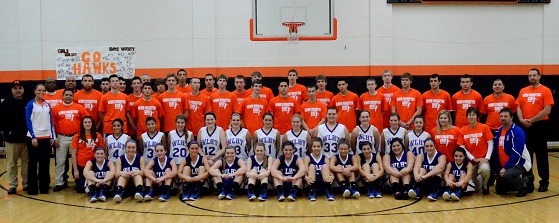 Two more rivals, Fennville and Saugatuck, met late last month for their second “Never Forgotten” boys and girls basketball games with proceeds going to the Wes Leonard Heart Team for the purchase of AEDs.
Players wore jerseys with names on the backs of friends and family members who had died, and those jerseys were then given to family members after the games. Officials Ace Cover, Chris Dennie and Kyle Bowen also donated their game checks to the Heart Team, as did the winner of that night’s 50-50 raffle.
Leonard died from sudden cardiac arrest after making the game-winning shot in a basketball game March 3, 2011. The two schools played their first “Never Forgotten” games last season.
More support for less specialization
I’m asked once a year at least about sport specialization – that is, athletes focusing on just one sport, often from an early age, and if it pays off some way down the road.
Most of my evidence to support my belief in the well-rounded athlete has been anecdotal, based on conversations with people at the high school and college levels over the years. But a British study published this fall in the Journal of Sport Sciences by University of Birmingham researchers provides some interesting empirical findings.
The study of 1,006 people from the United Kingdom showed that those who participated in three sports at ages 11, 13 and 15 were “significantly more likely to compete at a national rather than club standard” between ages 16-18 than those who had practiced only one sport.
In other words, the study found that those who played more sports at earlier ages played at a higher level during their high school-age years, which seems to contradict the one-sport focus philosophy.
Click for more perspective on the study from Chris Kennedy, the Superintendent of Schools in West Vancouver, British Columbia.
PHOTO: The boys and girls teams for Fennville and Saugatuck pose together after their "Never Forgotten" games Dec. 21 at Fennville High. (Photo courtesy of Al LaShell.)
Title Time Differs Among Hockey States
July 12, 2019
By Rob Kaminski
MHSAA benchmarks editor
Next season’s three-week playoff format for the MHSAA Ice Hockey Tournament will fall more closely in line with similar postseasons for state associations around the country which sponsor the sport.
According to 2017-18 National Federation of State High School Associations participation statistics, 18 states sponsor boys ice hockey.
Michigan ranked third in number of schools involved with 240, behind Minnesota (282) and Massachusetts (278). In terms of overall participants, the MHSAA was fourth with 3,353, trailing Massachusetts (7,377), Minnesota (5,751) and New Jersey (3,492) and just ahead of New York (3,088). Wisconsin and Ohio boast more than 2,000 participants annually.
So, how do the tournaments compare among those states similar to Michigan? Most use longer tournament calendars than the two-week span previously employed by the MHSAA.
The timeframe for the season just past in the Minnesota tournament had most play beginning Feb. 21 and ending the same day as the MHSAA Finals, March 9. Some teams started on Feb. 19. The MHSAA dropped the puck for its first games on Monday, Feb. 25. It should be noted that Minnesota crowns just two champions annually, compared to the MHSAA’s three divisions.
Meanwhile, in Wisconsin and Ohio, just one school takes the statewide title each year, so it stands to reason that the postseason is spread out even further. Both states began the 2019 playoffs on Monday, Feb. 11.
Wisconsin’s tourney culminated on March 2 at Veteran’s Memorial Coliseum in Madison as teams played the Quarterfinals, Semifinals and Final over three consecutive days.
Ohio, meanwhile, took a week-long break following District Finals on March 1 or 2, then played the Semifinals and Final at Nationwide Arena in Columbus during March 8-9. This is similar to the rest period the MHSAA will enjoy moving forward from its Quarterfinals to the Semifinals and Finals in 2020.
Just as the season was reaching its pinnacle in Wisconsin, the postseason title chase was merely beginning in Massachusetts, where this year it opened Feb. 25.
Massachusetts is tied for the most divisions of the states studied here with four, but the top division is created with a different twist.
“The top division is often called the ‘Super 8’ or 1A. This tournament is set up differently than the other divisions,” said Massachusetts Ice Hockey Coaches Association President Dan Connolly. “The Super 8 is a double-elimination tournament. The seedlings for this tournament are done by power seeding via a committee using strength of schedule, record, team vs. teams under consideration and win-loss record down the stretch.”
Connolly said just 10 teams are chosen for the Super 8, and seed Nos. 7 through 10 must face off in a play-in game to join the top six. The two teams losing the play-in game return to their respective pre-assigned state divisions and can still win those tournaments. Such was the case in 2019, when Duxbury High lost in its bid to join the Super 8 field, but then won the Division 1 Final.
Like Michigan, those three divisions are based on enrollment, but unlike Michigan, the divisions are seeded based on winning percentage.
The Finals take place on a Sunday at the TD Garden in Boston, a celebration of hockey that features six games (four boys and two girls finals). This year’s event took place March 17, and nearly went into March 18. The Division 1 Final began at 9:59 p.m. as the previous contest, the Super 8 Final, went to four overtimes.
As mentioned, Minnesota’s tournament ended the same day as the MHSAA’s in 2019, and featured one overtime game among its two Finals at the Xcel Energy Center in St. Paul as Edina took the top class over Eden Prairie, 3-2.
The Sunday finales in Boston might seem foreign to followers of MHSAA tournaments, but New York also features a Sunday as the stage for its two state Finals, following Semifinals on Saturday. This year’s playoffs went from Feb. 20-March 10, culminating at the Harborcenter in Buffalo.
Neighboring New Jersey comes closest in length to the old MHSAA format with four divisions – three public and one non-public – taking just 14 days to determine winners at the Prudential Center in Newark. The 2019 titles were determined on Monday, March 4, with Semifinals the Wednesday prior.
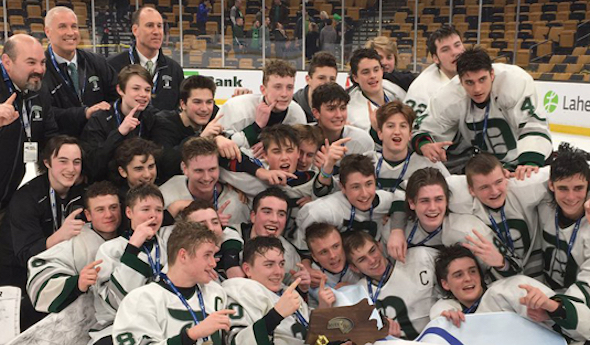
PHOTO: Duxbury celebrated Massachusetts’ Division 1 championship this past season after missing out on making the “Super 8” bracket.