

Rivaling for a Cause
January 25, 2013
It’s impossible to include all the perspective we gain from every “Battle of the Fans” visit.
But this anecdote, although it didn't make Tuesday’s story about our Frankenmuth trip, tells of another great example for what student cheering sections can accomplish.
Frankenmuth and Millington are heated rivals, to say the least, separated by 13 miles and made more competitive by plenty of championship-deciding matchups over the years.
But for their boys basketball game Jan. 10 at Frankenmuth, student section leaders from both schools almost completely on their own set up the game as a cancer awareness night, complete with Frankenmuth students in black shirts and Millington’s wearing pink.
The idea was the brainchild of a of Frankenmuth section leader, who then received help from a local bank and contacted Millington to get the ball rolling.
Battle of the Fans has shown us the obvious – these student sections need strong leaders – but also the special things they can accomplish with additional initiative.
“Never Forgotten”
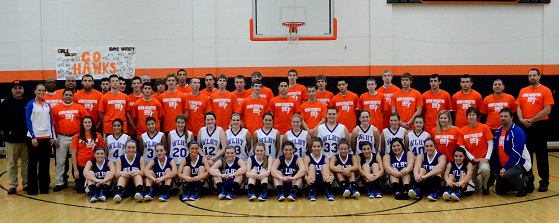 Two more rivals, Fennville and Saugatuck, met late last month for their second “Never Forgotten” boys and girls basketball games with proceeds going to the Wes Leonard Heart Team for the purchase of AEDs.
Players wore jerseys with names on the backs of friends and family members who had died, and those jerseys were then given to family members after the games. Officials Ace Cover, Chris Dennie and Kyle Bowen also donated their game checks to the Heart Team, as did the winner of that night’s 50-50 raffle.
Leonard died from sudden cardiac arrest after making the game-winning shot in a basketball game March 3, 2011. The two schools played their first “Never Forgotten” games last season.
More support for less specialization
I’m asked once a year at least about sport specialization – that is, athletes focusing on just one sport, often from an early age, and if it pays off some way down the road.
Most of my evidence to support my belief in the well-rounded athlete has been anecdotal, based on conversations with people at the high school and college levels over the years. But a British study published this fall in the Journal of Sport Sciences by University of Birmingham researchers provides some interesting empirical findings.
The study of 1,006 people from the United Kingdom showed that those who participated in three sports at ages 11, 13 and 15 were “significantly more likely to compete at a national rather than club standard” between ages 16-18 than those who had practiced only one sport.
In other words, the study found that those who played more sports at earlier ages played at a higher level during their high school-age years, which seems to contradict the one-sport focus philosophy.
Click for more perspective on the study from Chris Kennedy, the Superintendent of Schools in West Vancouver, British Columbia.
PHOTO: The boys and girls teams for Fennville and Saugatuck pose together after their "Never Forgotten" games Dec. 21 at Fennville High. (Photo courtesy of Al LaShell.)
Century of School Sports: All-Time 'Parade of Champions'
By
Geoff Kimmerly
MHSAA.com senior editor
June 25, 2025
As we do every June, we will complete 2024-25 this week by publishing our “Parade of Champions” – a listing of every team to win an MHSAA Finals championship trophy this school year.
Recognizing about 130 champions annually – give or take a few if there were shared titles along the way during that past fall, winter and spring – it’s always an impressive list. So we’re plenty stoked – maybe even 100 times more – to present as our second-to-last “Century of School Sports” feature a few findings from our work-in-progress all-time “Parade of Champions.”
Eventually, the data we’ve collected will be provided on the MHSAA website as a searchable data base – there’s more work to come, and I’ll explain some of that below. But for today, here are some of the first facts that jump off the pages from this massive collection.
Starting with the biggest: Since its first titles were awarded to finish the Winter 1924-25 season, the MHSAA has recognized 6,876 teams for winning Finals championships.
Five schools have won at least 100 Finals titles, and 17 schools have won 50 or more. Marquette leads the list with 295, followed by East Grand Rapids (145), Escanaba (134), Ann Arbor Pioneer (122) and Detroit Country Day (107).
For several reasons, it’s difficult to compare championship totals among Upper Peninsula and Lower Peninsula schools as apples to apples – chiefly, schools in both peninsulas compete against each other in postseason competition in only 16 of 28 MHSAA-sponsored sports, and a handful of those 16 have little or no representation from the U.P. despite being statewide tournaments.
That said, here’s a look at some expanded school Finals title rankings, but by peninsula, going deeper on Lower Peninsula schools ranked because the majority of Michigan’s high schools are below Mackinac Bridge:
Lower Peninsula: 1. East Grand Rapids (145), 2. Ann Arbor Pioneer (122), 3. Detroit Country Day (107), 4. Bloomfield Hills Cranbrook Kingswood 88, 5. Detroit Catholic Central (74), 6. Bloomfield Hills Brother Rice (69), 7. Grosse Pointe Woods University Liggett (64), 8. Jackson Lumen Christi (55), 9. Petoskey (46), 10. Traverse City Central (45).
11. Okemos (44), 12. Detroit St. Martin dePorres (41), 13. East Lansing (39), 14. Rockford (37), T-15. Ann Arbor Greenhills (35), T-15. Birmingham Seaholm (35), 17. Flint Powers Catholic (33), T-18. Bloomfield Hills Marian (32), T-18. Kalamazoo Central (32), 20. Grand Rapids Forest Hills Northern (31).
Upper Peninsula: 1. Marquette (295), 2. Escanaba (134), 3. Iron Mountain (78), 4. Menominee (66), 5. Ishpeming Westwood (65), T-6. Ishpeming (64), T-6. Pickford (64), T-8. Negaunee (50), T-8. Ontonagon (50), 10. Houghton (49).
A few more interesting notes:
• Note Detroit dePorres at No. 12 among Lower Peninsula schools; dePorres closed in 2005. Flint Northern ranks 21st among Lower Peninsula schools with 30 championships despite closing in 2013. The former Ypsilanti High School, which consolidated with Willow Run in 2013 to form Ypsilanti Community, also is high on the list with 24 titles.
• Larger schools generally play more sports, and hence have more opportunities to win Finals titles. But Lower Peninsula small schools fell just outside those listed above, including Battle Creek St. Philip and Fowler – both with 29 championships – and Flint Beecher, Kalamazoo Hackett Catholic Prep and Pewamo-Westphalia with 26 apiece.
• We don’t have an easy way – yet – to figure out which schools have won at least once in the most sports. But among the top five, East Grand Rapids and Marquette both have won titles in 18 sports, Country Day has won in 17, Ann Arbor Pioneer in 15 and Escanaba in 13. Pioneer’s 15 include boys gymnastics, which was sponsored by the MHSAA from 1925-31 and 1961-81.
• Detroit Catholic Central has the most championships among all-boys schools, among 11 sports. Bloomfield Hills Marian ranks highest among all-girls schools, with its titles covering seven sports.
As noted, this remains a work in progress, as we’re continuing to research several school closings, consolidations or other name changes over the last 100 years and how those might affect our championship totals. We also need to continue figuring in how to list championships won by cooperative programs and if those are credited to primary schools or as standalone programs.
In the meantime, we’ll continue to update the data with championships won each season, including in our new sports of girls field hockey and boys volleyball debuting in 2025-26. Once the data is fully edited and complete, we’ll add this substantial source to our growing collection of historical information available for all to enjoy.
Previous "Century of School Sports" Spotlights
June 17: Top Performers Tell Us What High School Sports Mean to Them - Read
June 10: 'The Mitten' Becomes Sought-After Symbol of MHSAA Greatness - Read
June 3: MHSAA's Move to TV, Now Internet, 60 Years Old & Growing - Read
May 27: Upper Peninsula Helps Make Michigan's School Sports Story Unique - Read
May 20: From Nearly A to Z, Schools Repped by 221 Nicknames - Read
May 13: These Record-Setters were Nearly Impossible to Defeat - Read
May 6: 200+ Representatives Fill All-Time Council Roster - Read
April 29: MHSAA Programs Prioritize Health & Safety - Read
April 23: Patches Signify Registered Officials' Role in MHSAA Story - Read
April 16: Student Advisory Council Gives Voice to Athletes - Read
April 9: State's Storytellers Share Spring Memories - Read
April 2: Sharp Leadership Synonymous with MHSAA Success - Read
March 25: Athletic Directors Indispensable to Mission of School Sports - Read
March 18: 2025 Finals Begin Next Half-Century of Girls Hoops Championships - Read
March 11: Boys Basketball's Best 1st to Earn MHSAA Finals Titles - Read
March 5: Everything We Do Begins with Participation - Read
Feb. 25: Slogans & Logos Remain Unforgettable Parts of MHSAA History - Read
Feb. 19: MHSAA Tickets Continue to Provide Fan-Friendly Value - Read
Feb. 11: We Recognize Those Who Make Our Games Go - Read
Feb. 4: WISL Conference Continues to Inspire Aspiring Leaders - Read
Jan. 28: Michigan's National Impact Begins at NFHS' Start - Read
Jan. 21: Awards Celebrate Well-Rounded Educational Experience - Read
Jan. 14: Predecessors Laid Foundation for MHSAA's Formation - Read
Jan. 9: MHSAA Blazes Trail Into Cyberspace - Read
Dec. 31: State's Storytellers Share Winter Memories - Read
Dec. 17: MHSAA Over Time - Read
Dec. 10: On This Day, December 13, We Will Celebrate - Read
Dec. 3: MHSAA Work Guided by Representative Council - Read
Nov. 26: Finals Provide Future Pros Early Ford Field Glory - Read
Nov. 19: Connection at Heart of Coaches Advancement Program - Read
Nov. 12: Good Sports are Winners Then, Now & Always - Read
Nov. 5: MHSAA's Home Sweet Home - Read
Oct. 29: MHSAA Summits Draw Thousands to Promote Sportsmanship - Read
Oct. 23: Cross Country Finals Among MHSAA's Longest Running - Read
Oct. 15: State's Storytellers Share Fall Memories - Read
Oct. 8: Guided by 4 S's of Educational Athletics - Read
Oct. 1: Michigan Sends 10 to National Hall of Fame - Read
Sept. 25: MHSAA Record Books Filled with 1000s of Achievements - Read
Sept. 18: Why Does the MHSAA Have These Rules? - Read
Sept. 10: Special Medals, Patches to Commemorate Special Year - Read
Sept. 4: Fall to Finish with 50th Football Championships - Read
Aug. 28: Let the Celebration Begin - Read
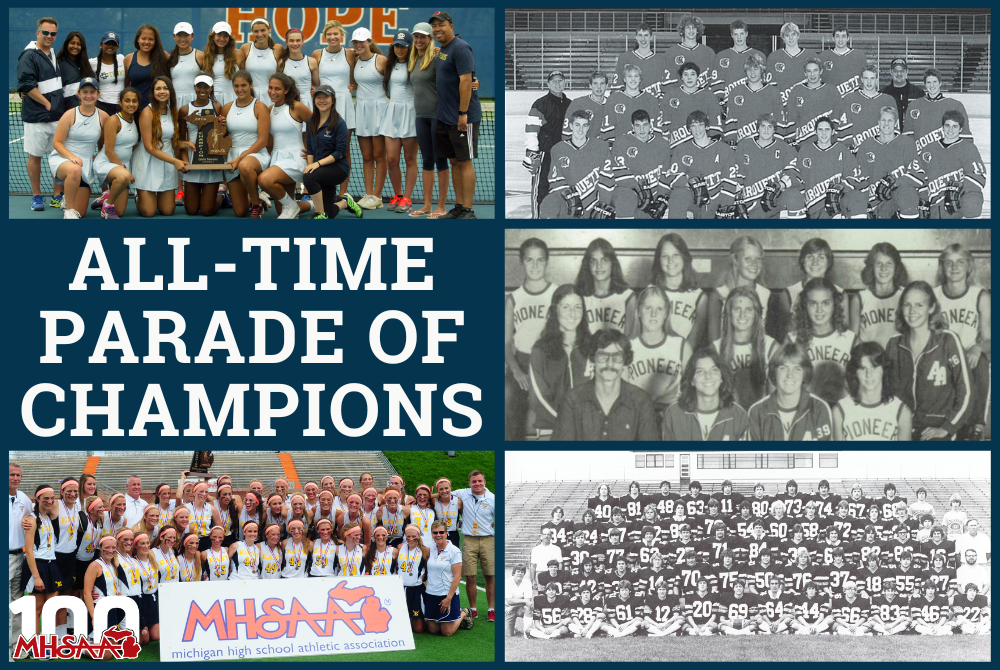
PHOTOS These are all past MHSAA Finals champions, clockwise from top left: The 2016 Detroit Country Day girls tennis team, 2004 Marquette ice hockey team, 1978 Ann Arbor Pioneer girls cross country team, 1981 Escanaba football team and 2013 East Grand Rapids girls lacrosse team.