


Rivaling for a Cause
January 25, 2013
It’s impossible to include all the perspective we gain from every “Battle of the Fans” visit.
But this anecdote, although it didn't make Tuesday’s story about our Frankenmuth trip, tells of another great example for what student cheering sections can accomplish.
Frankenmuth and Millington are heated rivals, to say the least, separated by 13 miles and made more competitive by plenty of championship-deciding matchups over the years.
But for their boys basketball game Jan. 10 at Frankenmuth, student section leaders from both schools almost completely on their own set up the game as a cancer awareness night, complete with Frankenmuth students in black shirts and Millington’s wearing pink.
The idea was the brainchild of a of Frankenmuth section leader, who then received help from a local bank and contacted Millington to get the ball rolling.
Battle of the Fans has shown us the obvious – these student sections need strong leaders – but also the special things they can accomplish with additional initiative.
“Never Forgotten”
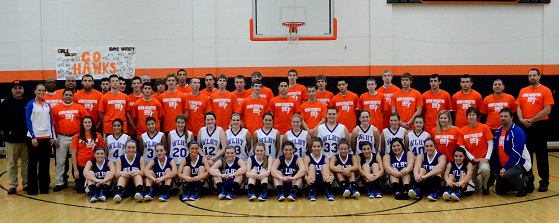 Two more rivals, Fennville and Saugatuck, met late last month for their second “Never Forgotten” boys and girls basketball games with proceeds going to the Wes Leonard Heart Team for the purchase of AEDs.
Players wore jerseys with names on the backs of friends and family members who had died, and those jerseys were then given to family members after the games. Officials Ace Cover, Chris Dennie and Kyle Bowen also donated their game checks to the Heart Team, as did the winner of that night’s 50-50 raffle.
Leonard died from sudden cardiac arrest after making the game-winning shot in a basketball game March 3, 2011. The two schools played their first “Never Forgotten” games last season.
More support for less specialization
I’m asked once a year at least about sport specialization – that is, athletes focusing on just one sport, often from an early age, and if it pays off some way down the road.
Most of my evidence to support my belief in the well-rounded athlete has been anecdotal, based on conversations with people at the high school and college levels over the years. But a British study published this fall in the Journal of Sport Sciences by University of Birmingham researchers provides some interesting empirical findings.
The study of 1,006 people from the United Kingdom showed that those who participated in three sports at ages 11, 13 and 15 were “significantly more likely to compete at a national rather than club standard” between ages 16-18 than those who had practiced only one sport.
In other words, the study found that those who played more sports at earlier ages played at a higher level during their high school-age years, which seems to contradict the one-sport focus philosophy.
Click for more perspective on the study from Chris Kennedy, the Superintendent of Schools in West Vancouver, British Columbia.
PHOTO: The boys and girls teams for Fennville and Saugatuck pose together after their "Never Forgotten" games Dec. 21 at Fennville High. (Photo courtesy of Al LaShell.)
Grand Haven Playmakers Rising to Challenge After Loss of Senior Standout
By
Tom Kendra
Special for MHSAA.com
September 9, 2026
Grand Haven was expected to have one of the state’s best backfield duos this season in seniors Andrew Willemsen and KV Korenstra.
 That duo became singular in July, when Willemsen tore his ACL for the second-consecutive year, a gut-punch both for him and the Buccaneers’ coaching staff – which was planning on handing the ball to Willemsen 20-plus times per game.
Despite that emotional setback, Haven is off to its first 2-0 start since 2018, as the team’s many other offensive standouts – notably Korenstra and senior quarterback Easton Hintz – have stepped up their games.
“We all feel so bad for Andrew, and it just makes us appreciate things so much more,” said Korenstra, a Ferris State commit who rushed for 519 yards and caught 26 passes for 291 yards last fall.
“It’s good for our morale to be 2-0, but we all know that we can play so much better and that we have to play so much better, especially on offense.”
Grand Haven (2-0) heads into the gauntlet of its schedule the next three weeks, starting with Friday night’s Ottawa-Kent Conference Red opener at defending league champion Hudsonville, followed by East Kentwood at home and at Rockford.
The Bucs have found a way to win two tight games, a 35-34, triple-overtime thriller over visiting Spring Lake in the opener and then a hard-fought, 17-14 road win at Muskegon Reeths-Puffer last week.
“It hasn’t always been pretty, but we have been able to finish games out, which hasn’t been the case in the past,” said fourth-year Grand Haven coach Andrew Biedenbender, a Mount Pleasant native who played offensive line at Grand Valley State. “We can’t puff our chests out. We understand what’s ahead of us, but going into it with the confidence we now have is big.”
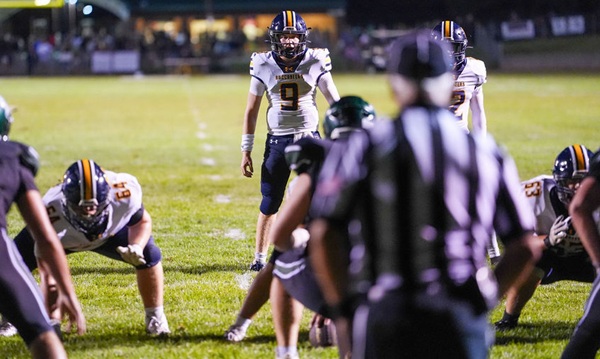
 Senior quarterback Easton Hintz has been the catalyst, completing 28-of-42 passes (67 percent) for 359 yards and four touchdowns, with no interceptions. The dual-threat playmaker also has rushed for 168 yards and a score.
Hintz employs a variety of receiving options, starting with 6-foot-2 wideout Amani Frierson, another Ferris State commit, who has 11 catches for 151 yards and a touchdown.
An emerging weapon for the Bucs is junior tight end Grayam Beyer (6-6, 225), who had a breakout game against Spring Lake with four catches for 43 yards, including two TDs. Beyer already has five Division I college offers and visited Ohio State last Saturday.
If those weapons draw excessive attention, Hintz often hooks up with shifty junior slot receivers Lennon Jorgensen and Drew Hammerle.
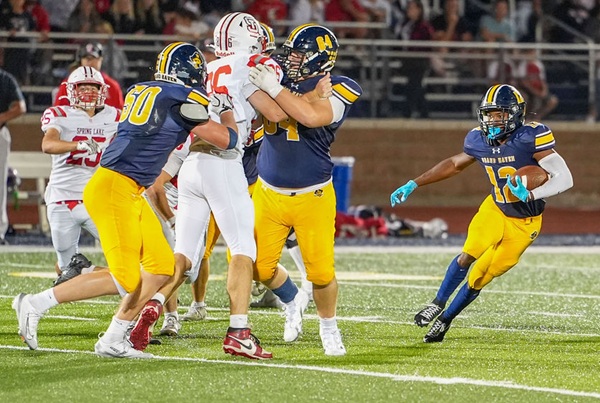
Korenstra has been solid, if not spectacular, with 157 rushing yards and two TDs through two games. Korenstra, who finished third at the Lower Peninsula Division 1 Finals in the 100-meter dash last spring (10.79), has been slowed by a sprained ankle which he suffered early in the opening game.
“If you saw him early last week, you would have never thought he could play a football game,” said Biedenbender of the senior speedster, who was clocked at 4.28 seconds in the 40-yard dash this summer.
“So he has been fighting that ankle but still has hit a couple of 15- or 20-yard runs, but we’re waiting for him to break off a couple of 40- or 50-yarders.”
While he waits for Korenstra to get back up to full speed, Biedenbender occasionally allows himself to imagine what might have been this fall if Willemsen had stayed healthy.
The three-sport standout and athletic freak burst onto the scene as a sophomore with 1,321 yards and 11 TDs. He missed his entire junior year after tearing his ACL during summer workouts but came all the way back and was part of two school-record sprint relay teams in track this spring.
 His recovery was so impressive (running a 4.3 40-yard dash and squatting almost 500 pounds early this summer) that he was offered a scholarship at Grand Valley. Willemsen was working out at GVSU in July when the unthinkable happened – a full tear of his other ACL.
“It’s like having a sports car in your garage that you never had a chance to drive,” said Biedenbender, whose main assistants are Matt Naber (offensive coordinator) and Eric Rozema (defensive coordinator). “He’s one of the best athletes ever at Grand Haven that no one’s going to know about. He has some great football ahead of him but, unfortunately, it won’t be for us.”
The Buccaneers still possess a variety of weapons that other teams would love to have, with an experienced senior quarterback in Hintz directing the show. Hintz (6-0, 185) threw for 975 yards last fall despite missing about one-third of the season with an injury, but is now on pace to easily eclipse the 1,000-yard passing plateau.
Haven’s 2-0 start also has put the team in position to make some noise in the conference race and compete for five wins and the school’s first playoff berth since 2019.
The quick start is a continuation of success at Grand Haven, which won the Division 1 boys volleyball title in the spring, to go along with a Finals appearance in softball and a fifth-place team finish in boys track.
“So much of it comes down to belief,” said Hintz, a crafty left-hander who is just as comfortable throwing on the run as he is in the pocket. “Our aiming point is making it to the playoffs and then winning a playoff game, which is something that hasn’t been done at this school in a long time. I believe we have the team to do it.”
 Tom Kendra worked 23 years at The Muskegon Chronicle, including five as assistant sports editor and the final six as sports editor through 2011. E-mail him at [email protected] with story ideas for Muskegon, Oceana, Mason, Lake, Oceola, Mecosta and Newaygo counties.
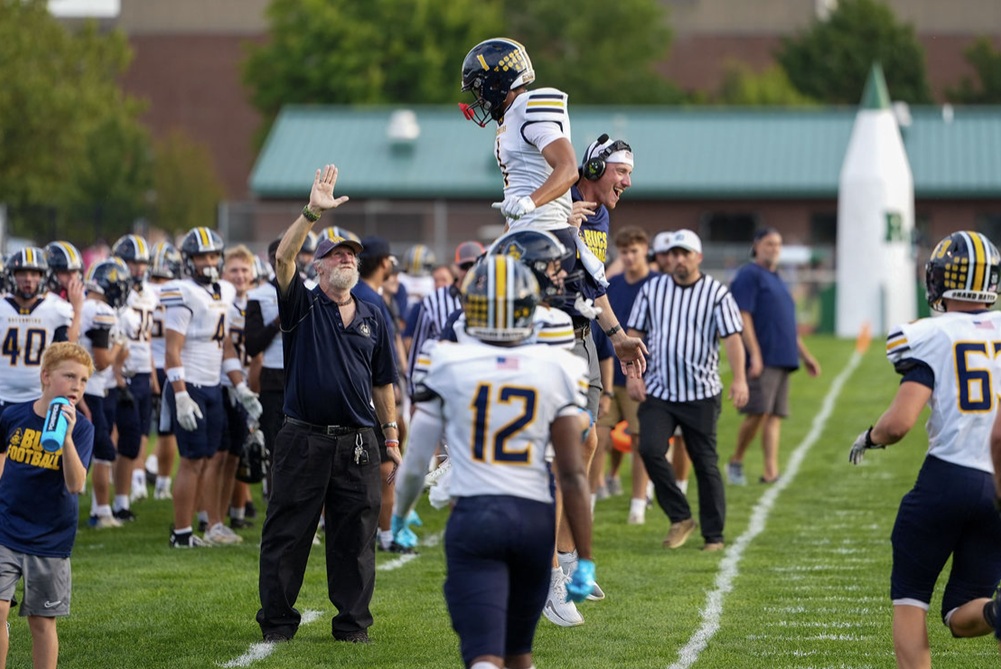
PHOTOS (Top) Fourth-year Grand Haven coach Andrew Biedenbender celebrates with wideout Amani Frierson (1) during last week’s victory over Muskegon Reeths-Puffer. (Middle) KV Korenstra (12) follows his blockers against Spring Lake. (Below) Senior quarterback Easton Hintz (9) prepares to take a snap against Reeths-Puffer. (Photos by Josh Walters/JWaltVisuals.)