

Special Year Thanks to No Specialization
August 7, 2015
By Geoff Kimmerly
Second Half editor
As we embark on another sports-filled school year Monday, we can look to a recent Monroe St. Mary Catholic Central grad for the value of a school year filled with sports.
As specialization at the highs school level continues to be debated, Bryce Windham will start his college baseball career this fall at Division I Old Dominion University – after playing baseball but also football and basketball for the Falcons.
 The MHSAA has long advocated athletes taking on as many sports as they have interest instead of focusing on just one in pursuit of a college scholarship – a position that’s received plenty of public backing of late, be it from stars of the U.S. women’s soccer team after their World Cup championship run or former Lansing Waverly multi-sport athlete John Smoltz during his enshrinement in the Major League Baseball Hall of Fame.
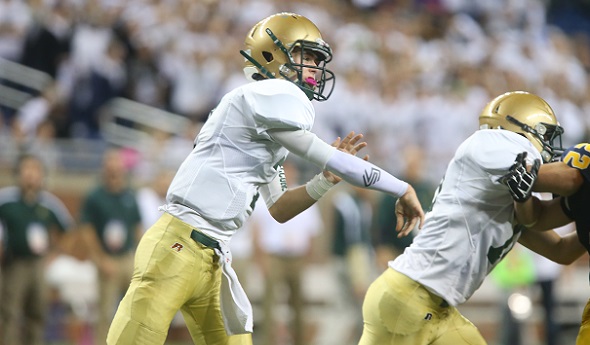
Enter Windham – who easily could’ve been excused for focusing on baseball, or even basketball as his dad is the St. Mary’s varsity boys coach. Instead, Bryce quarterbacked the football team to last season’s Division 6 championship – breaking Ithaca’s national-best 69-game winning streak in the Final – before being named Class C Player of the Year by The Associated Press in basketball and earning a Most Valuable Player honor at the baseball state coaches association all-star game at Comerica Park this spring.
All three of Windham's teams reached at least the MHSAA Quarterfinals.
“His participation in football and basketball helped land a Division 1 baseball scholarship to Old Dominion. They were able to see his athleticism in basketball and toughness in football, and ODU’s coach loved it,” dad and hoops coach Randy Windham said.
“He probably would’ve given up football, and that ended up his greatest memory by winning a state championship.”
Click to read about Windham’s multitude of accomplishments as reported last month by the Monroe Evening News.
Honors Abound
National coaching honors were bestowed on a trio of Michigan coaches over the summer:
- Retired Trenton ice hockey coach Mike Turner – the winningest hockey coach in MHSAA history with a record of 629-126-52 from 1974-81 and then 1995-2014 – was named National Coach of the Year in Special Sports by the National High School Athletic Coaches Association. His teams won 11 MHSAA titles and finished runner-up four times. “I was there when the MHSAA added hockey as one of their sanctioned sports and crowned their first MHSAA state championships in 1975. At that time there were 60-70 high school teams participating, and now there are 170,” Turner said. “It has been great to be a part of the advancements made in the sport of high school hockey, with more teams participating, more player development, and more opportunities that exist for players after high school.”
- Traverse City Central boys track and field and cross country coach John Lober won his second national coaching honor of the 2014-15 school year, named the NHSACA Coach of the Year for track and field to go with a previous honor earned in January from the National Federation of State High School Associations. He has coached the Traverse City Central boys track and field team since 1977 and also the boys cross country team since 1989. His 1992 track team won the Class A championship, and he has coached 17 individual MHSAA Finals champions. He was inducted into the Michigan Interscholastic Track Coaches Association Hall of Fame in 2006.
- Ann Arbor Pioneer assistant girls swimming and diving coach Liz Hill was named the Assistant Coach of the Year for all girls sports by the NHSACA. Hill, a former All-American at the University of Michigan and standout sprinter at Pioneer, began assisting her husband Denny Hill in 1983 before becoming his fulltime assistant a few seasons later. Together they’ve led the Pioneers girls to 15 MHSAA team titles, the last two as co-head coaches.
Michigan Mourns
Fremont and the high school athletic community statewide mourned the death July 21 of longtime coach Rich Tompkins, who led Fremont’s boys cross country teams to six MHSAA cross country championships including three and a runner-up finish during his last decade of coaching before retiring in 1997.
The Muskegon Chronicle reported that his boys and girls cross country teams and boys track and field team combined for 45 league championships, with his boys cross country team winning 116 straight duals from 1977-88. Tompkins was executive director of the Michigan High School Coaches Association for more than a decade and served on its board for more than two decades.
Click to read more from the Chronicle on Tompkins’ legacy.
Officials in the News
The Monroe County Officials Association took to the county fair to encourage passers-by to “Be the Referee” – and received 47 sign-ups from people interested in the avocation. Visitors to an MCOA booth at the fair were told in some detail what is involved with being an MHSAA official, and those who then signed up to find out more about officiating football, basketball, baseball or softball (sports the MCOA trains for and schedules) will be invited to an orientation session where they will become eligible for one of 20 complimentary registration fees for this school year.
 The West Michigan Officials Association marked a decade of support at the start of this summer for the Visually Impaired Sports and Activity Day, sponsored by the Helen DeVos Children’s Foundation. The WMOA has contributed nearly $18,000 to the event over the last 10 years as well as taking part in the event, which includes a number of sports and other activities.
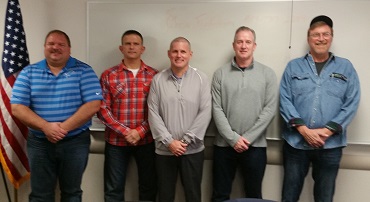
The Saginaw Athletic Officials Association sent along this photo of five members who worked 2013-14 MHSAA Finals, from left: Mark Jarlock (baseball), Tom Behmlander (softball), Scott Helmka (football), Dale Brown (softball and football) and Mark Schoenow (football). The Baseball Final was Jarlock’s first; the other officials had worked Finals in the past.
PHOTO: (Top) Monroe St. Mary quarterback Bryce Windham unloads a pass during last season's Division 6 Final win over Ithaca at Ford Field.
How To Be Proactive About Concussions In Student Athletes
December 5, 2023
Most people have seen the headlines about concussions as a common sports injury—and it's natural that parents of athletes may have concerns. A large misconception in sports is that previous concussions are to be blamed for ongoing headaches, blurred vision and memory loss, among other symptoms.
 “It’s really important to think about concussions in tandem with overall brain health,” says Jake Carpenter-Thompson, M.D., Ph.D., a board-certified neurologist at the Henry Ford Kutcher Clinic for Concussion and Sports Neurology. “Concussions can be concerning, but they shouldn’t be looked at in a vacuum. It is important to understand an athlete’s overall brain health to help manage recovery after any impact.”
One way to do that is to consult with your child’s doctor or a sports neurologist for an annual evaluation. A sports neurologist focuses on managing sports-related brain and nervous system injuries and conditions in athletes, such as concussions, post-concussion syndrome, peripheral nerve injuries, migraines, epilepsy and more.
“Having an annual evaluation of your athlete’s brain health when they are at their baseline – and uninjured – can help diagnose and treat issues when they arise,” says Dr. Carpenter-Thompson.
A qualified healthcare professional can use the baseline evaluation results as an important comparison tool if an athlete develops a suspected concussion.
Best Practices For Keeping Athletes Safe
Dr. Carpenter-Thompson shares these tips to ensure you keep front of mind your child’s brain health and safety, not just their athletic performance:
- Get a brain health baseline test. This should include a personal and family neurological history, with a focus on current issues. It is important to note any neurological conditions that may influence concussion recovery, such as ADHD, depression, anxiety or migraine headaches.
- Encourage your children to listen to their body. There are risks to playing any sport. Encourage your child to listen to and be honest about how they’re feeling. It’s the best way to prevent and treat injuries.
- In the event of an injury, look for the signs. Within 24 hours after an injury, an athlete should be evaluated if they are experiencing: headaches, fatigue, dizziness and nausea, changes in sleep habits, trouble with memory, confusion, irritability and anxiety, or light sensitivity.
- Know that brain injuries don’t just occur with a blow to the head. They can also occur from falls, car accidents or even whiplash. If your child is experiencing any symptoms, consult your physician.
- Remember that brain health is more than just concussions. If your athlete is complaining of chronic headaches, migraines, dizziness, memory or mood issues, there may be an underlying issue.
“There is no magic number of concussions a brain can sustain. Each person is different,” says Dr. Carpenter-Thompson. “The severity of the impact and recovery time can vary greatly for numerous reasons. By getting a brain health assessment before the injury, we can provide more targeted care to improve an athlete's overall clinical course.”
To find a sports medicine doctor or athletic trainer at Henry Ford, visit henryford.com/athletes.