

Special Year Thanks to No Specialization
August 7, 2015
By Geoff Kimmerly
Second Half editor
As we embark on another sports-filled school year Monday, we can look to a recent Monroe St. Mary Catholic Central grad for the value of a school year filled with sports.
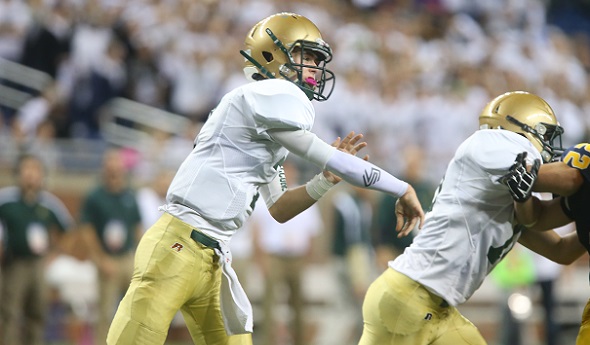
As specialization at the highs school level continues to be debated, Bryce Windham will start his college baseball career this fall at Division I Old Dominion University – after playing baseball but also football and basketball for the Falcons.
 The MHSAA has long advocated athletes taking on as many sports as they have interest instead of focusing on just one in pursuit of a college scholarship – a position that’s received plenty of public backing of late, be it from stars of the U.S. women’s soccer team after their World Cup championship run or former Lansing Waverly multi-sport athlete John Smoltz during his enshrinement in the Major League Baseball Hall of Fame.
Enter Windham – who easily could’ve been excused for focusing on baseball, or even basketball as his dad is the St. Mary’s varsity boys coach. Instead, Bryce quarterbacked the football team to last season’s Division 6 championship – breaking Ithaca’s national-best 69-game winning streak in the Final – before being named Class C Player of the Year by The Associated Press in basketball and earning a Most Valuable Player honor at the baseball state coaches association all-star game at Comerica Park this spring.
All three of Windham's teams reached at least the MHSAA Quarterfinals.
“His participation in football and basketball helped land a Division 1 baseball scholarship to Old Dominion. They were able to see his athleticism in basketball and toughness in football, and ODU’s coach loved it,” dad and hoops coach Randy Windham said.
“He probably would’ve given up football, and that ended up his greatest memory by winning a state championship.”
Click to read about Windham’s multitude of accomplishments as reported last month by the Monroe Evening News.
Honors Abound
National coaching honors were bestowed on a trio of Michigan coaches over the summer:
- Retired Trenton ice hockey coach Mike Turner – the winningest hockey coach in MHSAA history with a record of 629-126-52 from 1974-81 and then 1995-2014 – was named National Coach of the Year in Special Sports by the National High School Athletic Coaches Association. His teams won 11 MHSAA titles and finished runner-up four times. “I was there when the MHSAA added hockey as one of their sanctioned sports and crowned their first MHSAA state championships in 1975. At that time there were 60-70 high school teams participating, and now there are 170,” Turner said. “It has been great to be a part of the advancements made in the sport of high school hockey, with more teams participating, more player development, and more opportunities that exist for players after high school.”
- Traverse City Central boys track and field and cross country coach John Lober won his second national coaching honor of the 2014-15 school year, named the NHSACA Coach of the Year for track and field to go with a previous honor earned in January from the National Federation of State High School Associations. He has coached the Traverse City Central boys track and field team since 1977 and also the boys cross country team since 1989. His 1992 track team won the Class A championship, and he has coached 17 individual MHSAA Finals champions. He was inducted into the Michigan Interscholastic Track Coaches Association Hall of Fame in 2006.
- Ann Arbor Pioneer assistant girls swimming and diving coach Liz Hill was named the Assistant Coach of the Year for all girls sports by the NHSACA. Hill, a former All-American at the University of Michigan and standout sprinter at Pioneer, began assisting her husband Denny Hill in 1983 before becoming his fulltime assistant a few seasons later. Together they’ve led the Pioneers girls to 15 MHSAA team titles, the last two as co-head coaches.
Michigan Mourns
Fremont and the high school athletic community statewide mourned the death July 21 of longtime coach Rich Tompkins, who led Fremont’s boys cross country teams to six MHSAA cross country championships including three and a runner-up finish during his last decade of coaching before retiring in 1997.
The Muskegon Chronicle reported that his boys and girls cross country teams and boys track and field team combined for 45 league championships, with his boys cross country team winning 116 straight duals from 1977-88. Tompkins was executive director of the Michigan High School Coaches Association for more than a decade and served on its board for more than two decades.
Click to read more from the Chronicle on Tompkins’ legacy.
Officials in the News
The Monroe County Officials Association took to the county fair to encourage passers-by to “Be the Referee” – and received 47 sign-ups from people interested in the avocation. Visitors to an MCOA booth at the fair were told in some detail what is involved with being an MHSAA official, and those who then signed up to find out more about officiating football, basketball, baseball or softball (sports the MCOA trains for and schedules) will be invited to an orientation session where they will become eligible for one of 20 complimentary registration fees for this school year.
 The West Michigan Officials Association marked a decade of support at the start of this summer for the Visually Impaired Sports and Activity Day, sponsored by the Helen DeVos Children’s Foundation. The WMOA has contributed nearly $18,000 to the event over the last 10 years as well as taking part in the event, which includes a number of sports and other activities.
The Saginaw Athletic Officials Association sent along this photo of five members who worked 2013-14 MHSAA Finals, from left: Mark Jarlock (baseball), Tom Behmlander (softball), Scott Helmka (football), Dale Brown (softball and football) and Mark Schoenow (football). The Baseball Final was Jarlock’s first; the other officials had worked Finals in the past.
PHOTO: (Top) Monroe St. Mary quarterback Bryce Windham unloads a pass during last season's Division 6 Final win over Ithaca at Ford Field.
Retired NHL-er Back on Ice to Answer Call - By Making Them
By
Rob Kaminski
MHSAA benchmarks editor
March 16, 2023
The most accomplished skater on the ice during Friday’s triple-overtime MHSAA Division 1 Semifinal hockey thriller between Hartland and Brighton was not wearing the school colors of either team.
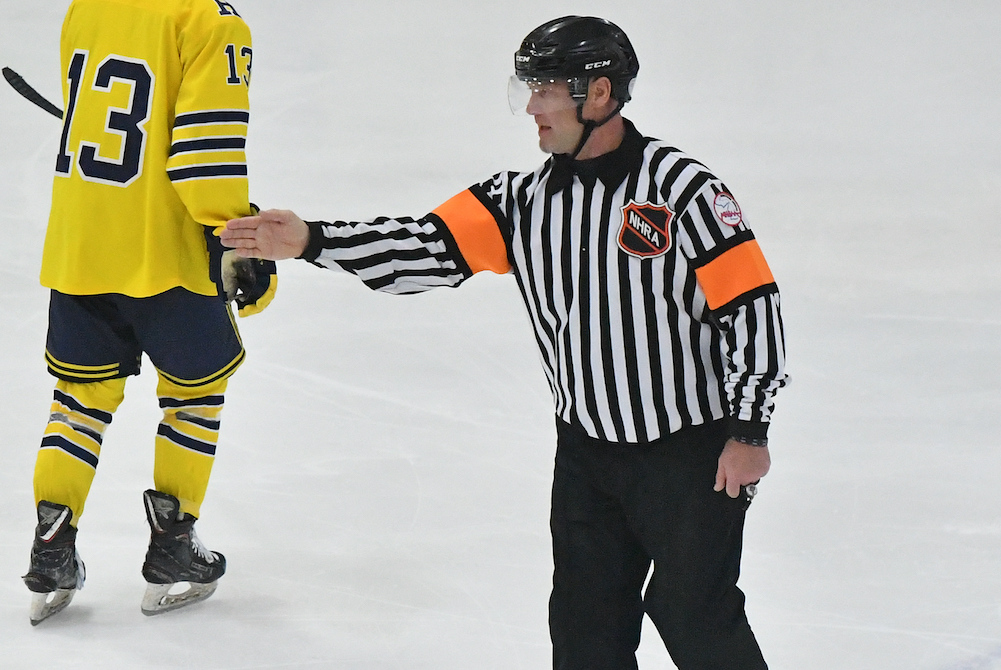
In front of a packed house at Plymouth’s USA Hockey Arena, referee Bryan Smolinski was in stripes, just like the rest of his officiating crew.
In his former life, he pulled on plenty of sweaters before lacing up the skates. That happens when one logs more than 1,000 games, tallies nearly 300 goals (274) and close to 400 assists (377) with eight teams spanning a 15-year playing career in the National Hockey League.
So, how did the 52-year-old former star player find himself on the ice last weekend as one of the referees for the pinnacle weekend of this high school season? Good question, even for the man known as “Smoke” during his playing days.
“I was working in youth development programs a few years back and reached out to some Michigan guys I had connections with about other ways to help the game,” Smolinski said. “I called Kevin May just to chat and asked, ‘Hey, how’s your reffing going?’ He said, ‘You know, we’re down a little bit,’ then said, ‘Why don’t you do it?’ I said, ‘Not a chance,’” Smolinski laughed.
Never Say Never
May persisted, imploring his friend to skate with him during a Fall league at Cranbrook in Bloomfield Hills. After eight weeks, once a week, Smolinski had a revelation.
“I’m like, ‘I’m kind of diggin’ this,’” Smolinski said “So, I did all the testing, and the educational part of it, and I really enjoyed it. I got with Danny (DiCristofaro) and his group, and he put me in as much as he could, and I really started to get my feet wet.”
 DiCristofaro is the assigner and referee-in-chief for the MHSAA’s Northeast Hockey Referees Association, and he has seen Smolinski’s growth first-hand.
“Obviously he’s got great instincts and a feel for the game, along with a wealth of experience, all of which has allowed him to climb the ladder quickly,” said DiCristofaro. “It’s been a joy to watch his growth as an official.”
Fast forward to last Friday, and there were Smolinski and May sharing duties as referees during the MHSAA Semifinal with linesmen Michael Andrews and Thomas Robbins.
In between, there has been a learning curve that still continues, but the jump to officiating was not quite as daunting as his introduction to the NHL.
“I was scared to death. My first game was against Mario Lemieux. I’m in the old Boston Garden and now I’m playing against these guys and it’s their job, and they’re out there trying to make a living,” Smolinski recalled.
The emotions were not running nearly as frenzied for his first game as an MHSAA official, obviously, yet respect came in a different form.
“I couldn’t pick the puck up, I was breathing heavily; it was Kevin and me doing a two-man game in Brighton,” Smolinski recalled. “There were a few high-end kids playing, and I’m thinking, ‘I’m dying here.’ You know, there’s no training for that first time.”
What that experience did, however, was revitalize Smolinski in a new way. His playing career is well documented, not only in the NHL, but around Michigan. He enjoyed an honor-laden career at Michigan State University from 1989-93 before joining the Boston Bruins (who had drafted him three years earlier) at the end of the ’93 NHL campaign. Even after his final season, with Montreal in 2007-08, he stayed in the game via men’s leagues, or coaching his son, Max.
Smolinski and his wife, Julie, have three daughters: Ashtyn (22), Jojo (16) and Rylen (12), along with Max, whom dad coached for seven years including during a national championship run with a Little Caesars U15 team in 2019. Max, 19, is now playing collegiately at Rensselaer Polytechnic Institute.
So, for Smolinski, officiating offers a new chapter.
“Reffing brought back ... I wouldn’t say love of the game, because that’s always been there; it’s a different side of enjoying the game now. I have no horse in the race, my son’s off to college, my daughters are doing their thing; I wanted to find something new in the game,” Smolinski said. “I’ve coached, and I don’t want to do that. I found this, and I’ve stuck with it.”
Old College Ties
One of the great benefits of athletics at any level are the friendships made. For two kids who met in their first years on the MSU campus and forged a bond that lasts to this day, it’s amazing how their careers reached the pinnacle and have now come full circle.
Wes McCauley, an MSU teammate, is one of Smolinski’s best friends. After numerous years in the minor leagues, McCauley, like his friend, made it to the NHL. But McCauley made it as an official, working his first NHL game in 2003, when Smolinski was nearing the end of his playing career.
 Their games lined up on just a few occasions in the NHL, and the two lobbied hard to have McCauley work Smolinski’s 1,000th career game in his final season with the Canadiens in 2007-08. The request, sadly, was denied by the league.
On the rare occasions when the friends did share the same ice, less than a handful by Smolinski’s count, it was McCauley who was forced to rebuff any attempts at fraternization. It’s just part of an official’s edict.
“For both of us, it was amazing; it was just great,” Smolinski said. “I’d say, ‘Hey man what’s up?’ and he says, ‘Can’t talk.’ I’m like, ‘What do you mean, we talk all the time.’ Again, he’s like, ‘Can’t talk, get away from me.’ You know, it was just business.”
McCauley then reached the 1,000-game plateau himself in 2018 and is still going strong as a regular selection for playoff duties with nine Stanley Cup Finals assignments, including last year.
So, it should have been natural for Smolinski to go to his old friend immediately for officiating pointers once he joined the ranks, right? Well, maybe not immediately.
“I talk to Wes all the time, but I actually hid it from him right out of the gate because I didn’t want to take his razzing. Eventually it got out, and he was loving it. He started sending me whistles and visors and pants,” Smolinski said, grinning. “And none of it fit, you know, because I’m older and fatter, and he’s so damn skinny. So, I still had to go out and get all new gear.”
Both Sides Now
Having been to the top of his profession, now moving to the other side of that same mountain that his friend McCauley scaled, the respect has grown for those blowing the whistle.
“The preparation for officiating is much more mental,” Smolinski said. “Way more rules oriented. You’re always trying to get away with things that you can as a player; now you have to police that.”
Smolinski has a distinct advantage.
“I know everything they’re trying to do because I’ve done it. I know where you’re going with the puck, I know what kind of breakout you’re trying to do,” Smolinski said. “I have all the instincts, now I just try to stay out of the way and not ruin their game. The most fun is watching the game develop and the ups and downs. For me to be out there and enjoy it with them, that’s the fun part.”
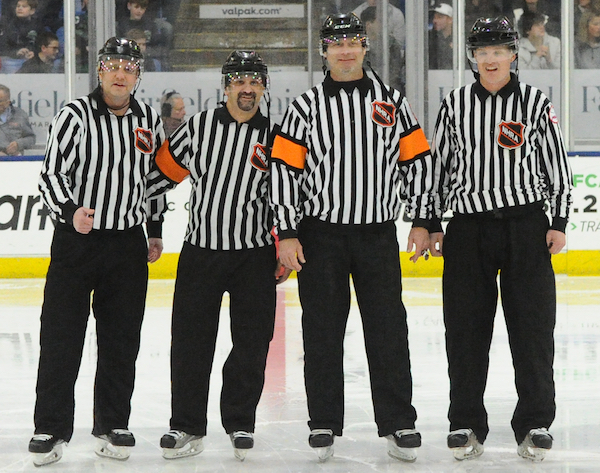 Those who have played hockey at any level have a built-in advantage should they consider the officiating avocation: the ability to skate. Unlike officiating in any other sport, skating is a prerequisite. This makes the pool limited, and almost solely composed of former players. Smolinski offers this advice.
“I prefer sticking with high school because I think there’s more decorum, more administrative structure. Kids are playing for their schools, there’s loyalty there,” said Smolinski. “And there is more accountability. People need report to athletic directors and supervisors. Other levels can be more loosely governed, or a bit more maverick in nature. Moms and dads get involved more, coaches maybe know a little less,” said Smolinski.
He has, in fact, worked a handful of non-school games, and there’s a stark difference.
“I wanted to see what was going on, and I see it first-hand,” Smolinski said. “There are some crazy people and parents out there, and these guys are getting absolutely tortured. I’ve been tortured. There has to be a level of respect for what officials do. I think schools can rein that in a little more. All the guys I’ve met give up a lot of time and work hard because they love to do it and love the game.”
All sports need an assist from school administration and from those who once played the games to keep the officials recruitment moving in the right direction. People like Smolinski can help.
“He clearly doesn’t need to do this, and that’s what makes it so fantastic,” DiCristofaro said. “We need more people who have played – at any level – to do what he’s done and stay in the game as officials.”
Smolinski continues to promote the game in other ways as well. Currently, he is involved in the NHL’s Learn To Play initiative, which aims to inspire youth and welcome more families into the hockey community.
“We work hand-in-hand with the NHL Players Association for player development and industry growth,” Smolinski said. “Ages 5 to 9 are introduced to hockey, get head-to-toe gear and instruction, and meet some former players.”
The idea is to have fun first, which can translate into years and maybe even a lifetime in the sport. It’s a lifetime that has given Smolinski so much and continues to do so as he watches it unfold for others from his new vantage point.
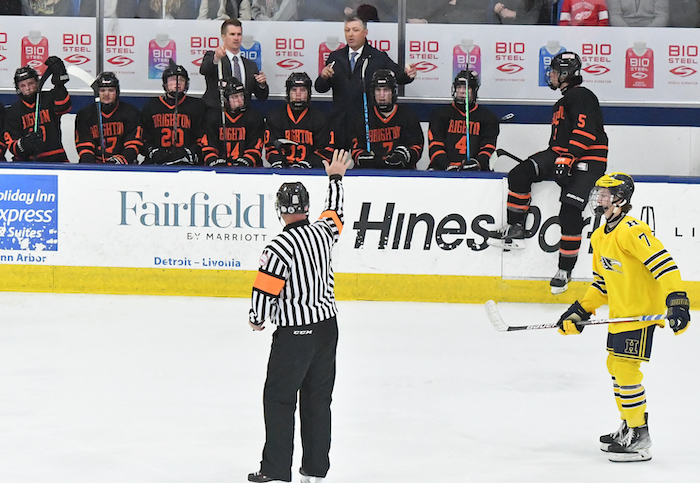
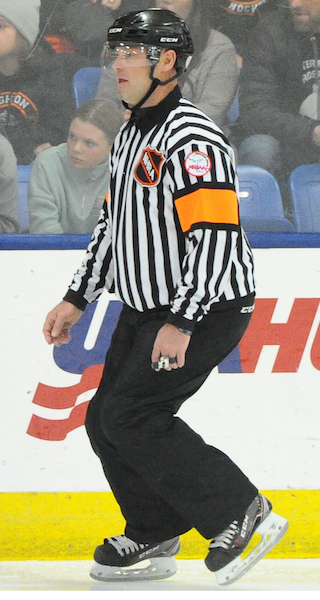
PHOTOS (Top) MHSAA official Bryan Smolinski signals during Friday's Division 1 Semifinal between Brighton and Hartland. (2) Smolinski, a retired NHL standout, communicates with the Bulldogs' bench. (3) Smolinski keeps watch during game play. (4) Smolinski, third from left, with his crew: Michael Andrews, Kevin May and Thomas Robbins.