


Special Year Thanks to No Specialization
August 7, 2015
By Geoff Kimmerly
Second Half editor
As we embark on another sports-filled school year Monday, we can look to a recent Monroe St. Mary Catholic Central grad for the value of a school year filled with sports.
As specialization at the highs school level continues to be debated, Bryce Windham will start his college baseball career this fall at Division I Old Dominion University – after playing baseball but also football and basketball for the Falcons.
 The MHSAA has long advocated athletes taking on as many sports as they have interest instead of focusing on just one in pursuit of a college scholarship – a position that’s received plenty of public backing of late, be it from stars of the U.S. women’s soccer team after their World Cup championship run or former Lansing Waverly multi-sport athlete John Smoltz during his enshrinement in the Major League Baseball Hall of Fame.
Enter Windham – who easily could’ve been excused for focusing on baseball, or even basketball as his dad is the St. Mary’s varsity boys coach. Instead, Bryce quarterbacked the football team to last season’s Division 6 championship – breaking Ithaca’s national-best 69-game winning streak in the Final – before being named Class C Player of the Year by The Associated Press in basketball and earning a Most Valuable Player honor at the baseball state coaches association all-star game at Comerica Park this spring.
All three of Windham's teams reached at least the MHSAA Quarterfinals.
“His participation in football and basketball helped land a Division 1 baseball scholarship to Old Dominion. They were able to see his athleticism in basketball and toughness in football, and ODU’s coach loved it,” dad and hoops coach Randy Windham said.
“He probably would’ve given up football, and that ended up his greatest memory by winning a state championship.”
Click to read about Windham’s multitude of accomplishments as reported last month by the Monroe Evening News.
Honors Abound
National coaching honors were bestowed on a trio of Michigan coaches over the summer:
- Retired Trenton ice hockey coach Mike Turner – the winningest hockey coach in MHSAA history with a record of 629-126-52 from 1974-81 and then 1995-2014 – was named National Coach of the Year in Special Sports by the National High School Athletic Coaches Association. His teams won 11 MHSAA titles and finished runner-up four times. “I was there when the MHSAA added hockey as one of their sanctioned sports and crowned their first MHSAA state championships in 1975. At that time there were 60-70 high school teams participating, and now there are 170,” Turner said. “It has been great to be a part of the advancements made in the sport of high school hockey, with more teams participating, more player development, and more opportunities that exist for players after high school.”
- Traverse City Central boys track and field and cross country coach John Lober won his second national coaching honor of the 2014-15 school year, named the NHSACA Coach of the Year for track and field to go with a previous honor earned in January from the National Federation of State High School Associations. He has coached the Traverse City Central boys track and field team since 1977 and also the boys cross country team since 1989. His 1992 track team won the Class A championship, and he has coached 17 individual MHSAA Finals champions. He was inducted into the Michigan Interscholastic Track Coaches Association Hall of Fame in 2006.
- Ann Arbor Pioneer assistant girls swimming and diving coach Liz Hill was named the Assistant Coach of the Year for all girls sports by the NHSACA. Hill, a former All-American at the University of Michigan and standout sprinter at Pioneer, began assisting her husband Denny Hill in 1983 before becoming his fulltime assistant a few seasons later. Together they’ve led the Pioneers girls to 15 MHSAA team titles, the last two as co-head coaches.
Michigan Mourns
Fremont and the high school athletic community statewide mourned the death July 21 of longtime coach Rich Tompkins, who led Fremont’s boys cross country teams to six MHSAA cross country championships including three and a runner-up finish during his last decade of coaching before retiring in 1997.
The Muskegon Chronicle reported that his boys and girls cross country teams and boys track and field team combined for 45 league championships, with his boys cross country team winning 116 straight duals from 1977-88. Tompkins was executive director of the Michigan High School Coaches Association for more than a decade and served on its board for more than two decades.
Click to read more from the Chronicle on Tompkins’ legacy.
Officials in the News
The Monroe County Officials Association took to the county fair to encourage passers-by to “Be the Referee” – and received 47 sign-ups from people interested in the avocation. Visitors to an MCOA booth at the fair were told in some detail what is involved with being an MHSAA official, and those who then signed up to find out more about officiating football, basketball, baseball or softball (sports the MCOA trains for and schedules) will be invited to an orientation session where they will become eligible for one of 20 complimentary registration fees for this school year.
 The West Michigan Officials Association marked a decade of support at the start of this summer for the Visually Impaired Sports and Activity Day, sponsored by the Helen DeVos Children’s Foundation. The WMOA has contributed nearly $18,000 to the event over the last 10 years as well as taking part in the event, which includes a number of sports and other activities.
The Saginaw Athletic Officials Association sent along this photo of five members who worked 2013-14 MHSAA Finals, from left: Mark Jarlock (baseball), Tom Behmlander (softball), Scott Helmka (football), Dale Brown (softball and football) and Mark Schoenow (football). The Baseball Final was Jarlock’s first; the other officials had worked Finals in the past.
PHOTO: (Top) Monroe St. Mary quarterback Bryce Windham unloads a pass during last season's Division 6 Final win over Ithaca at Ford Field.

Jackson's Imprint on MHSAA Stretches 45 Years, Across 4 Executive Directors
By
Geoff Kimmerly
MHSAA.com senior editor
October 5, 2022
First impressions can be significant, as many a saying goes. And Karen Brown unknowingly provided one in 1978 that helped affect the course of athletics in this state over the next 40-plus years.
A Michigan State University student named Karen Leinaar had shown up at the Michigan High School Athletic Association for a meeting about a 5K road race she was planning that was unrelated to the MHSAA except that the building provided a good meeting place – and Brown, just a year out of high school, was the first person to greet her at the old Trowbridge Road headquarters.
Seeing someone her age immediately made Leinaar more comfortable. She ended up returning to that office several times over the years, registering as an MHSAA game official while still an MSU student and then starting a career in 1982 that has included nearly 40 years as a high school athletic director and two decades of shaping policy as part of the MHSAA Representative Council.
That’s the kind of impact that’s emanated from Karen Jackson, formerly Brown, and over the last 45 years as assistant to four of the five executive directors during the MHSAA’s 98-year history. Jackson finished that run with her retirement Friday.
“She was always one that would welcome you, and whether you walked into the office or called on the phone, she always had an answer that would calm you down or provide you with the information you needed,” said Leinaar, who currently is serving as interim athletic director at Frankfort High School in addition to her duties as executive director of the Michigan Interscholastic Athletic Administrators Association.
“I remember initially calling and needing something from Mr. Norris – it was always Mr. Norris – and she could answer the question,” Leinaar added, referring to retired MHSAA executive director Vern Norris, who served in that role from 1978-86. “You didn’t want to talk to scary Mr. Norris – Vern was a wonderful man, but he was like the superintendent or principal. Karen always had the answer. … It was always that smile that made you feel like you were more than welcomed, wanted in the office, and everything is going to be OK.”
 Jackson began at the MHSAA in June 1977, two days before her graduation from long ago-closed Harry Hill High School in Lansing.
Her high school sports career amounted to about half a season on the Hill varsity volleyball team as a sophomore before she had to switch gears to begin working for the Lansing Regional Chamber of Commerce as part of a school co-op program.
Jackson graduated as a co-valedictorian of Hill’s Class of 1977. Despite her academic standing, she hadn’t received much guidance at school on the possibility of college. But she had a job offer from the Chamber – and also had heard from grade-school friend Deborah Norris (Vern’s daughter) about an opening at the MHSAA.
The MHSAA was offering more money, and Jackson was hoping to buy a car – and so at 18, she became the secretary for executive director Allen W. Bush.
The title has changed over the years, from secretary to the executive director, to executive assistant, to senior executive assistant. The MHSAA’s administrative processes obviously have changed, mostly because of technology, from everything done on paper and through the mail to just about everything conducted digitally over the internet.
But many of Jackson’s most important duties at the end of her tenure resembled those she was hired to carry out nearly half a century ago.
Setting Exemplary Expectations
Bush retired a year after Jackson began, and she then assisted Norris for his eight as executive director. She served with Jack Roberts through his 32 years as executive director from 1986-2018 and then for these first 3½ under current director Mark Uyl.
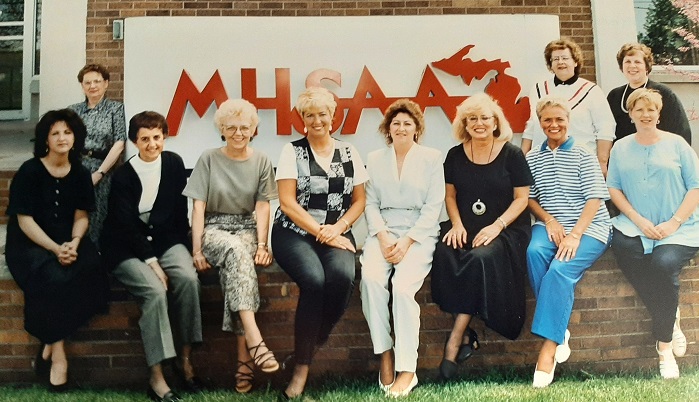
She was considered the “baby” of the MHSAA staff during her first 12 years, until she turned 30 and her support staff teammates declared she wasn’t the baby anymore during a Christmas party serenade. Just about 33 years later, she’s leaving as one of two people left who worked in the old offices before the MHSAA moved to another East Lansing headquarters at Ramblewood Drive in 1996.
School sports happen thanks to a Karen Jackson or two in every community -- people who provide the unseen support that makes these programs possible every day.
For the last 45 years, she’s provided a consistent anchor for service to 1,500 schools and millions of student-athletes across Michigan.
 “She’s shaped so much of what we’ve done,” said MHSAA assistant director Kathy Vruggink Westdorp, who joined the staff during the 2003-04 school year after more than two decades working for Grand Rapids-area schools. “Her service to schools was imperative to what she was doing, and it was a valuable part for our membership. Hers was such a dedicated service, such an exemplary service – finding solutions, to do what’s needed.”
There are file cabinets and libraries and hard drives at the MHSAA office, the contents of which are known by only a handful of people on Earth – and Jackson perhaps the most as she did most of the sorting and maintaining of those files over the years.
For a 1996 Lansing State Journal feature on the MHSAA’s support staff, Jackson (then Yonkers) explained “there are always new challenges, new issues and controversies. It never gets boring. In the past 19 years, we’ve slowly shifted from dealing with athletic administrators, principals and superintendents to dealing with legislators, attorneys and courts.”
The last 25 years has seen much of the work swing back to providing service directly to schools. And Jackson’s mind has become part MHSAA library and part card catalog of where to find those few snippets she might not recall immediately from the last half century.
“I guess what I’m proud of is being able to find things, to know where to find things and how to find things that other people don’t,” Jackson said. “Yes, the technology has changed everything. … We used to have more schools – they used to have 40-some Detroit public schools – and there was a whole era of (litigation), but it’s calmed down now.
“I liked what I did, and it kept me on my toes – that’s for sure.”
The MHSAA is rooted in its responsibilities as a championship and eligibility rules maker, and Jackson was involved in just about every communication in those areas during her time. Tournament changes are made at Representative Council meetings, and she’s reported the minutes for at least 150 of those, including piles of special sessions as the MHSAA managed sports through the COVID-19 pandemic. Eligibility waivers are requested at Executive Committee meetings, and she’s prepared somewhere north of 505 sets of minutes for those monthly sessions even as those agendas have grown in content substantially over the years.
Then there’s all of the correspondence from those four executive directors – all with the initials “kb” or “kj” to go with “AWB” or “VLN” or “JER” and “MU.” She also was in charge of MHSAA election ballots for 35 years, served as the lead organizer of cooperative programs, helped with football tickets for a time and briefly was part of the program-selling crew at early Football Finals at the Pontiac Silverdome.
“I think I’m pretty lucky, being on the Council and Executive Committee, that I’ve been able to work with her a lot. And most athletic directors, they may not even know who she is because they may not have contact with her or do anything with her – but she’s obviously been the unsung hero of that office,” said Vic Michaels, who serves as director of physical education & athletics for the Archdiocese of Detroit and has served on the Representative Council since 2003.
“She just does so much that you don’t really know about, especially with the Council. Whenever I need anything, Karen’s the one I call. She is the history, really. She’s the keeper of that.”
Unprecedented & 'Never to be Replicated'
A longtime co-worker of Jackson, Shirley Hytinen, retired in 1998 after just a few months more than 43 years. She too had worked for four executive directors, as she began in 1955 during the Charles E. Forsythe era.
Jackson surpassed Hytinen’s tenure a few years into Uyl’s, and can readily recall some of what stood out from all four directors she’s assisted.
Bush was “really stern” – he had served in the U.S. Marines – and she said he didn’t smile much until the day he announced his retirement, when it was “like a switch turned. He was smiling and happy and joking around.”
Norris was “the sweetest guy in the world.” Jackson had bought her first house in her mid-20s and was preparing to move in with only her dad and his motor home to assist, when Norris showed up to help at 7:30 a.m. that morning to provide another set of hands.
Roberts is known by Michigan administrators and national colleagues for his writing, and Jackson said jokingly she still “cringes” when she sees a yellow legal pad. She was an important proofreader and spent the majority of her career serving with her desk just a few paces away from that of the recent National Federation Hall of Fame selection, and she attended his induction this past summer and San Antonio.
 Roberts pointed out that during the 1980s, the MHSAA would conduct nine Executive Committee meetings, each averaging fewer than 10 requests for waivers. By the end of his 32 years, there were 11 Executive Committee meetings annually – with approximately 50 waiver requests presented on average. Still, he and Jackson were able to process the meeting minutes and continue to distribute those decisions within 24 hours.
“Over the more than three decades that Karen and I worked together at the MHSAA, the work became increasingly more voluminous and complicated – and Karen kept finding ways to increase our efficiency and maximize our output,” Roberts said.
Like Norris when Bush was executive director, Uyl had been part of the MHSAA staff under Roberts since 2004 before eventually moving into the corner office. After those first 15 years together, Uyl knew what a valuable person he had just a few yards away to assist in his transition, and “he just says to do this” and allows his staff to run with it, which Jackson enjoyed.
Her duties have been shifted confidently, mostly to Jamie VanDerMoere, another longtime administrative assistant who is best-known to Michigan school sports people for her leadership with the annual wrestling championship tournaments.
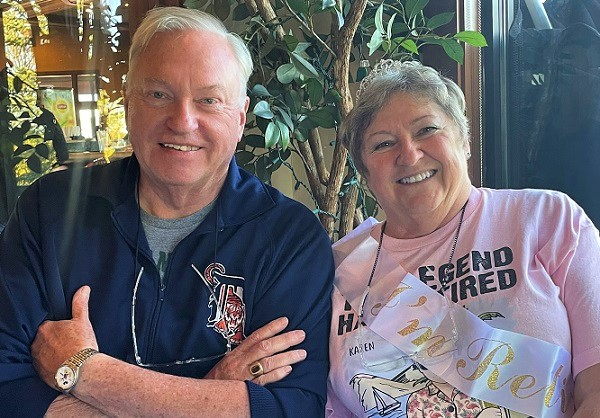
Jackson recently was married to Jim Jackson, and they have plans as they close in on their first anniversary – they’re hoping to travel to Italy at some point and also The Masters in Augusta, Ga., next spring. “I’m not going to miss coming to work every day, but the people,” Karen Jackson said.
And many in school sports across Michigan, although they may not realize it, will miss the contributions Jackson has made to their community over the decades including the context she’s provided as thousands of decisions have been made.
“Not only her understanding of our regulations and the processes of our regulations, but understanding why we have those things in place – when someone does something 45 years, you get a lot of historical context,” Uyl said. “What’s made her so effective is understanding the why – and that to me is something that’s almost impossible to replace.
“When an organization has been around 98 years with only five directors, it says something to have worked for four out of the five. That will never be replicated again.”
PHOTOS (Top) From top left, Karen Jackson has been a mainstay of the MHSAA for decades – serving membership, working with administrators like Randy Allen and Gina Mazzolini or serving as assistant to executive directors like Jack Roberts (right) and Vern Norris. (Middle) Jackson, sitting fourth from left, was the “baby” of the MHSAA staff after joining when she was 18. (Below) Jackson and husband Jim have plans to travel in retirement. (MHSAA archives.)