

MHSAA Teams Up for Leadership Training
October 2, 2014
By Rob Kaminski
MHSAA benchmarks editor
Nothing strengthens a community like neighbors working together. The same can be said for organizations whose missions and goals are closely aligned.
Welcome to East Lansing, where the MHSAA and the Michigan State University Institute for the Study of Youth Sports share geographical boundaries and the same philosophies for educational athletics.
The ISYS mission, as stated on its website, is as follows: “The mission of the Institute for the Study of Youth Sports is to provide leadership, scholarship and outreach that ‘transforms’ the face of youth sports in ways that maximize the beneficial physical, psychological, and social effects of participation for children and youth while minimizing detrimental effects.”
That should sound familiar to athletic leaders within the MHSAA.
Key to the relationship between the MHSAA and the ISYS was the hiring of Dan Gould to the MSU faculty in 2004. Director of the ISYS, he helped to facilitate one of the first major initiatives between the ISYS and the MHSAA, which was to revamp the coaches education program, replacing the PACE program with the Coaches Advancement Program (CAP). Dr. Larry Lauer of the ISYS was heavily involved in creation of the CAP under the direction of MHSAA Assistant Director Kathy Vruggink Westdorp.
At the same time, Dr. Gould also led a study with athletic directors and coaches throughout the state to understand the greatest issues in high school sports. Additionally, to continue the ISYS mission to disseminate research findings, Dr. Marty Ewing, Dr. Gould, and a number of the ISYS graduate students have been presenters at the MHSAA Women in Sport Leadership Conference.
Such services have now become a natural fit into the development of the MHSAA’s student leadership programs, providing huge dividends to those in the ISYS program and the MHSAA.
“The mutually beneficial relationship led to a joint project to enhance student-athlete development with a specific focus on leadership development,” said Scott Westfall, one of two ISYS graduate students who work closely with MHSAA Director of Brand Management Andy Frushour.
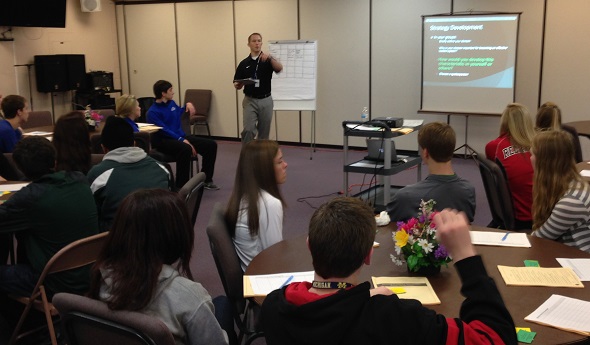
Frushour spearheads the student-based programs at the MHSAA with assistance from Andi Osters and Paige Winne. Among the first ISYS students to work with the MHSAA were Dana Voelker and Jed Blanton, who helped conceptualize the Captains Clinics curriculum. Today at the clinics, ISYS graduate students lead one-day seminars that provide student-athletes with insight on how to understand themselves as leaders, build key leadership skills and handle tough situations on their teams.
Currently, Westfall and Scott Pierce are the ISYS members providing their time and expertise with the MHSAA Student Advisory Council, Captains Clinics, and a new Online Captains Course set to debut this school year.
The Course is student-driven, with two SAC members serving as the faces of the program. Such peer delivery is vital to delivering the messages.
“Students often view leadership from teachers, coaches and administrators as regular, everyday activity. While adults are highly respected figures, students often see adults as outsiders who do not fully understand what it is like to walk a mile in their shoes,” Westfall said.
“The power is rooted in the peer-to-peer relationships and mutual empathy, as student-athletes are very close in age. Student-based leadership is often held with higher validity because the student leader is likely experiencing many of the same adversities and temptations as the peers on his or her team.”
Adding value and credence to the opinions of the ISYS staff is the fact they are steeped in research. The ISYS can gear its efforts to surveys and field studies that the MHSAA, due to staff constraints, cannot. It’s what the ISYS does; it’s the forte of its staff, and the findings help to shape CAP, the SAC and Captains Clinics.
“Research tells us that when kids get to middle school and high school, peer comparison has a really strong influence on how students and student-athletes act and behave,” said Pierce. “Based on this, we believe that student leaders can, and do, act as important role models on the field and in the classroom.
“It is not always easy for students to stand up as leaders because often times this means standing up and being different. So while student-based leadership is vitally important, it doesn't happen automatically. It needs to be talked about and developed over time.”
The MHSAA Captains Clinics and upcoming online course, it is believed, are examples of programs which can develop leaders.
“One of the leadership quotes we used in Tier 1 of the online student leadership course is from Vince Lombardi. It states: ‘Leaders are made, they are not born. They are made by hard effort, which is the price which all of us must pay to achieve any goal that is worthwhile,’” said Westfall. “This type of sentiment, combined with the joint belief between the ISYS and the MHSAA that leadership skills can be taught and cultivated, leads us to believe that leadership can be developed in an individual.”
Through such development, real inroads can be made to promote sportsmanship, teamwork and citizenship in school sports. It’s a worthwhile endeavor for participants, both attendee and instructor.
“Our staff finds the MHSAA Captains Clinics to be some of the most enjoyable and rewarding work that we do,” Pierce said. “The events focus on building leadership in the student-athletes, and give us (ISYS) an ideal opportunity to put our research and scientific knowledge into practice with the students and have a lot of fun doing so.”
Throughout the year, Frushour works with schools and conferences to schedule dates and locations for the clinics. For each day-long clinic, three to five ISYS staff lead a series of workshops for high school student-athletes. The workshops focus on building the four key pillars of leadership – motivation, communication, positive peer-modeling and team cohesion – and have the students involved in discussions, group activities, journaling and role plays.
“We are always trying to find new ways to integrate the new knowledge that we acquire about leadership and trying to reach as many students as possible,” said Pierce, alluding to the forthcoming Online Captains Course. “The online course aims to build off the great things the MHSAA and the ISYS have done with the Captains Clinics.”
A tremendous amount of enthusiasm surrounds the project, and for good reason. The track record of the MHSAA-ISYS partnership reflects a successful venture that might just be hitting stride.
“Over the past 15 years, the relationship between the ISYS and the MHSAA has blossomed. It is to the credit of the forward-thinking MHSAA staff members along with the ISYS faculty and graduate students that this relationship is stronger than ever,” Westfall said. “With the arrival of Dr. Karl Erickson to the ISYS this fall, the upcoming MHSAA coaching requirements for CAP courses, and the launch of the Online Captains Course, the future looks bright for the ISYS-MHSAA team.”
PHOTO: Scott Westfall from the Institute for the Study of Youth Sports conducts a Captains Clinic session as part of his work with the MHSAA.
Heritage's Hawk Nest Taking Charge
By
Geoff Kimmerly
MHSAA.com senior editor
February 11, 2020
SAGINAW – Braeden Dinninger was so stoked before Friday’s Saginaw Heritage boys basketball game against Midland Dow, it felt like he might bounce right out of his neon green headband and hot pink arm sleeve.
A year ago, Heritage’s Hawk Nest became a bona fide all-star student section, even reaching the MHSAA’s Battle of the Fans VIII finals. A year later, Dinninger is a product of what he and his classmates have created on the way back to the championship round for BOTF IX.
“The environment – it's electrifying when you're in there,” said Dinninger, a senior football player and track sprinter who was elected a Nest leader this winter. “Everyone's talking, having a good time. So it's a time when you can come in, cheer, see your friends – talk to people you don't know, meet new friends – and it's an experience that we want people to come out and get more.”
We received our share of that electricity during the MHSAA’s BOTF visit Friday, the first on this year’s finalists tour that will include stops in Buchanan on Tuesday and Zeeland East on Friday.
At Heritage, we met with Dinninger, juniors Sophia Spradlin and Nikki Ambas and sophomore Charlie Davis to find out how the Hawk Nest had changed things up and taken another step this school year.
Two years ago, there was nothing like this. A year ago, thanks to the leadership of a dedicated teacher who made the student section part of her curriculum for the school’s Leadership class, the Hawk Nest was born.
The Hawks received a BOTF finalist banner last March on the floor at Breslin Center, and on the way home then-sophomore Sophia Spradlin brainstormed ways for the section to make a run at the championship this time.
She’s now one of the leaders of the “Battle of the Fans Club” – borne out of but separate from the school’s Leadership class – as the Hawk Next this winter has become fully student-organized and directed.
“We liked the student section how it was, but I feel like a lot of people could agree that it just wasn’t where it could be,” Spradlin said.
Dinninger added: “We wanted to take that step and also include more things that we thought could be fun, not just what we did last year.”
Hence, Hawk Nest version 2.0. Prepare for landing.
Game Time
They’re the Hawks of Saginaw. If you don’t get that by the time you leave a Saginaw Heritage game, you just haven’t been listening.
Over eight years of Battle of the Fans tour stops, some cheers simply have stuck in our heads. Heritage’s “We’re the Hawks of Saginaw” is one of them – “We do it ... any time in the game. It’s just a blast,” Davis said.
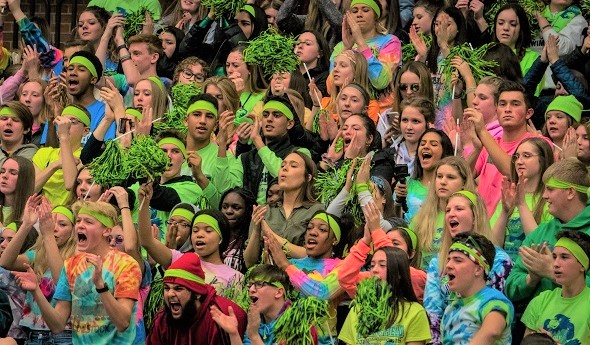
Also recognizable from our 2019 visit was a baseline bleachers filled with students in some mix of neon, mostly green again this time with a side of tie dye. But there were many more new features on the Hawk Nest playlist
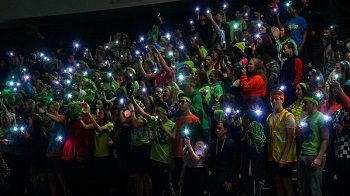
Before every home game, a different pair of students enjoys the responsibility of providing the “light show” during pregame introductions – which is more or less a pair of flashlights racing around the domed arena, with parents and other fans along the sidelines using their cell phones to add to the mystique. Simple perhaps, but proof it doesn’t take much to add a touch of coolness to something otherwise ordinary at most places.
Introductions end with a Heritage player firing an imaginary arrow into the stands, sending the section falling backward. This is actually a common theme – the Hawks look for any number of opportunities to topple over, including leaders throwing a classmate into the stands like an airborne bowling ball.
What follows is a lot of chants, a lot of “We’re the Hawks of Saginaw” and generally just a lot of fun.
The Nest always has some interactive activity set up for halftime, and this time it was a relay race that included hula hoops and 3-point shots. It took a little while to set up, and to be honest was pretty tough to follow – but who cares? It got a bunch of students moving around, yelling and laughing instead of sitting with their heads in their hands until the game got rolling again.
Like at most places, basketball is the big show during winters at Heritage – and here it’s following the girls team, winners of two straight Class A/Division 1 championships. But the section also follows the boys hoops team, the highly-ranked hockey team and has come together for swim meets, volleyball matches and the Heritage-hosted pompon regional. (See the Challenge Round video below showing the section cheering on a variety of teams.)
“The big thing,” Spradlin said, “is we’re so excited for every single game.”
Be like Heritage
Take some of these tips from the Hawk Nest:
Take ownership: As noted above, Heritage students made a point of taking the baton by becoming the directors of their section this season, and almost everything they do is rooted in that sense they're working on something that belongs to them. That adds a level of meaningfulness. The Battle of the Fans Club meets at least once a week and often more, with about 30 students at many meetings – and Spradlin said every meeting sees someone new show up. Each grade is represented by elected representatives who are counted on to be part of setup and takedown on game nights. All of that leads to that feeling of ownership – and the pride that goes along with it.
Spread the wealth: Heritage has roughly 1,500 students, and while not all of them participate in the Nest, it’s still common – as Dinninger mentioned above – to see classmates in the stands he’s never met. How do Nest leaders make them all feel welcome? By making sure to include them in as many ways as possible. The Challenge Round allowed the Hawks to include a wide variety of students in the BOTF competition, and activities like the pregame light show and halftime games provide more opportunities to get students from various grades involved.
Set expectations: This goes back to ownership a bit. A handful of Heritage leaders have attended MHSAA Sportsmanship Summits, where they learned chants like “Air ball” and the like just aren’t a cool way to go. That and just having a little bit of empathy – of course it’s awful to be the player people are chanting about – have helped the section set some standards. And working hard to develop a positive reputation makes section leaders work even harder to make sure everyone is taking part in keeping it.
Word of mouth works: It’s always smart for student sections to connect with classmates on social media, with posters and daily announcements and even more one-on-one with class visits and all-school assemblies. But at the end of the day, one of the most effective ways to grow a student section is by word of mouth – one friend tells another, who tells another, and so on. Heritage hasn’t put it into practice yet, but is considering something of a buddy program where an upperclassmen recruits an underclassmen to a game. Similar invites bring a personal touch to recruiting efforts.
They said it best
Take a chance: “I think the only thing you have to do is be open-minded,” Spradlin said. “I was always kinda nervous to get involved, and I think the biggest step for me was being the Hawk (mascot) last year. I did it a few different times, and even though I wasn’t in the student section, I could be part of it. You have to push past your comfort zone. I met some of my best friends from the student section; through this club I’ve met so many new people. If (students) just knew what comes out of (getting involved), they would be more open to it.”
 Buzz is contagious: “The best part is when it’s a new school week and we’re just talking about the game,” Davis said. “At lunchtime, it’s ‘Are you going to the game?’ or ‘Can I get a ride to the game?’ or ‘Will I see you at the game?’ It’s so much fun. You talk about it at school, and it really hypes it up when you get here and it just brings all the positive energy to one place.”
Be brave: “Everyone’s cheering and no one’s afraid to start a cheer,” Ambas said. “I’m always timid to start a cheer, but everyone’s so inviting. They’re open to when you want to start anything, no matter who you are.”
Don’t miss out: “I think the next step is trying to get a lot of kids out of their comfort zones, to come out and get that experience,” Dinninger said. “Like me personally, I didn't come out until my junior year to the games, and I totally regret it. I wish I would've come out here my freshman and sophomore year. And there's been plenty of kids who said that: They wish they would've come out to the games and had that experience, because you only get this high school experience four times.”
Next stop on BOTF: We will visit Buchanan for its boys basketball game tonight against Watervliet, and finish the 2020 BOTF tour at Zeeland East for Friday’s boys basketball game against Hamilton.
The Battle of the Fans is sponsored in part by the United Dairy Industry of Michigan.
PHOTOS: (Top) Fans filled Saginaw Heritage’s “Nest” for Friday’s boys basketball game against Midland Dow. (Middle) Students light the way for pregame introductions. (Photos by Josh Frank.)