

MHSAA Teams Up for Leadership Training
October 2, 2014
By Rob Kaminski
MHSAA benchmarks editor
Nothing strengthens a community like neighbors working together. The same can be said for organizations whose missions and goals are closely aligned.
Welcome to East Lansing, where the MHSAA and the Michigan State University Institute for the Study of Youth Sports share geographical boundaries and the same philosophies for educational athletics.
The ISYS mission, as stated on its website, is as follows: “The mission of the Institute for the Study of Youth Sports is to provide leadership, scholarship and outreach that ‘transforms’ the face of youth sports in ways that maximize the beneficial physical, psychological, and social effects of participation for children and youth while minimizing detrimental effects.”
That should sound familiar to athletic leaders within the MHSAA.
Key to the relationship between the MHSAA and the ISYS was the hiring of Dan Gould to the MSU faculty in 2004. Director of the ISYS, he helped to facilitate one of the first major initiatives between the ISYS and the MHSAA, which was to revamp the coaches education program, replacing the PACE program with the Coaches Advancement Program (CAP). Dr. Larry Lauer of the ISYS was heavily involved in creation of the CAP under the direction of MHSAA Assistant Director Kathy Vruggink Westdorp.
At the same time, Dr. Gould also led a study with athletic directors and coaches throughout the state to understand the greatest issues in high school sports. Additionally, to continue the ISYS mission to disseminate research findings, Dr. Marty Ewing, Dr. Gould, and a number of the ISYS graduate students have been presenters at the MHSAA Women in Sport Leadership Conference.
Such services have now become a natural fit into the development of the MHSAA’s student leadership programs, providing huge dividends to those in the ISYS program and the MHSAA.
“The mutually beneficial relationship led to a joint project to enhance student-athlete development with a specific focus on leadership development,” said Scott Westfall, one of two ISYS graduate students who work closely with MHSAA Director of Brand Management Andy Frushour.
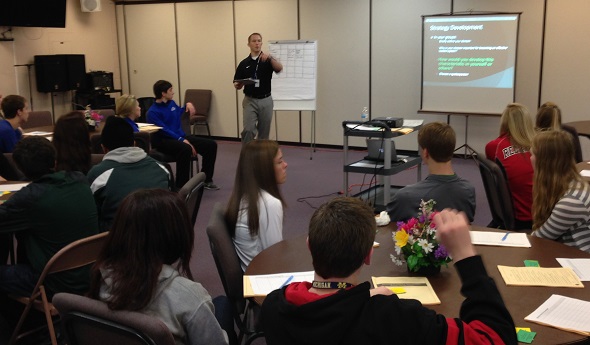
Frushour spearheads the student-based programs at the MHSAA with assistance from Andi Osters and Paige Winne. Among the first ISYS students to work with the MHSAA were Dana Voelker and Jed Blanton, who helped conceptualize the Captains Clinics curriculum. Today at the clinics, ISYS graduate students lead one-day seminars that provide student-athletes with insight on how to understand themselves as leaders, build key leadership skills and handle tough situations on their teams.
Currently, Westfall and Scott Pierce are the ISYS members providing their time and expertise with the MHSAA Student Advisory Council, Captains Clinics, and a new Online Captains Course set to debut this school year.
The Course is student-driven, with two SAC members serving as the faces of the program. Such peer delivery is vital to delivering the messages.
“Students often view leadership from teachers, coaches and administrators as regular, everyday activity. While adults are highly respected figures, students often see adults as outsiders who do not fully understand what it is like to walk a mile in their shoes,” Westfall said.
“The power is rooted in the peer-to-peer relationships and mutual empathy, as student-athletes are very close in age. Student-based leadership is often held with higher validity because the student leader is likely experiencing many of the same adversities and temptations as the peers on his or her team.”
Adding value and credence to the opinions of the ISYS staff is the fact they are steeped in research. The ISYS can gear its efforts to surveys and field studies that the MHSAA, due to staff constraints, cannot. It’s what the ISYS does; it’s the forte of its staff, and the findings help to shape CAP, the SAC and Captains Clinics.
“Research tells us that when kids get to middle school and high school, peer comparison has a really strong influence on how students and student-athletes act and behave,” said Pierce. “Based on this, we believe that student leaders can, and do, act as important role models on the field and in the classroom.
“It is not always easy for students to stand up as leaders because often times this means standing up and being different. So while student-based leadership is vitally important, it doesn't happen automatically. It needs to be talked about and developed over time.”
The MHSAA Captains Clinics and upcoming online course, it is believed, are examples of programs which can develop leaders.
“One of the leadership quotes we used in Tier 1 of the online student leadership course is from Vince Lombardi. It states: ‘Leaders are made, they are not born. They are made by hard effort, which is the price which all of us must pay to achieve any goal that is worthwhile,’” said Westfall. “This type of sentiment, combined with the joint belief between the ISYS and the MHSAA that leadership skills can be taught and cultivated, leads us to believe that leadership can be developed in an individual.”
Through such development, real inroads can be made to promote sportsmanship, teamwork and citizenship in school sports. It’s a worthwhile endeavor for participants, both attendee and instructor.
“Our staff finds the MHSAA Captains Clinics to be some of the most enjoyable and rewarding work that we do,” Pierce said. “The events focus on building leadership in the student-athletes, and give us (ISYS) an ideal opportunity to put our research and scientific knowledge into practice with the students and have a lot of fun doing so.”
Throughout the year, Frushour works with schools and conferences to schedule dates and locations for the clinics. For each day-long clinic, three to five ISYS staff lead a series of workshops for high school student-athletes. The workshops focus on building the four key pillars of leadership – motivation, communication, positive peer-modeling and team cohesion – and have the students involved in discussions, group activities, journaling and role plays.
“We are always trying to find new ways to integrate the new knowledge that we acquire about leadership and trying to reach as many students as possible,” said Pierce, alluding to the forthcoming Online Captains Course. “The online course aims to build off the great things the MHSAA and the ISYS have done with the Captains Clinics.”
A tremendous amount of enthusiasm surrounds the project, and for good reason. The track record of the MHSAA-ISYS partnership reflects a successful venture that might just be hitting stride.
“Over the past 15 years, the relationship between the ISYS and the MHSAA has blossomed. It is to the credit of the forward-thinking MHSAA staff members along with the ISYS faculty and graduate students that this relationship is stronger than ever,” Westfall said. “With the arrival of Dr. Karl Erickson to the ISYS this fall, the upcoming MHSAA coaching requirements for CAP courses, and the launch of the Online Captains Course, the future looks bright for the ISYS-MHSAA team.”
PHOTO: Scott Westfall from the Institute for the Study of Youth Sports conducts a Captains Clinic session as part of his work with the MHSAA.

Scholar-Athlete Finalists Announced
By
Geoff Kimmerly
MHSAA.com senior editor
January 25, 2013
The 120 finalists for the Michigan High School Athletic Association's Scholar-Athlete Award for the 2012-13 school year have been announced.
The program, which has been recognizing student-athletes since the 1989-90 school year, will honor 32 individuals from MHSAA member schools who participate in at least one sport in which the Association sponsors a postseason tournament. Farm Bureau Insurance underwrites the Scholar-Athlete Award, and will present a $1,000 scholarship to each recipient. Since the beginning of the program, 576 scholarships have been awarded.
Scholarships will be presented proportionately by school classification, with 12 scholarships to be awarded to Class A student-athletes, six female and six male; eight scholarships will be awarded to Class B student-athletes, four female and four male; six scholarships will be awarded to Class C student-athletes, three female and three male; and four scholarships will be awarded to Class D student-athletes, two female and two male. In addition, there also will be two at-large honorees which also are part of the general judging process, may come from any classification, and are designated by their school at the time of entry.
Every MHSAA member high school could submit as many applications as there are scholarships available in its classification, and could have more than one finalist. Saline has five finalists this year, while Kalamazoo Hackett and Muskegon Mona Shores have three. Eleven schools each had two finalists: Ann Arbor Gabriel Richard, Comstock Park, Grosse Ile, Hillsdale Academy, Macomb Dakota, Okemos, Oxford, Portland, Rock Mid-Peninsula and Sand Creek.
Multiple-sport participation remains the norm among applicants. The average sport participation rate of the finalists is 2.48, while the average of the application pool was 2.16 – both within a tenth of last year’s rates in those categories. There are 59 three-plus sport participants in the finalist field, and all but one of the 28 sports in which the MHSAA sponsors postseason tournaments are represented.
Of 409 schools which submitted applicants, 54 submitted the maximum allowed. This year, 1,675 applications were received. All will be presented with certificates commemorating their achievement. Additional Scholar-Athlete information, including a complete list of scholarship nominees, can be found on the MHSAA Website.
The applications were judged by a 66-member committee of school coaches, counselors, faculty members, administrators and board members from MHSAA member schools. Selection of the 32 scholarship recipients will take place in early February. Class C and D scholarship recipients will be announced on February 5; Class B scholarship recipients will be announced on February 12, and Class A scholarship recipients will be announced on February 19. All announcements will be made on the MHSAA Website.
To honor the 32 Scholar-Athlete Award recipients, a ceremony will take place during halftime of the Class C Boys Basketball Final, March 23, at the Breslin Student Events Center in East Lansing.
To be eligible for the award, students must have a cumulative grade point average of 3.50 (on a 4.0 scale), and previously have won a varsity letter in at least one sport in which the MHSAA sponsors a postseason tournament. Students also were asked to respond to a series of short essay questions, submit two letters of recommendation and submit a 500-word essay on the importance of sportsmanship in educational athletics.
Farm Bureau Insurance, one of Michigan's major insurers, has a statewide force of more than 400 agents serving more than 380,000 Michigan policyholders. Besides providing life, home, auto, farm, business and retirement insurance, the company also sponsors life-saving, real-time Doppler weather tracking systems in several Michigan communities.
2012-13 Scholar-Athlete Award Finalists
BOYS CLASS A
Marcus William Barnett, St Clair Shores Lake Shore
Connor James Bos, Holland
Andrew Camp, Midland Dow
Bryan Condra, Hartland
Jarrod Eaton, St. Johns
Tristan Eggenberger, Okemos
Alex Fauer, Macomb Dakota
Thomas Greidanus, Grand Rapids Christian
Kalvis Hornburg, Traverse City Central
Reed Hrynewich, Muskegon Mona Shores
Austin Jones, Bay City Central
Tyler Scott Kemerer, Saginaw Heritage
Anthony Lamus, Saline
Jacob J. Presto, Orchard Lake St Mary's
Charles Robert Proctor, Bay City Western
David Read, Midland Dow
Harrison Schurr, Jenison
Jeremy Simon, Richland Gull Lake
Jonathan Sollish, Berkley
Thomas Spicuzza, Oxford
Jason Vander Horst, Milford
Kevin W. Walsh, Detroit Catholic Central
Pierce Watson, Lowell
Adam Whitener, Saline
GIRLS CLASS A
Kristy Allen, East Grand Rapids
Casie Ammerman, Ann Arbor Huron
Jacqueline Burke, Troy
Francesca Ciaramitaro, Grosse Pointe North
Lara Fawaz, Dearborn
Kayla Giese, Macomb Dakota
Morgan Alexandria Gilliam, North Farmington
Kristin Nicole Green, Saline
Sarah Gutknecht, Farmington
Kelly Hall, Saline
Hailey Hrynewich, Muskegon Mona Shores
Jessica Kalbfleisch, Traverse City West
Jillian Klein, Muskegon Mona Shores
Brooke Kovacic, Oxford
Teresa LaForest, St. Joseph
Elizabeth Michno, Macomb L'Anse Creuse North
Kelly Raterink, Zeeland East
Roxanne Raven, Okemos
Kerigan Riley, Livonia Churchill
Haley Schaafsma, Riverview
Carley Serowoky, Waterford Kettering
Kendall Tamler, Birmingham Seaholm
Reinie Thomas, Portage Central
Lindsay Walter, Saline
BOYS CLASS B
Michael Azzopardi, Detroit Country Day
Michael Broderick, Pontiac Notre Dame Prep
Brice Brown, Ionia
Michael Chickeral, Flat Rock
Thomas D. Finch, Otsego
Alec Robert Fisher, Battle Creek Harper Creek
Mark Gibson, Freeland
Patrick Gifford, Haslett
Andrew Hammond, Grand Rapids Forest Hills Eastern
Michael Heinrich, Ludington
Luke James Hurst, Ovid-Elsie
Matthew Liu, Bloomfield Hills Cranbrook-Kingswood
Adam Olszewski, Ann Arbor Gabriel Richard
Scott Parkinson, Grayling
Keeton Thayer Ross, Grosse Ile
Ryan Schall, Comstock Park
GIRLS CLASS B
Brittany Beeler, Spring Lake
Ashley M. Carney, Jackson Northwest
Kelsi Caywood, Sturgis
Amanda Ciancio, Comstock Park
Morgan Kathleen Cinader, Goodrich
Mary Emington, Cadillac
Hannah C. Engle, Adrian
Nicole L. Green, Portland
Haley June Obetts, Wayland Union
Molly Oren, Hamilton
Catherine Polgar, Grosse Ile
Emily Quinn, Portland
Florence Ann Sobell, Croswell-Lexington
Anjali Sood, Ann Arbor Gabriel Richard
Megan Taylor, Houghton Lake
Shelby Walsh, Livonia Ladywood
BOYS CLASS C
Brian Christopher Aldrich, Kalamazoo Hackett
Jesse Anderson, Union City
Kenner Broullire, Manistique
Jesse Corbat, Breckenridge
Parker Eldred, Blanchard Montabella
Ashwin Fujii, Ann Arbor Greenhills
Zachary A. Kerr, Saugatuck
Connor Lockman, Royal Oak Shrine Catholic
Mike O'Brien, Maple City-Glen Lake
Elliott Rains, Sand Creek
Quinton Rice, Marcellus
Luke Schaffner, Clinton
GIRLS CLASS C
Alyssa R. Briolat, Ubly
Kara Craig, Schoolcraft
Lindsey Dopheide, Lawton
Margaret Elizabeth Durbin, Boyne City
Macayla Geiner, Hart
Natalie Perry, Sand Creek
Theresa Pickell, Reese
Abigail Radomsky, Kalamazoo Hackett
Kylei Ratkowski, Bronson
Faith Schroeder, Saginaw Michigan Lutheran Seminary
Grace Smith, Kalamazoo Hackett
Nicole Winter, Watervliet
BOYS CLASS D
Charles Barchett, Watervliet Grace Christian
Charles A. Blood, Hillsdale Academy
Brett Branstrom, Rock-Mid Peninsula
Matthew R. Katz, Tekonsha
Alexander G. Knight, Lake Linden-Hubbell
Francisco Jay Noyola, Lansing Christian
Joseph Samuel Paquette, Munising
Hunter Selby, Genesee Christian
GIRLS CLASS D
Anna Marie Couture, Posen
Sarah Cullip, St. Ignace
Erica LeClaire, Dollar Bay
Elyse Kathleen Lisznyai, Hillsdale Academy
Elena Victoria Luce, Mason County Eastern
Christina Smith, Gaylord St. Mary
Kari L. Steenwyk, Ellsworth
Krysta M. VanDamme, Rock-Mid Peninsula