

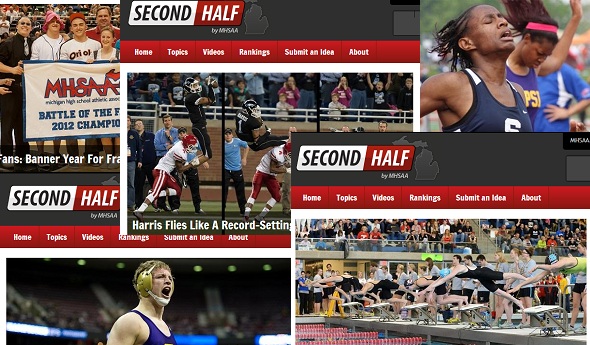
Thank You from Second Half
January 25, 2013
By Geoff Kimmerly
Second Half editor
Next week will mark the one-year birthday of Second Half, our place to tell your high school sports stories.
And I thank you for helping us to such a great start.
 We knew what we hoped to accomplish starting this site a year ago, but we've learned quite a bit during a relatively short time. Although we continue to pursue the mission of being home of the state’s best high school stories and a daily stop for fans, we’ll continue to experiment to figure out what you'd most like to see and how best we can continue to pass along the great things happening in MHSAA athletics.
A few things to call to your attention as we move ahead:
- First and foremost, we strive to tell your stories – hoping to hit every sport and all regions of our state – and have some intriguing ones coming up as we get into the second half of the winter season. Stay tuned.
- Second Half is the home for the “Battle of the Fans II.” We have visits to Buchanan and Vandercook Lake next week, followed by Ann Arbor Gabriel Richard and Zeeland East the week after. We’ll announce the winner Feb. 22. All will be found here first.
- We've revamped our video page (see menu across the top of this screen) and will be adding more videos more regularly in the year to come.
- After a brief hiatus, we’ll next week bring back “High 5s” featuring two athletes and a team that have done great things this season.
- What you’re reading now is the first of a weekly “First Pitch” blog that will allow us to post more of the quick hits we run across in our regular travels. Make sure to continue checking out the twice-weekly blog by Executive Director Jack Roberts, as well as the Viewpoints and SAC Sound-Offs supplied regularly by our friends from the Michigan State University Institute for the Study of Youth Sports and the members of our Student Advisory Council, respectively.
- We began providing in-depth statewide coverage – both previewing and then postgame reporting – of our Finals in every sport this fall, and hope to become your first and fastest source for the stories behind our championships.
We’re always looking for ideas both for stories or any other features you’d like to see – and feel free to send them directly to me at [email protected].
And again, thank you again for coming to our site today. We look forward to seeing you more in the year to come.

5 Strategies To Improve Range Of Motion
March 6, 2024
When it comes to health and fitness, regular exercise and strength training get the most attention. But it turns out that improving your range of motion may pay greater dividends, particularly over the long haul.

“All kinds of things can impact our range of motion,” says Jennifer Burnham, an athletic trainer at Henry Ford Health. “As we age, our joints become less pliable, but any kind of surgery or injury can also impact our range of motion. And if you're somebody who sits at a desk all day long, that can affect your range of motion as well.”
Why Is Improving Flexibility Important?
Staying active with regular cardiovascular exercise and strength training is a great way to maintain your overall physical health. But it’s important to remember that flexibility exercises come with plenty of perks, too, including:
- Preventing injury
- Staving off arthritis by lubricating joints and tissues
- Improving posture and balance
"Unfortunately, if you have limited range of motion, you may perform tasks incorrectly, causing other muscles and joints to overcompensate for the lack of mobility,” Burnham says. “Over time, that compensation mechanism can increase the risk of injury.”
To complicate matters, our lifestyles often don’t support our range of motion goals. Many of us spend most of our days sitting at a desk or hunched over a screen. And when we’re not sitting still, most of us are slouching.
What Are Some Ways To Improve Range Of Motion?
You don’t have to be able to twist your limbs into a pretzel to achieve full range of motion. Instead, try to improve on your current level of flexibility with these five simple strategies:
- Pay attention to timing. If you’re not ready to add a stretching day to your workout regimen, consider adding a set of flexibility exercises at the end of every session. Pre-workout stretching is helpful, too, but stretching when your muscles are warm is a more effective way to stave off injuries.
- Focus on mobility and stability. Even if you can do the splits or touch your toes to the back of your head, you won’t be able to hold the position if you don’t also have strong core muscles. “Most people do stabilizing exercises such as strength training and lifting weights without paying much attention to mobilizing activities like stretching and yoga,” Burnham says. “But you really need to do both stabilizing and flexibility exercises to get an effective workout.”
- Do a mix of dynamic and static stretches. Two types of stretches can help you gain an edge when it comes to improving range of motion: Dynamic (an active type of stretching where you’re moving within your range of motion) and static stretching (where you hold a stretch). Dynamic stretching with arm and head circles, side stretches, and hip circles before exercise is a good way to warm up cool muscles and help lubricate the joints. With static stretching such as touching your toes to stretch your hamstrings, the goal is to hold a position for 30 seconds or more. Static stretches are often best performed after a workout when your muscles are warm.
- Try foam rolling. Foam rollers act almost like a rolling pin to smooth out tight muscles. Used correctly, they can help improve range of motion — and release stress and tension. You can use foam rollers to prime your body for exercise, or to recover after a workout.
- Aim for balance. If one part of your body is super flexible, focus on increasing range of motion in the opposing muscle group. “So, for example, if your hamstrings are very flexible, make sure to target your quadriceps with flexibility exercises,” Burnham says. “The goal is to make sure you’re aiming for balancing in your body.”
While stretching is an important way to achieve and maintain balance, flexibility and range of motion, it isn’t always intuitive. Not sure where to begin? Consider meeting with a personal trainer or athletic trainer to help you devise a program.
“Watching YouTube videos can be helpful, but if you’ve never done flexibility exercises before, you could overstretch your muscles or find yourself in an incorrect position to stretch,” Burnham says. “And yes, you can create bodily injury by overstretching.”
To find a sports medicine provider at Henry Ford Health, visit henryford.com/sportsmedicine or call 313-651-1969.
Reviewed by Jennifer Burnham, MS, AT, ATC, CSCS, a certified athletic trainer at the Henry Ford Center for Athletic Medicine.