

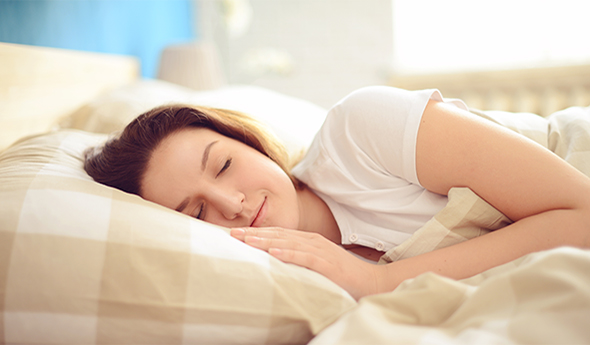
7 Sleeping Tips for Student-Athletes
November 5, 2019

Henry Ford Health System
Many athletes seem to believe time spent not training is time wasted. But, on the contrary.
The time athletes spend resting and sleeping is actually just as important. Take the world’s best female skier, Mikaela Shiffrin, for example. Shiffrin reportedly not only sleeps nine hours each night, but naps at least an hour every day.
So, what does sleeping have to do with her success? When asleep, the body not only has time to recover, but the information that was taken in during the day goes from short-term memory and becomes long term.
“Being an elite athlete is a 24-hour profession, and sleep and recovery are integral to optimal performance,” says Meeta Singh, M.D., a sleep medicine specialist at Henry Ford Health System.
Here are seven tips to help your student athlete catch some Zzzs during the season:
1. Limit caffeine. Caffeine is a popular ingredient in many pre-workout drinks, and many athletes choose to use it for an energy boost. However, having caffeine late in the day may make falling asleep and staying asleep difficult. But, everyone reacts differently to caffeine, so athletes should try logging their intake to determine what time to stop consuming and how much is okay to consume.
2. Maintain a regular sleep schedule. The body has an internal clock that’s largely affected by environment. Going to bed and waking up at approximately the same time each day can add a natural rhythm to the body’s internal clock, which can cause people to feel more awake during the day and fall asleep easily at night.
3. Workout early. Often times, working out later in the day gives people a burst of energy that can keep them up late into the night. For example, exercising after 9 p.m. can boost body temperature, making sleep difficult. However, research shows morning workouts can help achieve deeper sleep, and working out in the afternoon can help reduce insomnia.
4. Unplug. Nothing can keep one up at night like a buzzing smartphone. Additionally, the blue light a phone emits may slow the production of melatonin, making sleep difficult. Advise your children to leave electronics out of reach while they’re sleeping. And as an added bonus: If their phone is their alarm, it will force them out of bed in the mornings.
5. Use essential oils. Essential oils have seen growing popularity in recent years, and this is in part because scent helps trigger memory. Oils can be diffused, rubbed on temples or drops can be spread on pillows. Popular oils for promoting sleep are lavender, valerian root and roman chamomile.
6. Focus on breathing. Focusing on breath can help steady heart rate and relax the body. A popular breathing technique is the 4-7-8 exercise, in which one inhales through the nose for four seconds, holds their breath for seven, and exhales for eight.
7. Keep it dark, cool and quiet. Having the right environment is an important part of falling asleep … and staying asleep.
Ultimately, when it comes to enhancing athletic performance, getting proper sleep, resting and recovering can be just as important as training or hitting the gym.
“Since sleep can modulate reaction time and accuracy, it’s important to ensure an athlete gets his or her Zzzs,” Dr. Singh says.
See also: Is Your Teen Sleep Deprived?
Want to learn more? Henry Ford Health System sports medicine experts are treating the whole athlete, in a whole new way. From nutrition to neurology, and from injury prevention to treatment of sports-related conditions, they can give your athlete a unique game plan.
Visit henryford.com/sports or call (313) 972-4216 for an appointment within 24 business hours.

NFHS Voice: Reading the Crystal Ball
May 15, 2020
By Karissa Niehoff
NFHS Executive Director
Re-opening is the key word in sports at all levels right now. Every day, there are new projections for when the National Basketball Association and Major League Baseball will resume – and if the National Football League will start on time this fall.
Along with leaders of youth-level sports and the NCAA, the NFHS and its member state associations are exploring all options for conducting sports this fall. And while we all want answers, the truth is that there are more questions than answers at this point.
Dr. Anthony Fauci, the leading national medical authority throughout the COVID-19 pandemic, told ESPN earlier this week that “the virus will make the decision for us” on whether sports will return this fall. His comments underscore the need for leaders of all levels of sport in the United States to exercise great caution as we re-engage in activities.
Without a doubt, education will play a larger role in the decision-making process for high school programs than for non-scholastic programs. Despite the significant loss of revenue that could occur at some levels if programs remained closed, health and safety concerns must take priority when it comes to re-opening the sport or activity.
At the high school level, sports and other activity programs will most likely not return until schools re-open. High school sports and performing arts are education-based programs and complete the learning process on a day-to-day basis. As such, academics during the school day and sports and other activities after school are inseparable.
Could any of those sports and activities return without fans? That option is certainly not one schools favor, but it is a very real possibility. While a few state associations opted for that arrangement to complete state basketball tournaments, that is not a desired ongoing plan for school sports. Besides, this troubling question would have to be addressed: If it is unsafe for fans in the stands, is it safe for the students to be participating?
Students, parents and other fans in the stands cheering for and supporting student-athletes, and applauding from the theatre audience, are among the most wonderful aspects of education-based activities. Before accepting that arrangement, efforts will continue to make attending events a safe experience for everyone.
While we remain uncertain as to the timetable for the return of high school sports and other activities, we believe that when these programs return – and they will return – that everyone will bring renewed zeal to provide the 12 million participants in these programs the best experience possible.
One of the challenges to solving the crystal ball of high school sports and activities this fall is the uncertainty of the spread of the virus as states begin to re-open this month. The NFHS will continue to work with its Sports Medicine Advisory Committee on an ongoing basis to provide the most updated information.
With the non-negotiable tenet of safety for student activity participants, expect every avenue to be pursued so that students can be involved in football, soccer, volleyball, field hockey, speech, debate, music and many other school activities this fall.
Dr. Karissa L. Niehoff is in her second year as executive director of the National Federation of State High School Associations (NFHS) in Indianapolis, Indiana. She is the first female to head the national leadership organization for high school athletics and performing arts activities and the sixth full-time executive director of the NFHS, which celebrated its 100th year of service during the 2018-19 school year. She previously was executive director of the Connecticut Association of Schools-Connecticut Interscholastic Athletic Conference for seven years.