


Coaches Must Set the Example
October 15, 2012
By Scott Westfall
MSU Institute for the Study of Youth Sports
NOTE: This is part one of a two-part viewpoint explaining the importance of coaches and parents setting proper examples for young athletes in their treatment of game officials.
 In light of the recent uproar over NFL replacement officials, it seems that never before has it been so common and socially accepted to yell disgust at referees.
While this trend is prevalent in both professional and college football, it has unfortunately trickled down into the high school ranks. What is actually accomplished when a coach or fan yells at an official? Do people really believe that if they become irate, a ‘bad call’ will be erased? In all of my years watching, playing, and coaching athletics, not once have I seen a referee change his or her ruling because a coach or a fan yelled at him or her.
When adults lose control and scream at referees, who does this bad behavior really affect? Since youth learn their emotional control from adult leaders, I believe the true damage is done to the young minds that are witnessing their mentors lose their cool. After their display of anger, how can these same adults hope for kids to stay calm when things do not go their way in life? It is pure hypocrisy to expect otherwise.
Whether we like it or not, referees are the absolute authority in athletic contests; they control the game from start to finish, make the tough calls on the playing surface, and even decide who gets to stay and who is sent to the locker room. Yet, it is baffling how often their authority is disrespected.
It is the coach’s responsibility to establish his or her program as one that respects authority. Since players watch all of the moves their coaches make, it is imperative that coaches respect the officials – especially when the calls do not go their way. If a player sees his or her coach going berserk due to a ‘bad call,’ the same player will think it is OK to act like this down the road when upset or faced with adversity. Even more detrimental to these kids is hearing their coach preach a message but contradict it by not backing it up with actions.
Great high school coaches will use the playing surface as an extension of their classroom. In my years as a head coach, I tried my hardest to set a good example for my players and told them to never question, back-talk, or disrespect an official. However, I made the mistake of breaking my own rule on one occasion by questioning the referee’s judgment.
When I was a younger coach, I may have attributed my actions to the heat of the moment, or defended myself on the criteria that I was trying to stick up for my team. However, being a veteran leader who wanted to practice what I preached, I saw my mistake as a teaching moment.
The next practice, when we conducted team discipline conditioning, “Reminders” (usually reserved for players with unacceptable school behavior or poor grades), I asked my players what I had taught them about respecting authority and if I had broken my own rule. The players agreed that I had broken my rule and had not respected the referee.
I let them know that this rule applied to me as much as them. I then lined-up on the goal line and ran my own set of wind sprints as the players, assistant coaches, and managers watched in disbelief. Afterward, to even my surprise, several players thanked me for holding myself accountable.
One kid even had tears in his eyes, and said that after watching my self-imposed discipline, he wanted more than ever to be a man of his word and do the right thing.
Scott Westfall has spent the last 10 years as a teacher, coach, and athletic director in Fort Collins, Colo. He currently is working on his Doctorate at Michigan State University, with an emphasis in Sport Psychology and Athletic Administration, and assisting the MHSAA with its student leadership programs. Westfall is a former athlete who participated in football, wrestling, tennis and cross country at the high school level, and rugby at the collegiate level. He can be reached at [email protected].
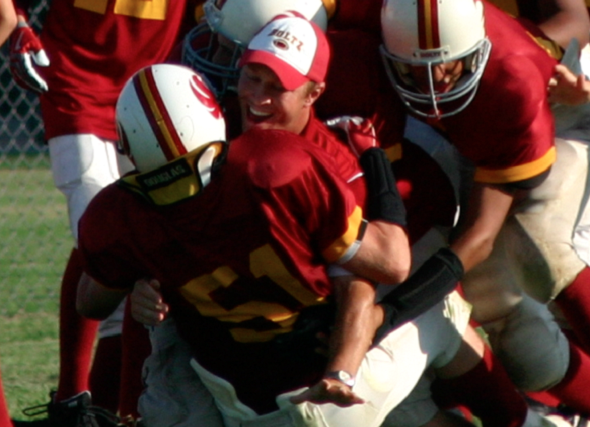
PHOTO: Scott Westfall celebrates with his football team while serving as a coach at Boltz Middle School in Fort Collins, Colo.
This Week in High School Sports: 12/4/18
December 4, 2018
This week's show features new officials filling a need in Michigan's southeastern region, awards game balls to Marquette's boys basketball team and Hudson's girls and boys bowling teams, discusses the extended basketball sideline coaching box in "Be The Referee" and closes with thoughts from a pair of notable college coaches on what they're seeking when recruiting the high school ranks.
The 5-minute program, powered by MI Student Aid, leads off each week with feature stories from around the state from the MHSAA’s Second Half or network affiliates. "Be The Referee," a 60-second look at the fine art of officiating, comes in the middle of the show and is followed by a closing MHSAA "Perspective."
Listen to this week's show by Clicking Here.
Past editions
November 27: Defensive performances from 11-Player Football Finals, notable experiences at Ford Field - Listen
November 20: 8-player football champions Morrice and Rapid River, power of giving thanks - Listen
November 13: Port Huron Northern football, broadcasting one of the busiest championship weekends of the MHSAA school year - Listen
November 6: Three-time cross country champs, MIS as LP XC Finals home - Listen
October 30: Calumet football, changes to the MHSAA Transfer Rule - Listen
October 23: Jackson High football, "Football Week in Michigan" - Listen
October 16: Selection Sunday football primer, past playoff expansion - Listen
October 9: Pickford football, teams that finished undefeated, untied and unscored upon on the gridiron - Listen
October 2: Grand Rapids official Dolly Konwinski, "You’ve Got To Be Kidding Me" on a federal court case made by the parents of a kid who didn’t make the cut - Listen
September 25: Bronson volleyball's Kiera Lasky, the real blue-chip participants in high school sports - Listen
September 18: Hanover-Horton runner Judy Rector, countering a growing shortage of high school game officials - Listen
September 11: Alpena soccer coach Tim Storch, balancing interests of all high school athletes - Listen
September 4: Radio stations celebrating 77 years of high school sports broadcasts, and radio's importance in educational athletics - Listen
August 28: Forest Hills Central football's Tate Hallock, keeping perspective amid changing times - Listen
August 21: Lansing Everett football coach Mike Smith, MHSAA executive director transition - Listen