

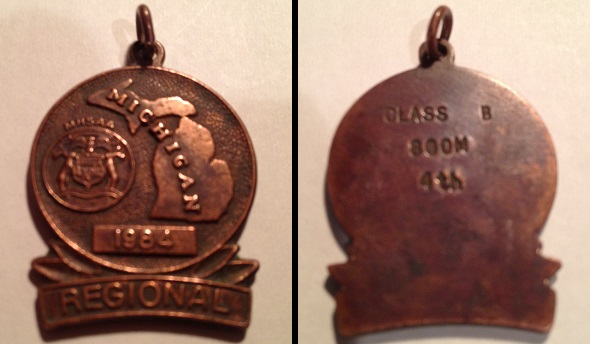
Did you lose this medal?
By
Geoff Kimmerly
MHSAA.com senior editor
August 19, 2013
It’s not quite a needle in a haystack. But it could turn into a great story.
This 1984 MHSAA Regional medal, pictured above, was found recently in Massachusetts with a metal detector. The finder, coincidentally a former collegiate track and field coach, hopes to return the medal to its rightful owner.
 Doing so might not be as difficult as it sounds, but we’ll need help from our friends in the track and field community.
Here’s what we know:
- The medal was received for finishing fourth in the 800 meters at a Class B Regional in 1984.
- The Regional had to be in the Lower Peninsula, because Class A and Class B were and continue to be combined in the Upper Peninsula.
- There were 10 Class B Regionals during the 1984 season, hosted by Sturgis, Parma Jackson County Western, Chelsea, Warren Fitzgerald, Linden, Corunna, Ovid-Elsie, Fremont, Greenville and Gaylord.
- So that means the medal could have only 20 possible owners.
Unfortunately, we do not have Regional results from the 1980s on file in our office. That’s where our helpers come in.
If you have results, or any idea who won this medal, please contact me at [email protected]. If we can connect medal with owner, we’ll tell much more of this story – including that of the coach who found it and made the call to start its return trip home.

Pandemic Planning: Creating a Schedule
December 15, 2020

By Stacy Leatherwood Cannon, M.D.
Henry Ford Health System
With coronavirus continuing to grab headlines and physical distancing orders still in place, every day tends to feel the same.
More parents than ever are working from home, have reduced hours or may even be out of work due to the pandemic. Those who are working at full capacity may feel the strain of trying to balance work and childcare. Many schools and extracurricular programs have been moved online or canceled.
With both parents and kids feeling the stress of new daily routines, it's more important than ever to create a schedule that all family members can follow.
Staying On Schedule
When schedules are off (particularly sleep schedules), children and teens may be at greater risk for depression and anxiety. Younger children may act out because they have increased energy with no outlet. The good news: Creating a schedule — and sticking with it — can help everyone feel more grounded.
Children thrive with an understanding of the daily routine. Knowing what to expect and what they need to do reduces anxiety and helps kids feel more in control.
A few ways to achieve an effective schedule:
• Make it a family affair: Instead of drawing up a schedule and expecting everyone to stick to it, involve your children in the process. Call a family meeting where you come up with sleep and waking times, mealtimes and breaks. Kids are more likely to embrace a new schedule if they played a hand in creating it.
• Enforce bedtime: Children doing remote learning may not have to rise as early to make it to school on time. Even so, it's important to set a regular bedtime so they can remain on task during daylight hours. Your best bet: Establish a bedtime routine that includes calming activities (like a bath and reading) and ensure your children go to bed at an appropriate hour. School-aged kids should get about 9 to 10 hours of sleep each night.
• Stick to mealtimes: Keeping mealtime consistent allows for a structured break where kids and parents can reconnect and troubleshoot when necessary. This is especially important with older adolescents who may work independently during the school day. Unfortunately, what works for one family member may not work for another. Ideally, families should work together to establish mealtimes, then adjust based on each individual's needs and assignments.
• Encourage breaks: Kids and adults alike become zombie-like after sitting in front of a screen for extended periods. For children who are distance learning, frequent breaks are especially important. The younger the child is, the more breaks they need to stay engaged. That said, even older kids should take breaks every 30 minutes or so to walk around, get a snack and do some simple stretches. Better yet, take your breaks together and do some jumping jacks or share a snack as a family.
Successful Scheduling
Coming up with an effective schedule that the whole family can follow is not something you do at the last minute. Plan for the week ahead over the weekend. Sit down as a family and discuss what worked — and what didn't — the previous week. Then tweak as necessary.
Most important, be patient. These are unprecedented times for all of us. And while we have months of experience dealing with this pandemic, transitioning back to school has brought new challenges.
Try to shift your focus toward the perks of this experience. This is a rare moment in history when families can come together and spend a lot of quality time together. It could be a time of growth and transformation for your whole family.
Concerned about how your children are managing the pandemic? Help is available. To find a doctor or pediatrician at Henry Ford, visit henryford.com or call 1-800-HENRYFORD (436-7936).
Stacy Leatherwood Cannon, M.D., is a board-certified pediatrician and the physician champion for childhood wellness for Henry Ford LiveWell. She sees patients at Henry Ford Medical Centers in midtown Detroit and Sterling Heights. Learn more about Dr. Leatherwood Cannon
PHOTO: Novi's Abigail Pheiffer, a senior on the MHSAA Student Advisory Council, gets in some wall sits during a break in her day.