

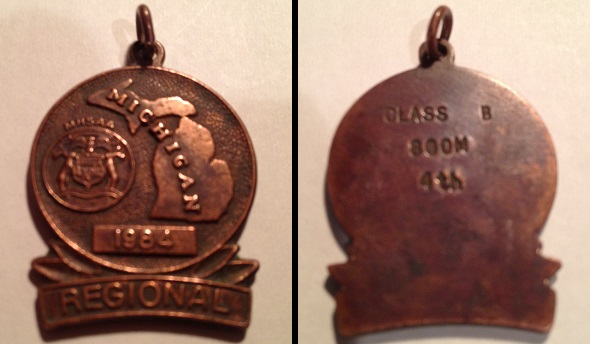
Did you lose this medal?
By
Geoff Kimmerly
MHSAA.com senior editor
August 19, 2013
It’s not quite a needle in a haystack. But it could turn into a great story.
This 1984 MHSAA Regional medal, pictured above, was found recently in Massachusetts with a metal detector. The finder, coincidentally a former collegiate track and field coach, hopes to return the medal to its rightful owner.
 Doing so might not be as difficult as it sounds, but we’ll need help from our friends in the track and field community.
Here’s what we know:
- The medal was received for finishing fourth in the 800 meters at a Class B Regional in 1984.
- The Regional had to be in the Lower Peninsula, because Class A and Class B were and continue to be combined in the Upper Peninsula.
- There were 10 Class B Regionals during the 1984 season, hosted by Sturgis, Parma Jackson County Western, Chelsea, Warren Fitzgerald, Linden, Corunna, Ovid-Elsie, Fremont, Greenville and Gaylord.
- So that means the medal could have only 20 possible owners.
Unfortunately, we do not have Regional results from the 1980s on file in our office. That’s where our helpers come in.
If you have results, or any idea who won this medal, please contact me at [email protected]. If we can connect medal with owner, we’ll tell much more of this story – including that of the coach who found it and made the call to start its return trip home.

NFHS Voice: Respect Everyone
November 4, 2019
By Karissa Niehoff
NFHS Executive Director
Case studies have revealed that kids want to participate in high school sports because they are fun. Being a part of a team gives them an identity, a sense of self-worth and, in some cases, a reason for engaging in academics. They are included, accepted and feel like a valued member of a community.
This describes the ideal and the goal of high school sports. Fortunately, that atmosphere exists at a majority of the 19,500-plus high schools within the NFHS family. And since it is the desire of high school leadership throughout the country that these ideals continue, we are concerned about the growing decline in respect, integrity and unacceptable behavior in and around high school sports.
Racism is one of our greatest concerns nationwide. We have heard of students posting videos to social media with racist comments. We read about racial comments by team members of nearly all-white schools to opposing players from schools composed of nearly all minority students. There have been cases of white players disrespecting Native American players on the opposing team by addressing them in an unacceptable manner.
This type of behavior could be a reflection of events occurring in our society, or due to lack of a respectful environment at home. Regardless, they are not defensible reasons for the occurrence of these horrible acts within education-based high school sports and activities.
High school sports and activities exist to lift people up, not demean or tear people down. National politics or lack of role modeling by adults at home aside, coaches, administrators and other leaders in high schools nationwide must direct programs with respect, acceptance and dignity and demand the same from the school participants.
More than 50 years ago, Special Olympics began a global movement to break down barriers and end discrimination against people with intellectual disabilities. Since then, lives have been changed for the better all around the world. Many schools have implemented Unified programs in sports, performing arts and even physical education.
We must do the same for everyone. All student-athletes – regardless of race, religion, political views or gender identity – should be treated equally. As baseball Hall of Famer Jackie Robinson said, “I’m not concerned with your liking or disliking me. ... All I ask is that you respect me as a human being.”
As schools hire individuals to fill coaching positions, character must be the top prerequisite for the job. They must be guided by honesty, integrity and ethics, and they must be positive role models for students. And this is certainly not a new idea.
H. V. Porter, the first full-time executive director of the NFHS, had the following to say in 1950: “The amount of success (in improving sportsmanship) is largely dependent on the degree to which attention is constantly given to the matter by the school staff.”
We certainly agree with Mr. Porter but also believe that everyone must pay attention.
The NFHS has several free online education courses through the Learning Center (www.NFHSLearn.com) that can assist in establishing a program that teaches and models respect for self and respect for others. We suggest that “Teaching and Modeling Behavior,” “Sportsmanship” and “Bullying, Hazing and Inappropriate Behaviors” be required courses for everyone working with student-athletes.
High schools must establish a culture that values the worth of every single person – both players on the school’s team and players on the opposing team. There must be a no-tolerance policy regarding behavior that shows disrespect for another individual.
Kids today are looking for a community, and high school sports and activities must be that community that is fun, respectful and supportive of everyone.
Dr. Karissa L. Niehoff is in her second year as executive director of the National Federation of State High School Associations (NFHS) in Indianapolis, Indiana. She is the first female to head the national leadership organization for high school athletics and performing arts activities and the sixth full-time executive director of the NFHS, which celebrated its 100th year of service during the 2018-19 school year. She previously was executive director of the Connecticut Association of Schools-Connecticut Interscholastic Athletic Conference for seven years.