

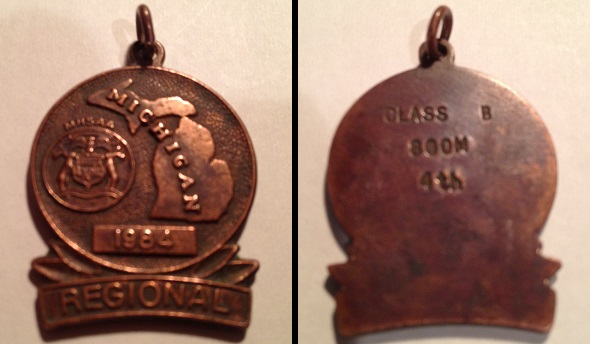
Did you lose this medal?
By
Geoff Kimmerly
MHSAA.com senior editor
August 19, 2013
It’s not quite a needle in a haystack. But it could turn into a great story.
This 1984 MHSAA Regional medal, pictured above, was found recently in Massachusetts with a metal detector. The finder, coincidentally a former collegiate track and field coach, hopes to return the medal to its rightful owner.
 Doing so might not be as difficult as it sounds, but we’ll need help from our friends in the track and field community.
Here’s what we know:
- The medal was received for finishing fourth in the 800 meters at a Class B Regional in 1984.
- The Regional had to be in the Lower Peninsula, because Class A and Class B were and continue to be combined in the Upper Peninsula.
- There were 10 Class B Regionals during the 1984 season, hosted by Sturgis, Parma Jackson County Western, Chelsea, Warren Fitzgerald, Linden, Corunna, Ovid-Elsie, Fremont, Greenville and Gaylord.
- So that means the medal could have only 20 possible owners.
Unfortunately, we do not have Regional results from the 1980s on file in our office. That’s where our helpers come in.
If you have results, or any idea who won this medal, please contact me at [email protected]. If we can connect medal with owner, we’ll tell much more of this story – including that of the coach who found it and made the call to start its return trip home.
This Week in High School Sports: 10/23/18
October 23, 2018
This week's show features the Jackson High School football team. Game balls go to the boys and girls cross country teams at Sault Ste. Marie, and Traverse City West golfer Anika Dy. Trickery and Communication is the topic of "Be The Referee," and the show wraps up talking about Football Week In Michigan.
The 5-minute program, powered by MI Student Aid, leads off each week with feature stories from around the state from the MHSAA’s Second Half or network affiliates. "Be The Referee," a 60-second look at the fine art of officiating, comes in the middle of the show and is followed by a closing MHSAA "Perspective."
Listen to this week's show by Clicking Here.
Past editions
October 16: Selection Sunday football primer, past playoff expansion - Listen
October 9: Pickford football, teams that finished undefeated, untied and unscored upon on the gridiron - Listen
October 2: Grand Rapids official Dolly Konwinski, "You’ve Got To Be Kidding Me" on a federal court case made by the parents of a kid who didn’t make the cut - Listen
September 25: Bronson volleyball's Kiera Lasky, the real blue-chip participants in high school sports - Listen
September 18: Hanover-Horton runner Judy Rector, countering a growing shortage of high school game officials - Listen
September 11: Alpena soccer coach Tim Storch, balancing interests of all high school athletes - Listen
September 4: Radio stations celebrating 77 years of high school sports broadcasts, and radio's importance in educational athletics - Listen
August 28: Forest Hills Central football's Tate Hallock, keeping perspective amid changing times - Listen
August 21: Lansing Everett football coach Mike Smith, MHSAA executive director transition - Listen