


More States Begin Mental Health Efforts
January 2, 2020
Editor’s Note: This is part of a series on NFHS News addressing the challenges of mental health issues in high school athletics. This article explores one statewide approach to this important subject.
Suicide is a serious public health problem. It is the second-leading cause of death of high school-aged individuals in the United States. (National Vital Statistics Report 2016 Data Published by the CDC July 2018)
In Oregon, the suicide rate is higher than the national average, and a recent survey of 11th-graders found that within the past year, 18 percent seriously considered suicide and 7 percent attempted suicide. (Youth Suicide Annual Report 2017 & Oregon Healthy Teens Survey 2017)
More concerning is the fact that the rate of completed suicides in youth has been increasing since 2011. Not only does suicide lead to a life lost much too early, it leaves a devastating impact on those left behind.
Fortunately, suicides are preventable. The Oregon Youth Suicide Intervention and Prevention Plan was created calling for “Zero Suicide ... through collective action among health and behavioral health systems, schools, communities, parents and other systems that touch the lives of youth.” (Youth Suicide Annual Report 2017) For numerous reasons, schools are being used as the primary means of dissemination and implementation of suicide prevention interventions.
One group of school personnel that had not been traditionally considered in school-based efforts are school activities personnel: coaches, athletic trainers and athletic administrators. These individuals spend a great deal of time with students, developing relationships that may go beyond what a student typically has with a teacher.
 Coaches, athletic trainers and athletic administrators are in the ideal position to recognize behavioral warning signs or be the point person for students to go to if they have concerns about a peer. This is vital as youth considering suicide often talk about suicide and exhibit behaviors and/or moods associated with increased suicide risk. Additionally, activities personnel are school leaders who are often known and trusted by parents, thus creating more opportunities for dialogue on suicide prevention.
Realizing the impact youth suicide has on school communities and the prevention opportunities that exist, the leadership of the Oregon School Activities Association (OSAA), the Oregon Athletic Coaches Association, the Oregon Athletic Directors Association and the Oregon Athletic Trainers’ Society partnered to promote the role of high school activities personnel in preventing youth suicide. While these groups had multiple means of reaching out to the intended audience, the leadership realized help was needed from experts for a statewide education campaign to be successful. The Suicide Intervention Coordinator for the Oregon Health Authority (the state agency charged with overseeing Oregon’s health-related programs) was contacted and agreed to assist in developing a statewide educational campaign geared to activities personnel.
The Campaign
It was determined that a series of articles geared specifically to activities personnel would be written by the Oregon Health Authority and then disseminated by the OSAA throughout the academic year.
The articles typically contained two pages of practical information and tips. The campaign was not designed to replace a formal suicide gatekeeper training; rather, it served to promote awareness of the role activities personnel play in countering the rising problem. The articles and additional resources were also posted to the OSAA website.
The OSAA Foundation provided funding for a poster that was provided to schools to be placed in locker rooms, team rooms, athletic training rooms and other areas where students congregate. The primary goal of the poster was to provide students with contact information for crisis lines.
Toward the end of the campaign, workshops were presented by a representative from the American Foundation for Suicide Prevention at the Oregon Athletic Directors Association’s annual statewide conference. The goal was to provide information on programs and policies that athletic administrators could implement at their schools.
While the campaign only spanned the 2017-18 academic year, the leadership of the stakeholder groups believed there was still more that could be done. In 2018-19, a campaign on anti-hazing and anti-bullying (which is a risk factor for suicide) was implemented using a similar approach as the suicide prevention campaign.
In addition, the groups coordinated a high school coaches’ symposium that included breakout sessions on suicide prevention, hazing prevention and character education.
Lessons Learned
Individuals who work with students involved with high school activity programs realize the power and opportunities which exist for positive character development. The focus of this campaign was to highlight a significant and growing public health problem – youth suicide. The goal of the campaign was to increase awareness and provide appropriate resources – not to create experts in suicide prevention.
The collaborative nature of this campaign strengthened the relationships between the different groups working together with a specific purpose. The groups have now partnered on several additional campaigns – the aforementioned anti-hazing/anti-bullying campaign and promoting the development of Emergency Action Plans.
The campaign also allowed the groups to work closely with state public health officials. While the OSAA had previously partnered with state public health officials regarding air quality policies and a guidance document for medical providers on pre-participation physical exams, this campaign provided several new and distinct advantages.
State public health officials were able to see the positive impact of participation in high school activity programs beyond just the activity itself – namely the positive mentorship relationships that may develop. They were also impressed by the large audience the campaign reached and the feedback provided (due to the expansive network of activities administrators, coaches and athletic trainers that the OSAA reaches). Ideally, this will spur additional collaborations in the future.
A major challenge for schools and school personnel is the competing demands for time and resources for the many worthy interventions and activities. Unfortunately, it is impossible to commit to all interventions and activities that may benefit students. While there was a monetary cost for the posters to be distributed to schools, development of the actual campaign articles and presentations were done by individuals as part of their job related to suicide prevention, so the campaign was relatively inexpensive. Since it was distributed throughout the year, it did not require a large time commitment from activities personnel and the monthly articles kept the issue front and center.
Conclusion
The statewide Youth Suicide Awareness Campaign is just one example of how the unique role of school activities personnel can be leveraged and how stakeholder organizations and state public health agencies can maximize their impact and reach through collaboration. While we will continue to review suicide incidence in Oregon during the coming years, the campaign is seen as a success at this point. It has strengthened relationships between the involved entities, and it promoted the role of coaches, athletic trainers and athletic administrators as mentors and trusted individuals to make an impact that extends beyond wins and losses.
— Sam Johnson, Rob Younger, Peter Weber, NFHS News, March 12, 2019
Colorado Institutes Mental Health Requirement
In a major step aimed at improving mental health of students across Colorado high schools, the CHSAA Board of Directors approved as a requirement that all coaches take a course on student mental health.
It is among the major topics facing high school students today. According to the U.S. Department of Health & Human Services, 31 percent of high school students reported symptoms of depression in 2017, and 17 percent reported they seriously considered attempting suicide.
 So, starting this fall, all coaches must take a course “Student Mental Health and Suicide Prevention” on the NFHS Learning Center, or a district-led mental health training. The NFHS Learn course is free.
In order to be a registered coach, this requirement must be satisfied. Unregistered coaches are not permitted to coach, per CHSAA bylaws. Other required courses or training are based around concussion, first aid, mandatory reporting, and the CHSAA coaches course.
“CHSAA’s vision is to deconstruct the stereotypes around mental health and help start the conversations that need to happen around our kids,” said CHSAA commissioner Rhonda Blanford-Green. “The mental and physical well-being of our student participants is our priority.”
The decision was made with the full support of the Sports Medicine Advisory Committee (SMAC), which discussed the topic at length during its meeting last school year.
“The committee was focused on finding great tools that we can give to our schools and coaches to help provide awareness around mental health, which is among the most important issues our students face,” said Jenn Roberts-Uhlig, the CHSAA staff liaison to SMAC. “We believe it is important for coaches to not be afraid to look for the signs and symptoms of a student who is struggling with their mental health, and this training will provide valuable instruction in how to do that.”
— Ryan Casey/CHSAA, June 27, 2019
Adjust Your Workout When Gym Isn't Option
April 6, 2020

Henry Ford Health System
Feeling at a loss about not being able to stick to your normal workout routine? You’re not alone.
Social distancing during the COVID-19 outbreak has resulted in people all over the world having to adjust their schedules to accommodate working from home, schooling and caring for kids, and finding ways to maintain as much of a “normal” schedule as possible.
As a result, many people are struggling to figure out how to get a good workout in without the help of gym equipment or a personal trainer.
“Anxiety over the current situation can add to a lack of motivation to work out,” says Brianna Gauna, an athletic trainer for Henry Ford Health System. “But just remember how beneficial it is to move your body, even if it is just around the house.”
How a Routine Change Affects Your Body
If you are used to working out every day or going hard at the gym on a regular basis, a short rest period from your routine might have its advantages.
“Taking time to rest can actually be a really good thing because it allows your body to recover,” says Gauna. “You might even start to see more muscle tone set in as you give your body a break.”
On the other hand, if you usually work out a few times throughout the week and suddenly stop, the results may cause negative effects. You may experience:
- Increased resting heart rate
- Less energy
- Change in mood or emotions
- Loss of sleep
How to Work Out at Home
Being stuck at home is not an excuse to skip a daily workout. Everyone works out a little differently, and there are plenty of options for you to stay active and try out new forms of exercise.
“Whether you are used to strength training or cardio, think about what your fitness goals are and choose activities based on what you’d like to achieve,” says Gauna.
Here are some ideas to keep you and your family active:
1. Yoga. Practicing yoga requires a great deal of muscle strength and balance. It is best for a full body workout. Look to YouTube or free apps on your phone for beginner workout videos that you can follow along.
2. HIIT workouts. These workouts are best for getting your heart pumping and increasing your stamina. Try choosing four exercises from the following list. (Search YouTube or Google for examples if you are not sure what each of these entails.) Do one exercise at a time for 30 seconds and then give yourself 20 seconds of rest before moving on to the next exercise. After you get through one rotation of those exercises, repeat three more times.
- Squats
- Push-ups
- Lunges
- Burpees
- Mountain climbers
- Glute bridges
3. Running or walking. Many apps allow you to track your run on a map, so you can plan out your route in your own neighborhood. This allows you to adjust how far you run or how much time you have for a run. A brisk walk through the neighborhood also works.
4. Biking. Biking is a great low-impact workout that works to engage and tone leg muscles. (Remember to wear a helmet!)
5. Team sports. If you are looking for something to engage you and your family, team sports are the way to go. Kick a soccer ball around, try to race through an obstacle course while dribbling a basketball or take turns throwing a football. If you don’t have the equipment, try playing keep-away with a stuffed animal or set up a relay race.
Exercise by Age and Fitness Level
The younger you are, chances are you have a faster metabolism. If you can’t get to a gym, think about how active you usually are and gauge the length of your workout from there.
If you are using this time to get started on your fitness journey, use these recommendations as a starting point:
Ages 7-17: 1-2 hours. Athletes that are used to going to weekly practices may find that two-hour workouts are more suitable.
Ages 18-30: About an hour. Look for times throughout the day that you can squeeze in workouts. Maybe you do yoga in the morning, a HIIT workout in the afternoon and a walk after dinner.
Ages 31-49: About a half hour. If you have children or a pet, you may find that you are already spending more time being active than this!
Ages 50 and up: At least 10-15 minutes. Gauge this based on your own abilities. You may live a more active lifestyle that allows you to be very active throughout the day. If you find yourself struggling to meet this mark, consider a walk during the day or stretches in the morning.
Once you get a regular fitness routine in place, work your way up to longer or more intense workouts to keep yourself challenged.
Making Your Own Equipment
If you have a treadmill, stationary bike or elliptical machine at home, now is the time to clear off the laundry it may have been collecting. If you don’t have access to weights or other gym equipment, though, that doesn’t mean you have to miss out on a quality workout. Look for things around your house that you can use in their place – get creative!
- Bags of beans, rice or pet food as added weight for squats or lunges
- Old books/textbooks as dumbbells
- A chair for triceps dips, calf raises or for stability during yoga
- Stairs to run sprints or to help you stretch out leg muscles
When your day-to-day routine is shaken up, do what you can to create normalcy in your life. If you find you have more free time throughout the day, take that time to get moving – even if it’s running up and down the stairs or going for a walk around the block.
“Don’t worry about feeling silly for switching up your routine,” adds Gauna. “Whether that’s using a random object for added weight during a workout or trying to remember how to ride a bike again on your street, think about yourself and your fitness goals first. Don’t let thoughts of what other people think of you get in the way of you reaching your goals!”
Want to learn more? Henry Ford Health System sports medicine experts are treating the whole athlete, in a whole new way. From nutrition to neurology, and from injury prevention to treatment of sports-related conditions, they can give your athlete a unique game plan.
Visit henryford.com/sports or call (313) 972-4216 for an appointment within 24 business hours.
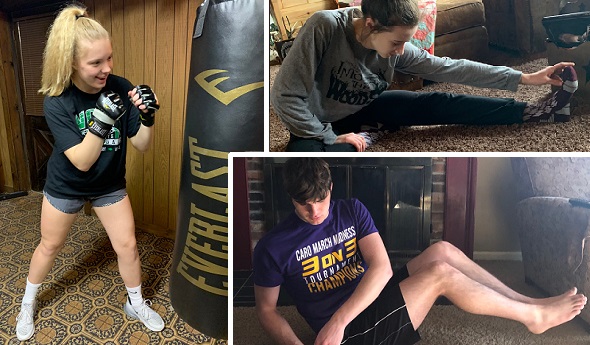
PHOTOS: (Clockwise from left) MHSAA Student Advisory Council members Abigail Pheiffer of Novi, Lydia Davenport of Ithaca and Trevin Phillips of Caro will be working to stay in shape while staying home these next many weeks.